Voters in five states back bans on noncitizen voting while one state bucks trend
Nov 04, 2026 | 1:33 pm ET
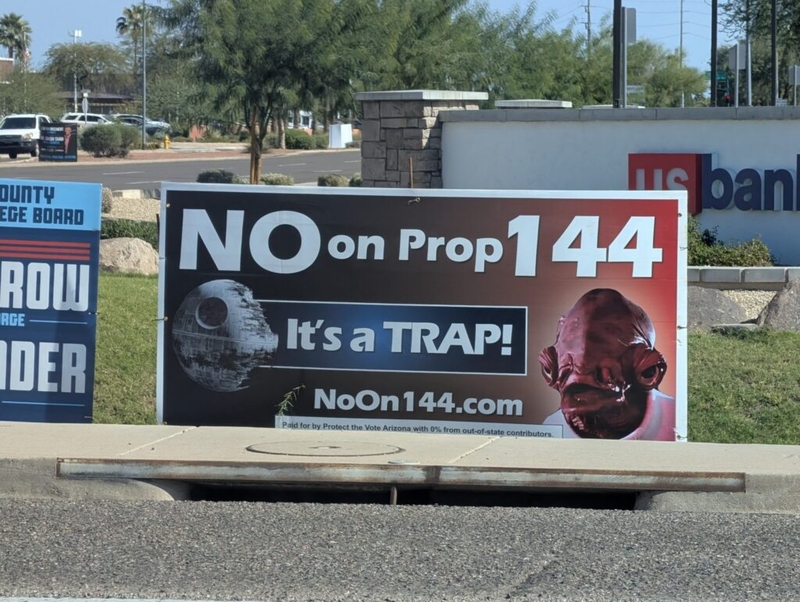
Description
A Star Wars-themed campaign sign opposing Proposition 144 at a Phoenix intersection. Arizona voters defeated Proposition 144, which would have mandated that only citizens could register and vote in Arizona elections. (Photo by Jim Small/Arizona Mirror)
Voters in five states approved new citizenship voting requirements on Tuesday while Arizona voters rejected theirs.
Proposals to explicitly bar noncitizens from voting were on the ballot this week in six states: Alaska, Arizona, Arkansas, Kansas, South Dakota and West Virginia.
Arizona voters defeated Proposition 144, which would have mandated that only citizens could register and vote in Arizona elections.
Arizona’s measure was much broader than those in other states. The citizenship voting requirement was included in a more sweeping proposal that would have required government-issued ID to cast in-person and mail-in ballots, banned foreign contributions in elections, and allowed voters to have their ballots counted at their polling precinct on election day.
Opponents were surprised the measure was defeated, reported the Arizona Mirror. Republicans and other supporters said it would make state elections faster and more secure. But critics including voting rights groups worried it would lead to the end of no-excuse mail-in voting.
Federal law already bars noncitizens from voting in federal elections, and no state currently allows noncitizens to vote in statewide elections.
Most states, including Arkansas, Kansas and South Dakota, already have citizenship voting requirements in state law or their constitutions, making the ballot measures seem redundant at first glance.
But sponsors of the citizenship voting requirements — primarily Republicans — said they wanted to preemptively bar cities or other local governments from allowing noncitizens to vote in local elections, as municipalities in California, Maryland and Vermont have done. Legal experts say that some state laws that seem to require citizenship to vote can be interpreted to allow noncitizen voters in certain elections.
Voters in West Virginia overwhelmingly supported adding the amendment to the state constitution to bar noncitizens from voting.
The amendment “would ensure that no future legislature could just simply change the election law with only a bill,” said West Virginia state Sen. Patricia Rucker, a Republican who sponsored the legislation that proposed the amendment, in September.
Rucker said Tuesday that she was “proud that West Virginia’s voters chose to protect the integrity of our elections” by voting yes on the amendment, reported the West Virginia Watch.
Critics of Kansas’s newly approved ballot measure worry it could make it harder for people to legally vote in the future.
“The supermajority in our legislature has a documented history of attempting to restrict voting in various ways,” Amii Castle, a law professor at the University of Kansas, told the Kansas Reflector. “My concern is that they’re going to use that to justify or as a pretext to say, ‘Well, wait a minute. We amended our constitution. Now it says only citizens can vote, therefore, prove your citizenship. Bring your documents.’”
This year’s ballot measures are the latest in a flurry of similar initiatives in recent years: Between 2018 and last year, states put 15 citizenship requirement measures on their ballots and voters approved all of them.
Stateline reporter Anna Claire Vollers can be reached at [email protected].