New Mexico lawmakers still split on legislative compensation ballot question as Election Day nears
Nov 02, 2026 | 12:24 pm ET
Description
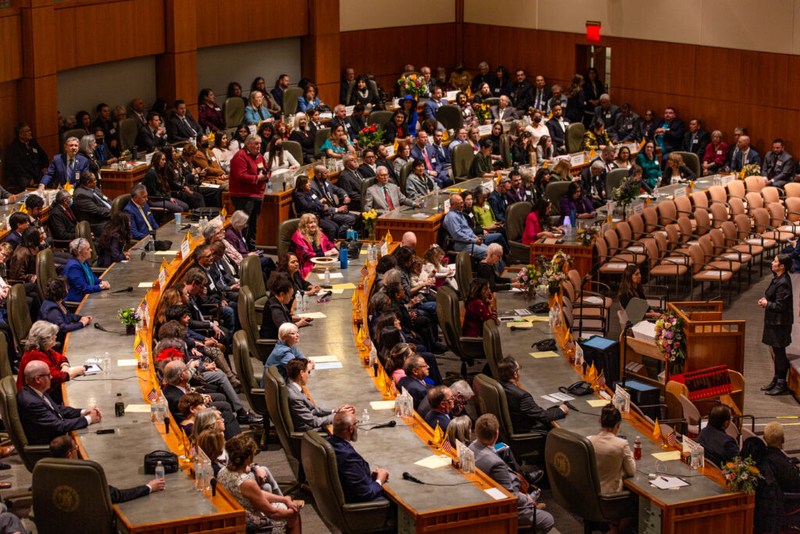
New Mexico voters will decide the fate of Constitutional Amendment 4, which would give state lawmakers an annual salary for the first time, during the Nov. 3, 2026, general election. (Photo by Anna Padilla for Source NM)
As Election Day nears, some New Mexico lawmakers remain split on a ballot measure that would let them collect an annual salary for their legislative work.
Constitutional Amendment 4, which appears on the Nov. 3 general election ballot, asks voters to approve or deny a measure that would let state lawmakers earn a salary equivalent to the state’s median household income, which is currently about $68,000. If approved, it would go into effect for lawmakers who are sworn into office beginning in 2029, according to the New Mexico Legislative Council Service.
New Mexico is the only state in the nation to not pay its lawmakers, though they receive per diem allowances for traveling to legislative meetings and are eligible to collect pensions after leaving office.
The latter continues to be a sticking point for opponents of the measure within the Roundhouse. State Sen. Jay Block (R-Rio Rancho) told Source NM that he doesn’t completely dismiss the arguments in favor of the proposal. But, he said lawmakers already have access to generous benefits.
“I think it would allow small business owners some flexibility to serve their community and keep their small business viable…because it’s more than just 30 days or 60 days,” Block said. “I see that side of the argument. But I also see the side where these people ran for office knowing they weren’t getting paid. They get a pretty generous retirement, as well.”
Block added that he has already voted against the constitutional amendment.
Across the aisle, Sen. George Muñoz (D-Gallup) also voted against the constitutional amendment.
Muñoz, who chairs the powerful Senate Finance Committee, told Source NM that he believes the per diem and mileage reimbursements lawmakers receive should adequately reimburse them. He said he believes that offering a salary in line with the median household income will encourage advocacy groups across the state and region to bankroll candidates who can further their agendas during the legislative session.
“If I go to Santa Fe right now, a hotel room’s like $250 a night, so I think it shouldn’t cost you anything” to be a lawmaker, he said. “This will change the Legislature completely. You’ll get more nonprofits pushing candidates to push their agendas than ever before. It’s a way to recruit people.”
Lawmakers who support the measure say that it would “level the playing field” for future candidates. Currently, supporters often say, only the “three Rs” can easily run for office: the rich, retired and resourceful.
If approved, the amendment would go into effect for lawmakers who are sworn into office beginning in 2029, according to the New Mexico Legislative Council Service, meaning unpaid lawmakers would not suddenly start collecting paychecks after its passage.
Some supporters, such as state Rep. Marianna Anaya (D-Albuquerque), say voters have an opportunity to empower people who can’t take enough time off or otherwise afford to run for office.
Recently, she said her legislative office was denied state funding to buy simple office supplies such as stamps. A colleague of hers was denied funding to buy a color printer to get colored versions of the numerous charts and graphs legislative committee members review, she said.
“That money is coming out of our pockets,” Anaya said. “We are actively paying and losing money by serving as legislators.”
When asked if she thinks the salary level should be equal to the median individual income, rather than the median household income, Anaya said “there are a lot of us that are the head of the household.”
Some lawmakers who voted against it didn’t adhere to the usual arguments that it would overpay lawmakers who serve in 30- and 60-day sessions or that it would attract people seeking a paycheck.
For state Sen. Shannon Pinto (D-Tohatchi), one of the few elected Democrats to oppose it during the legislative session, it was personal. Pinto, who was first appointed to hold her late grandfather’s seat in the state Senate, said she opposed it because she wants to “serve my time the way my grandfather did.”
When asked if she’d also oppose the measure on Election Day, she said she’ll “try to be consistent.”
The Legislature was divided when it voted in February to put the question on the ballot. It cleared the state House of Representatives on a 41-26 vote and the state Senate on a 23-19 vote.
New Mexico voters may also be similarly split.
A September Albuquerque Journal poll conducted by Research and Polling, Inc., found that 39% of likely voters surveyed supported the measure and 21% opposed it. However, it also found that 34% of likely voters were undecided or didn’t know, and 6% answered that it “depends.”
Santa Fe, NM