Not registered to vote? New Hampshire allows same-day voter registration. Here’s how to do it.
Nov 02, 2026 | 1:50 pm ET
Description
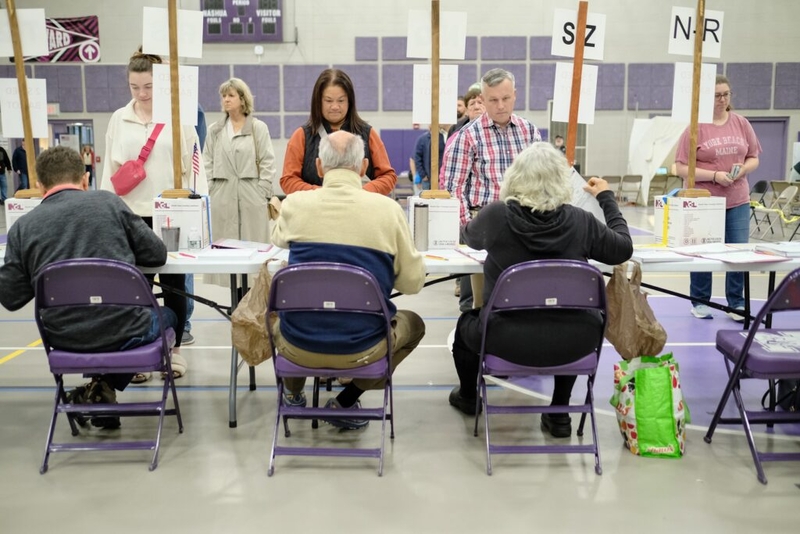
Nashua voters check in at their polling station on Nov. 5, 2024. (Photo by Will Steinfeld/New Hampshire Bulletin)
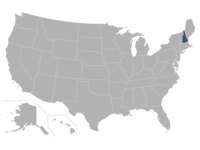
New Hampshire is one of 24 states (plus Washington, D.C.) that allows citizens to register to vote on Election Day, so Granite Staters who haven’t yet registered can still cast their ballot in Tuesday’s midterm elections.
Under state law, to register on Election Day voters need to bring to the polls proof of:
- identity (driver’s license, government-issued photo ID or passport serve that purpose);
- age (driver’s license, government-issued photo ID or passport also work for this);
- U.S. citizenship (birth certificate, passport or naturalization papers work; if you have none of these or forget them, you can sign a sworn affidavit);
- and domicile (government-issued ID with an address or documentation containing an address, such as a utility bill or lease).
New Hampshire’s polls open at varying times on Tuesday morning, depending on the municipality. Voters can find out where their polling location is and which races will be on their ballot on the Secretary of State’s website at https://app.sos.nh.gov/pollingplacesampleballot.
Who’s going to be on the ballot?
The highest profile races are those for Congress. U.S. Rep. Chris Pappas, a Democrat, and former Sen. John Sununu, a Republican, are competing for an open U.S. Senate seat. Former Portsmouth City Councilor Stefany Shaheen, the Democratic nominee, is battling car dealer Anthony DiLorenzo, the Republican nominee, for the 1st Congressional District. And in the 2nd Congressional District, incumbent Rep. Maggie Goodlander is facing a rematch against Republican challenger Lily Tang Williams.
Gov. Kelly Ayotte, a Republican, is facing her first reelection challenge against former Democratic Executive Councilor Cinde Warmington. Additionally, every state representative and state senator across the state is up for election (all New Hampshire elected state offices have two-year terms). Finally, all five members of the Executive Council — an elected body unique to New Hampshire that serves as a check on the governor — are up for reelection.
There will also be a number of county-level positions, such as sheriff, treasurer and county attorney, on ballots.
Also on the ballot are two questions
The first of the two ballot questions is a rather bureaucratic one. Mandated by the New Hampshire Constitution, every New Hampshire county elects a register of the probate. The position, which is currently defunct, used to complete administrative tasks for the courts. But in 2011, during a major overhaul of the court system, its job functions were absorbed by other staff. However, because it’s still in the Constitution, the position still appears on the ballot every two years and the winner accepts an annual $100 salary to do nothing. Ballot Question 1 would eliminate the position completely if more than 60% of voters vote “yes.”
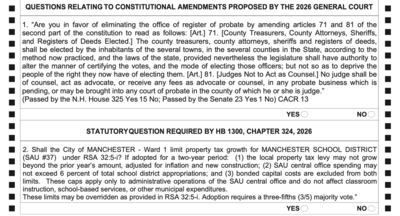
The second is a more consequential question. Question 2 on the ballot asks whether the voter would like to vote in a tax cap for their local school district — and impose a spending limit on their local school administrative unit.
Voting yes on Question 2 means voting to limit the school district’s “tax levy” — the total amount raised in property taxes each year — for the next two years. The limit would restrict the tax levy to the total levy of the year prior, plus an adjustment for inflation and for any new property construction in the school district that would increase the property tax base in that district.
If imposed, the tax cap would require the district’s school board to propose a budget that keeps the total tax haul below that level. Question 2 requires 60% of voters across the school district to vote in favor in order for the tax cap to apply. Should a district adopt the tax cap, it would apply for tax years 2027 and 2028. However, any tax cap could be overridden for a specific annual district budget if 60% vote to do so at the district’s annual school meeting in spring.
Question 2, if approved, would also make another change: It would require the voter’s School Administrative Unit costs to amount to less than 6% of the voter’s school district’s total budget.
Unlike the tax cap, which applies only to individual school districts, the SAU 6% limit applies to the entire SAU. SAUs can consist of one or more school districts. Thus, the 6% limit will not be put into force unless 60% of all voters in all school districts within that SAU vote to approve it.
Concord, NH