Energy costs dominate midterms; climate battles play out down ballot
Nov 02, 2026 | 7:55 am ET
Description
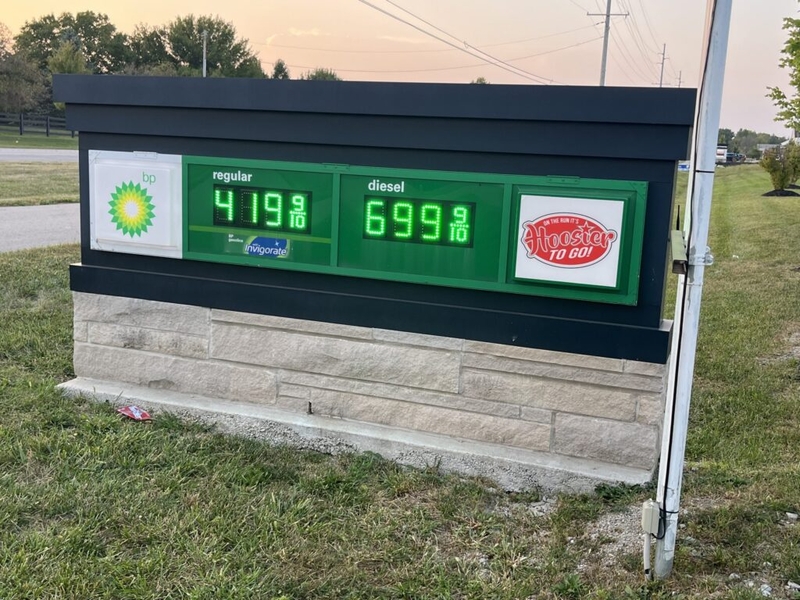
Gas and diesel prices in Indiana on Sept. 17, 2026. (Photo by Niki Kelly/Indiana Capital Chronicle)
This story was originally published by Capital & Main.
In the final stretch of the 2026 midterm campaigns, the most potent climate issue in American politics arrived by delivery truck across the country.
The average price of heating oil hit $6.23 a gallon for the week of Oct. 26, up from $3.60 a year earlier, according to the Energy Information Administration. At that price, filling a 250-gallon tank cost about $1,557 — roughly $657 more than the year before. As cold weather settled over the Northeast, Democrats turned that bill into an attack on Republican candidates.
In New Hampshire, where about 43% of residents heat with oil, Democratic nominee for U.S. Senate Chris Pappas said energy costs and heating oil prices were “the beginning and end of every conversation I’m having on the campaign trail.”
That is the pattern across the closest races in this cycle. Energy is everywhere on the ballot — as heating oil, diesel, power bills and water — but almost always as a question of price. The argument over what actually powers the country — fossil fuels or renewables — surfaces mostly down-ballot, in low-profile contests for the commissions that regulate utilities and drilling.
“If you talk to voters, they are upset about their energy bills and they’re upset about data centers,” Caroline Spears, executive director of Climate Cabinet, which backs climate-focused candidates in state and local races, told Capital & Main. “People want to hear from politicians about their plans on their energy bills and their plans on their data centers.”
The consequences reach far beyond any one state. Control of the Senate will determine whether Congress revisits the clean energy tax credits Republicans rolled back in last year’s budget law. And the governors and regulators elected Tuesday will approve the gas plants, transmission lines and data center deals that shape the grid for decades to come.
The U.S. Senate
More than $191 million was spent on political ads referencing utility and energy bills in the first nine months of 2026, plus another $96.3 million from Oct. 1 to Oct. 16, according to AdImpact data analyzed by Climate Power, a Democratic-aligned advocacy group.
In Maine, heating oil defined the final weeks of the race between Republican Sen. Susan Collins and her Democrat challenger Troy Jackson. Jackson said Mainers were paying 80% more for heating oil than a year earlier. Collins countered with an announcement: a release of 315,000 barrels from the Northeast Home Heating Oil Reserve, which she and her counterpart, Sen. Angus King, had requested of President Donald Trump. Climate itself registers here, too: In the Environmental Voter Project’s polling of eight U.S. Senate battlegrounds, Maine had the highest share of voters naming it a top-three priority at 22%.
In the farm belt, the price that matters is the cost of diesel. In Iowa, Democrat Josh Turek released a closing ad on fuel prices against Republican Rep. Ashley Hinson. Both candidates said data centers shouldn’t receive tax breaks — in a state that already gets more than 60% of its power from wind and solar. Kansas hasn’t elected a Democrat to the Senate since 1932, yet Adam Hamilton built his challenge to Republican Sen. Roger Marshall around energy and utility costs, while Marshall said Kansans were “on fire” over data centers. High fuel and fertilizer prices have strained the farm economy in a state that generates roughly 50% of its electricity from wind.
Data centers have scrambled the usual partisan lines. In Ohio, Democrat Sherrod Brown branded Republican Sen. Jon Husted “the face of data centers,” and WinSenate, the country’s main Democratic Senate super PAC, ran an ad implying corrupt dealings between Husted and an energy company, though Husted was never charged. Kelcy Warren, executive chairman of the pipeline giant Energy Transfer, gave $3,500 to Husted’s campaign in late September.
In Michigan, Democrat Abdul El-Sayed and Republican Mike Rogers agree on little except data centers: Both back moratoriums in some form. El-Sayed’s framework would bar utilities from using data center demand to weaken Michigan’s clean-energy laws, while Rogers holds up to $250,000 in a Blackstone real estate trust that backs data centers. The climate stakes are concrete: Surging data center demand could trigger a provision in the state’s climate law that lets fossil fuel plants stay online during a capacity shortage.
In Texas, where Democratic state Rep. James Talarico faces Republican Attorney General Ken Paxton for a critical U.S. Senate seat, the backdrop is Gov. Greg Abbott’s audit of every data center seeking to connect to the ERCOT grid — a review that won’t be finished until December, long after the midterm votes are cast.
In Alaska, the fossil fuel question barely registers. Both Republican Sen. Dan Sullivan and Democrat Mary Peltola support oil and gas expansion, so the fight is over who will deliver it and who is to blame for Iran war-driven fuel costs. Sullivan has made the Alaska LNG pipeline, backed by a $54 billion South Korean investment, a centerpiece of his campaign.
The statehouses
Thirty-six states will elect governors this November, and the nonpartisan Cook Political Report considers 12 of those contests competitive — including Alaska, Iowa, Georgia, Nevada, Ohio, Florida and Texas, where Republicans now hold the office. In 39 states, utility regulators are appointed by governors or legislatures rather than elected — which means many of those governors become energy policymakers whether they campaign on it or not.
Climate surfaces more openly in Alaska’s overlooked governor’s race, where Democrat Jonathan Kreiss-Tomkins has pressed the state to address climate change and said it relies too heavily on natural gas — rare talk from an Alaska politician. Republicans Dave Bronson, Treg Taylor and Bernadette Wilson are also on the ballot. Nathaniel Stinnett, founder of the Environmental Voter Project, called Kreiss-Tomkins “probably the favorite” but said the race is “extraordinarily close.” In the group’s polling, 21% of likely Alaska voters identified climate as a top-three priority, second only to Maine. “I don’t wanna pretend like this is a climate election,” Stinnett said. “But certainly thousands and perhaps tens of thousands of Alaskans are going to vote with climate change top of mind.”

In Nevada, the main climate focus is water. Republican Gov. Joe Lombardo sued the Trump administration over cuts to the state’s allotment of water from the Colorado River, and Arizona has since joined the suit. Nevada Conservation Voters gave Lombardo a C+ grade, crediting his support of clean energy while faulting his backing of fossil fuel projects. Because Democrats already control both chambers of the legislature, a win by his challenger, Attorney General Aaron Ford, would give the party a trifecta. Stinnett noted that Ford has talked up the clean energy transition in a state that “is kind of like the Saudi Arabia of solar energy, or it can be.”
Kansas offers Republicans their best chance to flip a Democratic-held governorship. Republican Ty Masterson is more moderate on energy than many in his party, and both he and Democrat Cindy Holscher voted for a 2025 data center tax exemption. Holscher has since said she would freeze data center development until stronger guardrails are in place.
Georgia’s open governor’s race between Democrat Keisha Lance Bottoms and Republican Rick Jackson will shape the state’s energy direction too — but the most direct fight over Georgia’s power sits further down the ballot.
Legislatures may matter as much. Spears, the Climate Cabinet director, is focused on five states where Democrats could win full control — Michigan, Minnesota, Wisconsin, Arizona and Pennsylvania. “If they were a country, they’d be the world’s ninth largest climate polluter,” she said. “But 22 flipped seats stand between five trifectas and none.”
Minnesota and Michigan both passed 100% clean energy laws the last time Democrats held full control. In Pennsylvania, where Republicans control the state Senate but not the House, Spears was blunt: “The Pennsylvania State Senate is where clean energy bills go to die.”
The regulators
This is where fossil fuels and renewables actually collide. Spears called these “weird statewides” and said that as utility bills have become a defining issue, the culture war is “getting involved in utility elections as well.”
Control of the Georgia Public Service Commission, which oversees Georgia Power, is on the ballot. Democrat Peter Hubbard, who won a special election last year, faces a rematch with Republican Fitz Johnson, while Republican Josh Tolbert and Democrat Shelia Edwards vie for an open seat. Republicans hold a 3-2 majority; if both Democrats win, Georgia would join Illinois’ commission as the nation’s only ones that are Democratic aligned. Hubbard argued the state is “oversubscribed on fossil fuels.” Johnson said data centers will pay their fair share because of protections he put in place.
In Texas, the race for the Railroad Commission — which, despite its name, regulates an oil and gas industry that supplied nearly half the country’s oil last year — tightened after Republican Bo French drew widespread condemnation for a racist post on X. The Texas Oil and Gas Association, which represents ExxonMobil and Chevron, left him off its latest endorsement list. French has been bankrolled largely through PACs funded by billionaires Tim Dunn and Farris Wilks. His opponent, Democratic state Rep. Jon Rosenthal, is a former oil-field mechanical engineer. A Democrat hasn’t held a seat on the commission since 1994.
Rosenthal traced the split to a rule backed by Jim Wright, the incumbent French ousted in the Republican primary, requiring liners for shallow oilfield waste pits so they don’t “leak noxious poison into the surrounding land and water, which I think most people think is a reasonable precaution.”
Rosenthal, who said he has taken almost no money from oil and gas operators, has proposed banning industry donations to commissioners. “If we actually had ethical campaign finance laws, you wouldn’t want these people’s campaigns to be wholly or majorly funded by the people they’re supposed to regulate,” he said. “But that’s just how it is in Texas.”
French did not respond to Capital & Main’s request for comment.
In Arizona, Republicans Kevin Thompson and Ralph Heap face Democrats Clara Pratte and Jonathon Hill for two seats on the Corporation Commission as electricity provider the Arizona Public Service seeks a roughly 14% rate increase — and the decision is not expected until after the election. Heap’s platform, endorsed by right wing group Turning Point, reportedly centers on prioritizing coal. Even if both Democrats win, Republicans keep a majority, since only two of five seats are up.
Colorado voters face the most literal version of the question. Amendment 82 would add a right to buy and sell natural gas to the state constitution and could limit state and local governments’ ability to enforce natural gas regulations. It needs 55% of the vote to pass. It is one of eight measures funded by the conservative group Advance Colorado — and the state’s own oil and gas industry opposed it, wary of upsetting its 2024 truce with Gov. Jared Polis.
The turnout
Who shows up may matter as much as what’s on the ballot. A report from the Environmental Voter Project, which works to turn out voters who prioritize climate, found that as of Oct. 26, more than 3.7 million climate voters in 21 states had already cast early ballots, including more than 400,000 voting in a midterm for the first time.
In every Senate battleground the group tracked, those voters were turning out faster than the electorate as a whole — often at twice the rate. In Georgia, 46.3% of climate voters had cast ballots by the time of the report, compared with 21.2% of all registered voters, Stinnett said. In Iowa, the figures were 22.8% and 9.5%.
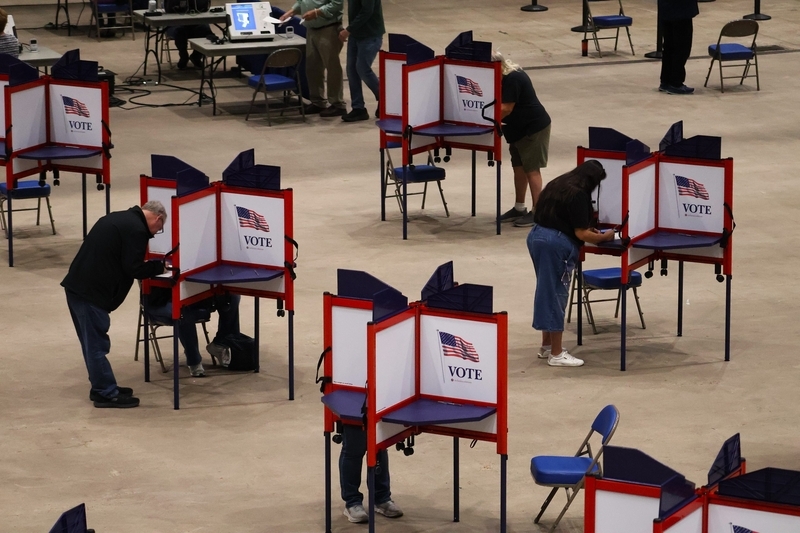
In Michigan and Nebraska, Stinnett said, the ratio was 2.5 to 1. “We often see that climate concerned voters are more likely to vote early than on Election Day,” he said. “But we’re not used to seeing margins like this.” His explanation: “Just because politicians aren’t talking about something doesn’t mean that voters aren’t concerned about it. Climate concerned Americans know how important these midterm elections are, and they ain’t gonna miss it come hell or high water.”
Whether they are voting over a heating oil bill or a warming planet, the result lands in the same place. The senators elected this fall will decide what Washington does about clean energy, and the regulators will decide what gets built. The harder conversation starts after Nov. 3, Spears said, when the winners realize, “Oh, now I have to actually figure out what to do.” The bills will keep arriving long after the ballots are counted.
Harrisburg, PA