2 North Dakota counties ask voters to override property tax cap
Nov 02, 2026 | 8:35 am ET
Description
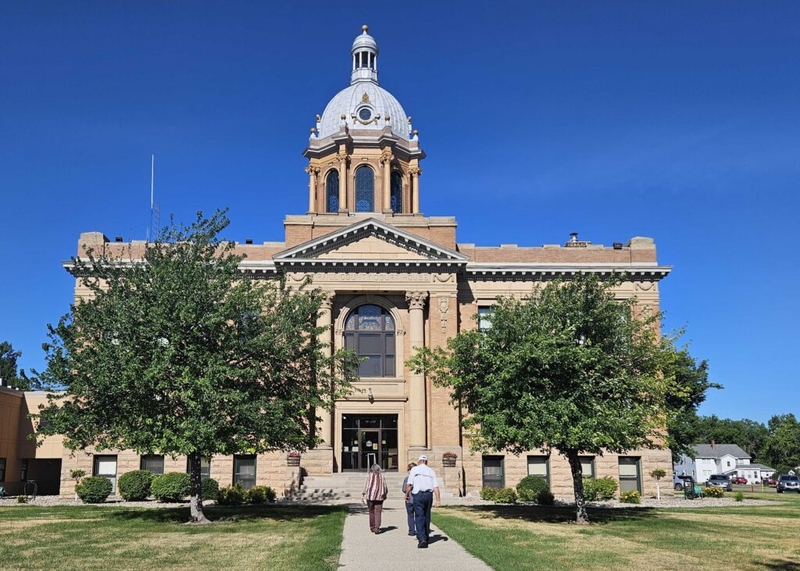
People walk into the Traill County Courthouse in Hillsboro, North Dakota, on July 13, 2026. (Photo by Jeff Beach/North Dakota Monitor)
At least two counties in North Dakota this week are asking voters to let them go over the state’s limit for how much local governments can increase property taxes, a crucial revenue source to funding various services.
The ballot measures in Divide and Traill counties show how some local governments are struggling with the limit of a 3% annual increase on local property taxes set last year by the Republican-led Legislature in a bill boosting a property tax credit.
“I think it’s unrealistic,” Divide County Commission Chairman Rodney Johnson said.
A key lawmaker said he doesn’t sense any legislative support to change or abolish the 3% cap. A county government advocate said the limitation affects every county differently and some costs are out of their control.
Divide County is asking voters for an additional 2%, or roughly $37,800 annually the next four years. The additional money would help cover the county’s operations, Auditor/Treasurer Gayle Jastrzebski said.
“With everything going up – you know, health insurance increased 10% last year. When you can only raise (property taxes) 3%, you gotta make up that difference,” she said.
The county will have to make cuts if voters don’t approve the measure, Johnson said.
“For the most part, I think they will understand, but you never know when the voters come out,” he said.
Traill County is asking voters for an additional 6.41%, or about $461,000 for each year over the next four years. The text of the ballot measure cites increases in veterans services, health insurance, cost of living and various operating expenses including roads, bridges and technology.
Traill County lies between the cities of Fargo and Grand Forks, and competition for employees is tough, she said.
“I think it’s just a matter of we’re just trying to keep up with the local economy and keep our staff,” County Auditor Heather Hovey said.
It isn’t guaranteed the county would use the full increase if voters approve it, she added.
If voters reject the increase, the county might have to consider cuts to staff and postponing road projects, Hovey said. The 3% cap is hard when the Legislature puts it on local governments but doesn’t do the same for state budgets, Hovey said.
Property taxes eliminated for 50,000 North Dakota households under new legislation
Rep. Craig Headland, who chairs the House Finance and Taxation Committee, said he’s gotten little pushback on the 3% limit, saying the counties in his area understand and abide by it. He said he doesn’t sense an appetite among lawmakers to increase or eliminate the cap. Lawmakers viewed 3% as a good, average inflationary number to use, he said.
One two-year budget cycle is not enough time to determine “if there’s any merit in what they’re saying or not,” said Headland, R-Montpelier.
“If they can show us real hardship, then, you know, we will have to take a look,” the longtime tax legislator said.
Rising property taxes have frustrated homeowners for years. In 2024, voters rejected a ballot initiative that would have eliminated assessed-value property taxes and required the state to replace billions of dollars of revenue. Afterward, the Legislature passed property tax legislation that expanded a tax credit for homeowners and placed the cap on local property tax increases.
The North Dakota Association of Counties supports exceptions to the 3% cap for difficult costs of health insurance, elections and jail expenses, Government/Public Relations Specialist Donnell Preskey said.
“I don’t know that we have counties out there that are just spending money to spend money,” Preskey said last week. “They’re providing the services to address the needs in their community and they know what those needs are the best.”
Roughly two-thirds of North Dakota’s 53 counties used reserves in the 2026 budget cycle, Preskey told lawmakers this year. Of those 33 counties, 13 also used the entire 3% increase. Reserves run out and are not a sustainable source for the future, she said.
Counties can also bank an unused portion of the 3% cap for future use. About two-thirds of counties did so, according to a survey by the association.
Some counties are economic drivers and others have hardly any sources to generate revenue other than property taxes, Preskey said. The 3% cap amounts to $18,000 for Slope County, population 700, and $1.8 million for Cass County, home to one-quarter of the state’s population or more than 200,000 people, according to association data.
Property valuations might be increasing in the largest cities of Bismarck and Fargo, but they are decreasing in some areas, meaning less money for local budgets, she said.
“We really have to think about those parts of our state that are really rural and more desolate and are really trying to hang on with any kind of population they can,” Preskey told lawmakers in September.
Reach North Dakota Monitor reporter Jack Dura at [email protected].
Bismarck, ND