Will the Attorney General Change the Way Her Office Fights Prison Sexual Assault Lawsuits?
Oct 28, 2026 | 5:00 am ET
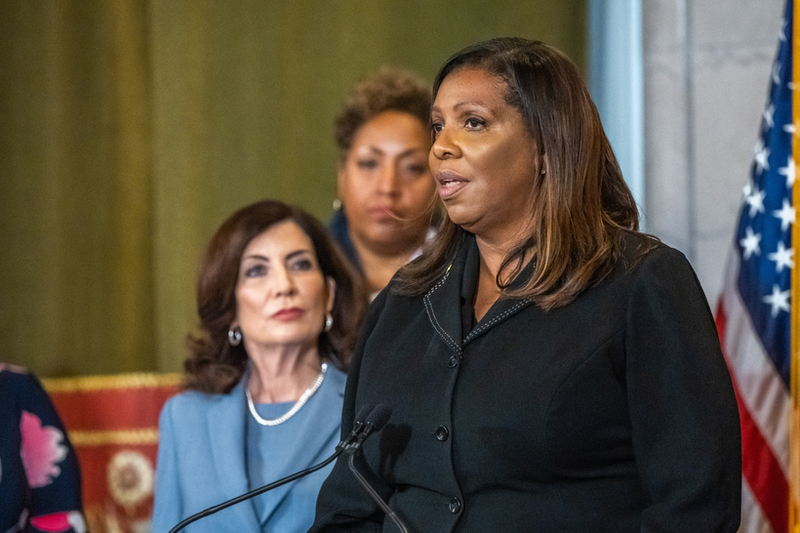
Description
Photo courtesy of New York Focus
Letitia James has wrestled with jail and prison sexual abuse allegations from both sides. As New York City’s public advocate, she investigated how Rikers Island administration handled staff sexual misconduct complaints. But as state attorney general, her office has sought to bury similar allegations made by state prisoners.
Now, James is trying to straddle the line: Her office helped draft legislation that could undermine the same tactic it has used to fight lawsuits alleging prison sexual abuse, New York Focus has learned.
The bill, which the legislature has passed but not yet sent to the governor, would allow people suing the state to add missing details or correct errors in their lawsuit by filing an “amended” claim.
That’s a common issue when it comes to allegations of sexual assault. Traumatized survivors may not recall specific details or recount them consistently, and formerly incarcerated victims may never have known the full names of the officers who allegedly assaulted them.
Nearly 1,700 current and former state prisoners filed sexual abuse lawsuits under a 2022 law known as the Adult Survivors Act. The law opened a year-long window for sexual assault victims to bring civil cases against their alleged abusers outside of the typical statutes of limitations.
During an interview with the New York Editorial Board last week, New York Focus Editor-in-Chief Akash Mehta pressed James about her office’s push to have many of the suits dismissed for lack of detail.
In most civil suits, claimants can initiate cases with limited details and uncover the rest through the litigation’s discovery process. When suing the state, however, claimants must assert the precise “time when,” “place where,” and “nature” of the alleged harm when they file the suit.
James’s office, charged with defending the state against these cases, has latched onto the strict filing parameters. Last year, attorneys for the state told a judge that they planned to ask to dismiss 500 of the prison claims based on the requirements, New York Focus and Hell Gate reported. By then, they had already succeeded in killing one case because the claimant’s lawyers had misstated the year the alleged abuse took place — a typo copied from the prison agency’s own records of the incident, the lawyers said.
For cases already in progress, like Adult Survivors Act lawsuits, the bill James supports would offer claimants up to a year after its effective date to ask a judge’s permission to file an amended claim, potentially giving them until spring 2028 if Governor Kathy Hochul signs it into law.
The bill wouldn’t exempt claimants from having to provide precise information about their abuse in the claim, James’s office explained.
“If passed, this legislation will allow for the correction of good-faith errors made in cases before the Court of Claims while also ensuring critical pleadings requirements are preserved to defend against potential future abuse of the system,” a spokesperson said in a statement.
That makes it different from a bill that survivors’ advocates have rallied behind. Last year, the Adult Survivors Act’s state Senate sponsor, Brad Hoylman-Sigal, introduced a bill that would exempt sexual abuse cases against the state from the strictest filing requirements. That bill and a new version introduced this year, sponsored by Senator Julia Salazar, both passed the Senate, but neither made it to a vote in the Assembly.
During the Editorial Board interview, Mehta asked James about the Salazar bill. James seemed to back it, adding that she wanted to work with the legislature next year to “address some of the deficiencies” in the law.
“And hopefully it’ll pass in the Assembly as well,” she said.
Asked later about James’s comments, however, a spokesperson for her office claimed she was actually referring to the bill allowing for amended claims, which has already passed both the Assembly and Senate. The spokesperson said she is reviewing the other bill.
“The attorney general is publicly seeking justice for an Ivy League Jane Doe while aggressively moving to foreclose justice for 500 New York state prison Jane Does.”
—Konstantin Yelisavetskiy, attorney, Slater Slater Schulman
Attorneys for the people who’ve filed prison Adult Survivors Act claims have excoriated James for her aggressive defense of the suits. They pointed to her recent statements in support of the alleged Cornell University gang rape victim, whose case Hochul assigned her office to investigate.
“The attorney general is publicly seeking justice for an Ivy League Jane Doe while aggressively moving to foreclose justice for 500 New York state prison Jane Does,” said Konstantin Yelisavetskiy, partner at the law firm Slater Slater Schulman, which represents over 1,200 people alleging prison abuse under the Adult Survivors Act.
He provided a list of six of his firm’s prison Adult Survivors Act cases that the attorney general’s office has so far moved to dismiss based on the strict filing requirements.
In one case, an assistant attorney general asked a judge to toss a lawsuit because a search of prison agency records supposedly turned up no evidence that the alleged abusers ever existed. New York Focus conducted its own search and, in February, found one former employee matching the formerly incarcerated woman’s description.
The attorney general’s office promptly rescinded its motion, and the case is ongoing. James acknowledged the error in last week’s interview, blaming the prison agency’s records management system. Going forward, she said, her office would “check with and require and demand” that the agency fully review its records.
In another case, a former prisoner recalled a corrections officer digitally penetrating her once and forcibly fondling her four times throughout October and November 2017. The woman recalled the officer’s last name, his height, his eye color, the shift he worked, and where he allegedly abused her. But her recollection of the timing was off by a couple of months, Yelisavetskiy said: The guard had retired late that summer. Rather than let the case proceed, the attorney general’s office moved to dismiss it, and the judge tossed it in April.
Asked about the dismissal motions in the New York Editorial Board interview, James claimed her office is moving to toss meritless suits.
“I think it’s a little bit more than just forgetting the names and the minor errors,” she said. “In most of the cases that we’ve dismissed, there is no basis in fact, and there’s a lot of omissions.”
“I’ve not changed my position,” she added.
Anna Kull, partner at Levy Konigsberg, which represents about 400 prison Adult Survivors Act claimants, argued that the state seems to treat these cases differently from other allegations of sexual abuse.
“The trauma suffered by the women abused in state custody should not be diminished because they were incarcerated,” she said. “Every survivor of sexual violence deserves an equal path to justice.”

Albany