West Virginia Attorney General backs down from environmental groups investigation
Nov 23, 2026 | 1:50 pm ET
Description
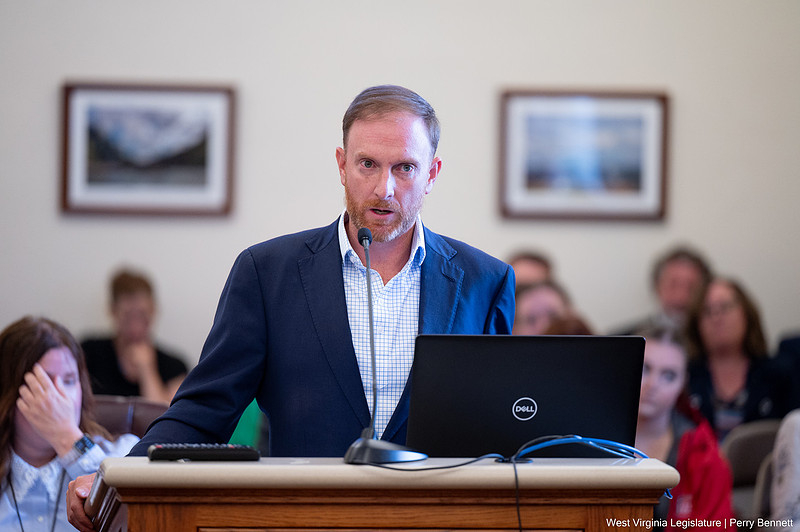
West Virginia Attorney General JB McCuskey
speaks to the Legislative Oversight Committee on Health & Human Resources Administration during legislative interims on Aug. 11, 2026 in Charleston, West Virginia.
(Photo by Perry Bennett/West Virginia Legislative Photography)
The West Virginia Attorney General’s Office is retreating from its investigation into at least six environmental groups.
The reversal comes less than a month after a U.S. District Judge Joseph R. Goodwin issued a temporary restraining order against the Attorney General’s Office on grounds that the subpoenas violated the groups’ First Amendment Rights.
“Following Judge Goodwin’s ruling, my office has permanently withdrawn all of the investigative subpoenas. We believe in the rule of law, and we respect the Court’s decision,” Attorney General JB McCuskey said a statement issued Monday.
On Nov. 20, McCuskey sent the West Virginia Rivers Coalition and 350.org, a group dedicated to reducing fossil fuel use, stating that it was rescinding subpoenas it issued in September for a decade’s worth of records.
“I have directed my attorneys and staff to take no further investigative action of any kind in either matter,” McCuskey wrote.
McCuskey had opened the investigation into the groups on the basis that their activities could potentially harm West Virginia’s coal and natural gas industries. However, in court, attorneys for his office shifted the argument to be that the groups were raising money from concerned citizens based on an outdated study.
McCuskey said in his statement that he was “acting on information that certain groups had made false and misleading statements to raise money.”
“We issued investigative subpoenas — a well-established process regularly used when there are potential violations of the state’s consumer protection laws,” McCuskey said. “The subpoenas were an investigative step, and my office did not file suit against anyone.”
Goodwin, appointed to the bench by President Bill Clinton in 1995, found the subpoenas to be overly broad, calling it a “fishing expedition.”
“But even on a fishing expedition, hoping to just get one bite in the vast and quiet water, a person brings a fishing pole. And in other cases, perhaps, a net,” Goodwin wrote, “Here, AG McCuskey has abandoned both the fishing pole and the net. Instead, he has brought dynamite to the lake. Tossing a couple in, he hopes to catch something.”
In the letter, McCuskey also wrote that he would ensure no new future investigations into the work these groups do in educating the public about climate change and effects from greenhouse gas emissions.
“This commitment is an act of the Office, not a personal undertaking. It binds the Office and all of its current and future officers, employees and agents acting on its behalf. The policy has been entered in the Office’s official records and distributed to relevant attorneys and staff,” McCuskey wrote.
The West Virginia Citizens Action Education Fund, a sister organization of the West Virginia Citizens Action Group, released a statement Sunday regarding its subpoenas being rescinded.
“Nonprofit organizations must be able to educate, engage communities, participate in matters of public concern and speak freely with partners without fear of becoming targets of government investigation for exercising constitutional rights,” said Dani Parent, Executive Director of West Virginia Citizens Action Education Fund and Citizens Action Group. “Free speech and the right to associate with others are fundamental to a healthy democracy. They must be protected, and a diversity of voices in the advocacy space is critical to a functioning democracy.”
In his letter, McCuskey said he was trying to uphold the West Virginia Consumer and Credit Protection Act, but he recognized it had limits.
“But in a contest between even the most essential statutory protection and the Constitution, the Constitution must always prevail,” he wrote.
Charleston, WV