Trump's DOJ sends 1,000 election monitors to 50 states, locations not yet disclosed
Oct 27, 2026 | 11:12 am ET
Description
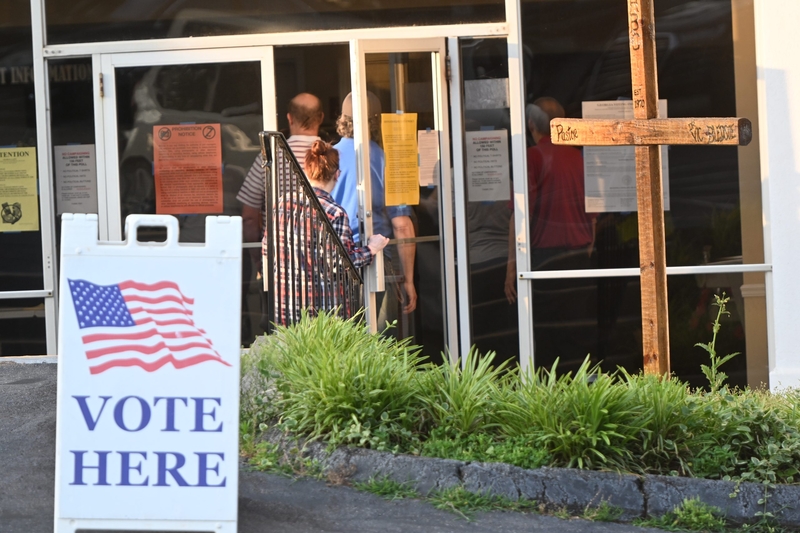
Voters line up outside Shiloh Hills Baptist Church in Kennesaw, Georgia, on Election Day, May 19, 2026. (Photo by Ross Williams/Georgia Recorder)
The U.S. Department of Justice plans to send election monitors to every state ahead of Election Day, expanding a longstanding practice that’s spurred concern this year among Democrats and voting rights advocates because of President Donald Trump’s push to influence elections.
The Justice Department for decades has deployed monitors across the country to watch the voting process. During President Joe Biden’s administration, the DOJ sent monitors to 64 jurisdictions across 24 states for the 2022 midterm elections.
The 2026 monitoring program is larger, with the Justice Department announcing it will have a presence in all 50 states. DOJ spokesperson Kiersten Pels told States Newsroom on Monday that about 1,000 monitors will be involved but that the department won’t disclose the full list of monitored locations until Election Day — Nov. 3.
“Every monitor will merely observe and report any potential violations of federal law to the Department, which will be reviewed after Election Day,” Pels said in a statement.
Lawsuits prompt unease
While election monitors, who watch polling places and election officials for compliance with federal voting rights laws, have long been a feature of U.S. elections, the Trump administration’s extraordinary moves to assert federal authority over state-run elections have left many Democrats and even some Republicans uneasy about this year’s expansive effort.
The Justice Department has sued dozens of states in an attempt to force election officials to turn over voter lists that contain sensitive personal data, such as driver’s license and Social Security numbers. The DOJ has lost 27 cases so far, and won none.
Less than two weeks ago, the Justice Department sued California to block election officials from counting ballots from roughly 20,000 voters it says are suspected noncitizens.
And on Friday, the DOJ sued Alaska to preemptively prevent the certification of its U.S. Senate election if the Republican incumbent loses by less than the number of votes received by another candidate of the same name, citing the potential for voter confusion.
But concerns about DOJ monitors began building in August after Wyoming Gov. Mark Gordon, a Republican, expressed reservations about monitors, calling their actions “very odd” after DOJ personnel watched voting in the state’s primary election.
Andrew Walchuk, senior policy director and counsel for voting & fair representation at the watchdog group Common Cause, told reporters last month that monitors in and of themselves are nothing new, pointing to the long history of the DOJ’s monitoring program.
“But with this administration, we will be watching their activity very closely,” Walchuk said.
1,000 monitors, 95,000 polling places
Election experts have emphasized that even with a 1,000 monitors, the Justice Department presence across the country will be far too small to interfere with voting on a wide scale. For example, the 2024 election included more than 95,000 polling places, according to survey data from the U.S. Election Assistance Commission.
“The math just ain’t mathing,” Harry Black, a senior counsel at the nonpartisan Brennan Center for Justice at New York University, said during a panel discussion on the midterms earlier this month at the University of Pittsburgh.
In early October, the NAACP sued the Justice Department for records about the election monitoring program. In their complaint, lawyers for the NAACP argued that the “unprecedented deployment” of federal officials could jeopardize the election and interfere with the right of voters to cast their ballots without intimidation.
U.S. District Court Judge Sparkle Sooknanan, an appointee of President Joe Biden in U.S. District Court in Washington, D.C., denied a request by the NAACP for an emergency order directing the DOJ to immediately begin producing records. The underlying lawsuit remains pending.
Local announcements of locations
While the full location list for the election monitors remains closely held, the Justice Department last week began notifying counties that will have monitors. In turn, some state and local election officials have announced where monitors will be present.
In Washington state, DOJ monitors will deploy to King County, which includes Seattle. In Oregon, they’ll be sent to the Portland area.
Salt Lake County in Utah will receive at least one monitor. Lt. Gov. Deidre Henderson, a Republican who has clashed with the Trump administration after she refused to hand over voter data, told reporters last week that the Justice Department offered assurances about how the monitors will act.
“They won’t be approaching voters. They won’t be wearing any sort of insignia,” Henderson said.
In Maine, DOJ monitors are expected to be present in Portland and Lewiston. Maine Secretary of State Shenna Bellows, a Democrat, has said her office “will monitor the monitors very carefully to ensure that they don’t cross any lines.”
Pels said all monitors must meet the same legal and ethical requirements, which includes not interfering in the voting process.
“Every monitor has the same role: observe for potential violations of federal law and report concerns to the Department, which the Department will review after Election Day and act where appropriate,” Pels said.
Reporting contributed by Maine Morning Star’s Lauren McCauley and Utah News Dispatch reporter Alixel Cabrera.
All States Newsroom content is free to republish. Read our republishing policy for more information.