Voting rights advocates organize volunteers to track potential intimidation at the polls
Oct 06, 2026 | 4:12 pm ET
Description
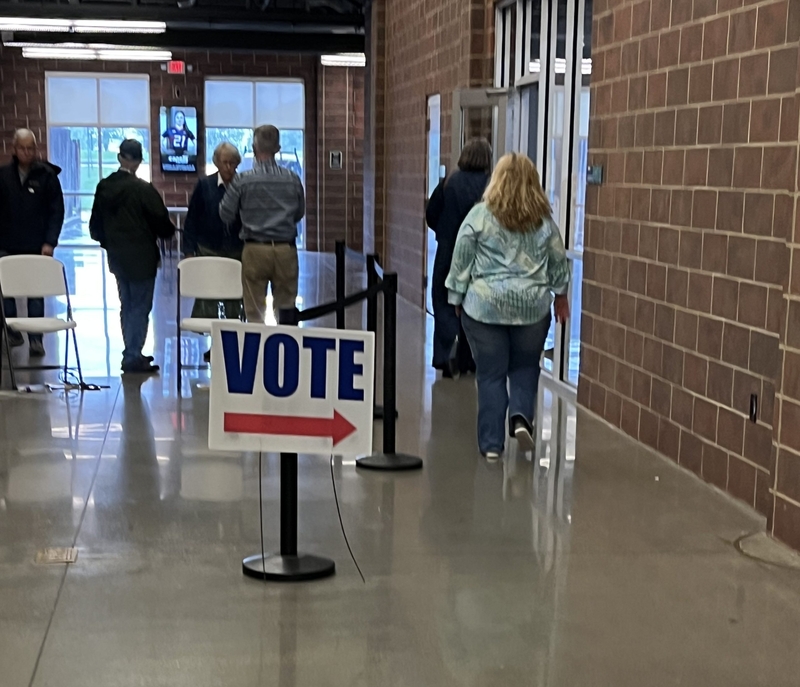
Voters head into a polling site at Grand Park in Westfield, Indiana, on Tuesday, May 5, 2026. (Photo by Tom Davies/Indiana Capital Chronicle)
As President Donald Trump refuses to rule out taking extreme action in the midterm elections, voting rights advocates and civil rights leaders are bolstering their voter protection efforts in anticipation of possible federal interference.
The focus by activists comes amid uncertainty among advocates and election officials over what Trump may do before, during and after Election Day. Some organizations are preparing to deploy volunteers to the polls to help assure voters in places where fear of federal intimidation may run high.
On Tuesday, several groups — including the Save America Movement, the American Federation of Teachers labor union and the National Action Network — launched Vote Safe, an initiative that will put local volunteers at polling locations in areas where they say pressure on Black, Latino and Asian voters is highest.
The program will include Georgia, Michigan, North Carolina and Ohio. The volunteers will document any intimidation and serve as a reassuring presence for voters, organizers said.
“The fear is the point and we must do something about it,” Mary Corcoran, executive director of the Save America Movement, a nonpartisan pro-democracy group, said on a call with reporters. “Left unaddressed, fear does the work of keeping people home without a single agent setting foot at a polling place.”
Volunteers will include clergy members, veterans, teachers and others trained to provide clear answers on voters’ rights, Corcoran said.
In Ohio, where Vote Safe will launch on the first day of early voting, Republican Sen. Jon Husted is facing former Democratic Sen. Sherrod Brown in one of the most closely watched Senate races in the country. Springfield, Ohio, also has a large Haitian immigrant population that has been repeatedly attacked by Trump, who is seeking to deport them.
The Rev. Al Sharpton, a civil rights leader who founded the National Action Network, suggested on Tuesday’s press call that some Americans in Ohio fear they could also be detained or even deported by ICE because of their skin color.
“‘You don’t understand, any Black looks like a Haitian in Ohio,’” Sharpton said, recalling a previous conversation with a journalist in Ohio. “You’ve got to prove you were from Alabama, not Port-au-Prince, after you’re deported.”
ProPublica reported on Tuesday that more than 500 U.S. citizens have been detained by immigration agents during the second Trump administration. About a dozen citizens, mostly children, have been deported.
What Trump has said
Trump, who has long made false claims about stolen elections and voter fraud, has maintained ambiguity surrounding what election-related actions he may take after the U.S. Supreme Court blocked his plan to use the U.S. Postal Service to restrict mail ballots. Congress also didn’t pass the SAVE America Act, a measure he championed that would require voters to offer documentary proof of citizenship.
In a recent TIME magazine interview, Trump said he hadn’t thought of deploying Immigration and Customs Enforcement, or ICE, agents to the polls.
But he also left open the possibility of declaring a national emergency, which legal experts say would give him no power over elections. Under the Constitution, states administer elections, not the federal government.
Earlier this year, Trump told reporters he would “do anything necessary to make sure we have honest elections.”
Department of Homeland Security Secretary Markwayne Mullin has said ICE agents can serve warrants at election sites, despite a ban on armed federal personnel at polling places. At the same time, DHS has denied any plans to target polling places.
DOJ election monitors
The Department of Justice’s plans to deploy 1,000 election monitors at polling places has also fueled concern among Democrats and voting rights advocates — and some Republicans.
While the DOJ regularly dispatches monitors each election cycle, the scope of the effort and Trump’s history of pressuring election officials has led to unease about how the monitors will behave.
Wyoming Gov. Mark Gordon, a Republican, earlier this year expressed reservations about Justice Department monitors, calling their actions “very odd” after DOJ personnel watched voting in the state’s primary election.
On Monday, the NAACP sued the Justice Department for records about its election monitor program, alleging the DOJ didn’t comply with Freedom of Information Act timelines.
“Americans deserve to know whether the Justice Department is abusing its law enforcement powers to the detriment of voters and the election officials tasked with running our elections,” Kristen Clarke, the NAACP’s general counsel, said in a statement.
Justice Department spokesperson Kiersten Pels wrote in an email to States Newsroom that monitors comply with all legal and ethical requirements. Pels added that they don’t interfere with the voting process and that their work “is consistent with longstanding Department practice of monitoring elections for compliance with federal law."
U.S. Attorney General Todd Blanche dismissed concerns about the monitors in an interview on “Fox News Sunday.” While confirming plans for about 1,000 monitors, he emphasized that the department sends out monitors every federal election.
“They’re not going to Republican states, they’re not going to Democrat states. They’re going to every state to make sure that our elections are carried out legally, fairly and appropriately,” Blanche said.
After Election Day
The preparations by civic groups also include post-election planning for potential disruptions to vote counting or attempts to overturn losses.
The FBI seized ballots from the 2020 election in Fulton County, Georgia, in January. The then-director of national intelligence, Tulsi Gabbard, was present at the raid at Trump’s request, underscoring its importance to the president.
The Justice Department also spent months seeking information on election workers in Fulton County during the 2020 election before a federal judge quashed the subpoena in July.
The raid raised questions among activists and election experts about whether federal law enforcement would seek search warrants to obtain ballots after Election Day.
Ballot seizures are a point of concern, said Andrew Walchuk, senior policy director and counsel for voting and fair representation at Common Cause, a voting rights group. The raid was “an alert” to election offices that a seizure is something they need to prepare for, Walchuk said.
“It is definitely something that groups across the country are ready for, that we’re watching,” Walchuk told reporters last week.
Like other groups, Common Cause’s election preparations include training a network of volunteers who can help voters and identify potential problems. In Texas alone, more than 400 volunteers are already, said Marliza Marin, Common Cause’s Texas program manager.
“It’s kind of unheard of to have this many volunteers already trained,” Marin said.
All States Newsroom content is free to republish. Read our republishing policy for more information.