Shapiro signs bell-to-bell cellphone ban for Pa. schools
Oct 26, 2026 | 2:05 pm ET
Description
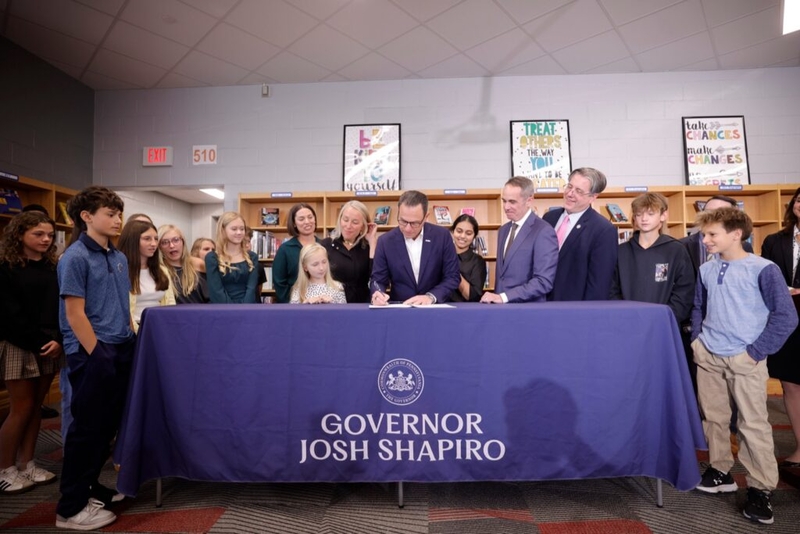
Governor Josh Shapiro signs a bell-to-bell cellphone ban into law at Lenape Middle School in Central Bucks School District on Oct. 26, 2026. (Photo from PACast)
More than 1.7 million K-12 students in public and private schools in Pennsylvania will soon all learn under a new, statewide law: a bell-to-bell cellphone ban restricting device use during the school day.
On Monday, Gov. Josh Shapiro ceremoniously signed Senate Bill 1014, which passed the House and Senate last week, at Lenape Middle School — part of the Central Bucks School District, which has its own cellphone ban already in place.
“What we’re doing is taking the example you set, and the model that you set, and now making sure that all schools across Pennsylvania follow that model,” Shapiro told assembled students. “I think students need to spend less time focused on their phones and a whole lot more time focused on learning and developing those social skills with their neighbors; on talking to their friends face-to-face; and on developing the critical life skills they’re going to need to interact with others.”
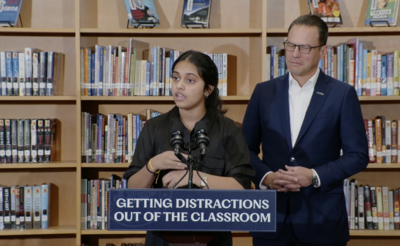
Sanjana Chamarty, a senior at Central Bucks High School South, pointed to research findings that having phones on silent or turned off wasn’t enough to mitigate negative effects.
“Eliminating the distraction altogether really does push forward and propel our idea of removing distractions, and also ensuring our students are receiving that quality education,” said Chamarty. “School is not only about the academics, but it’s also about making the social connections. Putting the phone down and looking up can really do a lot for our students.”
Two dozen states have a bell-to-bell cellphone ban, and most others have some sort of restrictions for K-12 students. PA Unplugged, a coalition of parents and educators in 32 counties, has repeatedly pushed for lawmakers to follow suit.
Kirstin McGowan, a co-leader with the organization and Bucks County mom of two, pointed to ever-increasing mental health concerns tied to cellphone use, including depression, anxiety and poor self-image.
“Research shows that teens are spending roughly 70 minutes of each school day on their phones, leading to lost learning, lost education and wasted tax dollars,” McGowan said. “This is a big step, but our work is not finished.”
School officials will need to adopt district policies before the 2027-2028 school year prohibiting cellphones all day, including during breaks and lunch, with a handful of exceptions for students with medical needs or disability accommodations.
The law allows districts to craft individualized policies, and also requires schools to brief parents on emergency notification procedures. The ability of parents to contact children during a crisis was a point of contention for some, specifically pointing to school mass shootings.
In response to a question on the topic, Shapiro pivoted to another, less bipartisan issue: reducing firearm access for those who might harm another.
“I don’t think we should accept the premise that a student having a phone in their hand or in their pocket makes a school any safer,” said Shapiro. “What we need to do is get the guns out of the hands of those people who shouldn’t have them. That’s why we need comprehensive gun reform in this commonwealth and in this country.”
Unclear reach of a bell-to-bell cellphone ban
The first bell-to-bell law was passed in Florida in 2023, making it difficult to determine whether statewide bans have any impact. An early analysis found that suspension rates spiked in the first year following its introduction, when students didn’t follow the new rule, but fell the subsequent year.
All the while, learning outcomes improved, according to the study. But more time is needed to assess whether reduced screen time will have the same impact on mental health.
“There are some learning benefits over the long run — but not in the initial period,” Harvard University professor Paul Peterson said in a July article. “And as for the social-emotional side, we know less about that because we can’t observe it easily through the data we have at present.”
Other experts told the New York Times last month that small-group tutoring would have the biggest impact on test scores, but costs more than bell-to-bell bans. Interventions like implementing the “science of reading” and universal pre-K were ranked more effective than increasing teacher pay or expanding private school vouchers.
Anecdotally, Central Bucks High School West teacher Christie Besack said students were more present, engaged in class and talkative with each other following the district’s cellphone restriction.
“We’ve seen in our district that this works, and I absolutely support making this a consistent expectation across Pennsylvania,” Besack added.
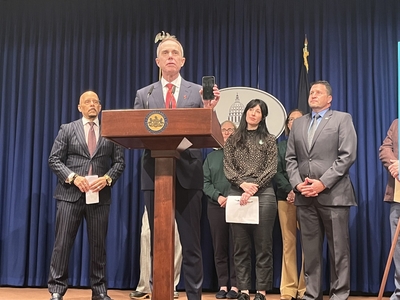
Sen. Steve Santarsiero (D-Bucks) cosponsored the effort with Sen. Devlin Robinson (R-Allegheny). But he said he noticed many of his colleagues were distracted by their own devices when he spoke about the bill last week from the Senate floor.
“It’s a problem for us too … we’re addicted to it too,” Santarsiero said on Monday. “I didn’t bring mine here today, because we need to be more present with each other. If we’re going to get past this very volatile time in our country’s history, it’s going to be by building those relationships one person at a time.”
Doing so would “repair our world… country… (and) state,” he continued, calling students “the vanguard for this.”
“You’re going to show us how it’s done, because the success you’re going to have in the schools will carry over to all of us as well,” he added.
Harrisburg, PA