Ohio Haitians and their supporters march on Columbus with demands
Oct 26, 2026 | 3:55 am ET

Description
Haitian immigrants and their supporters on a protest march out of Springfield, Ohio.
(Photo by Marty Schladen, Ohio Capital Journal.)
SPRINGFIELD — It’s been a golden autumn week in Ohio as many celebrated some of its happy traditions.
In Circleville, the 119th Pumpkin Show opened this past Wednesday. And in nearby Deer Creek State Park, people readied for the annual Halloween Campout, decorating campsites with fake skeletons, ghouls, graves and other spooky stuff.
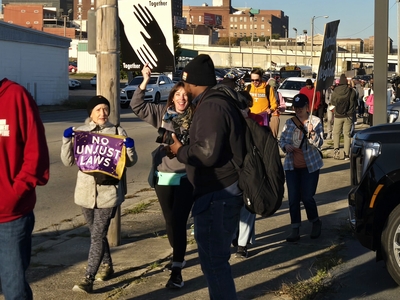
But not far away in Springfield, a group of about 40 marched out of town at dawn on a misty Wednesday morning to draw attention to the real nightmare they’re living and to demand action to ease it.
Ohio Haitian immigrants and their supporters embarked on a four-day pilgrimage to Columbus last week with a list of demands related to what they’ve been through since the start of President Donald Trump’s second term.
As many as 15,000 Haitian immigrants were living in Springfield, many with temporary protected status, until Trump and the conservatives on the U.S. Supreme Court ended it in late July. That means they were here legally, and had established new lives after an earthquake devastated their already-shaky home country in 2010.
Conditions in Haiti have only deteriorated since, and the government has almost ceased to function. Gangs are using murder, kidnapping and child rape to project their power ever further.
Some from Springfield have already been rounded up, imprisoned and deported back to what Gov. Mike DeWine called “hell.”
That treatment has come to people who committed no crime, Pastor Reginald Silencieux of the First Haitian Evangelical Church of Springfield said through an interpreter.
“We’ve had some people who lost their TPS and some of them have been deported and the League of Haitian Pastors are heartbroken by that,” Silencieux said. “People should not be treated that way. These are good people and humane people.”
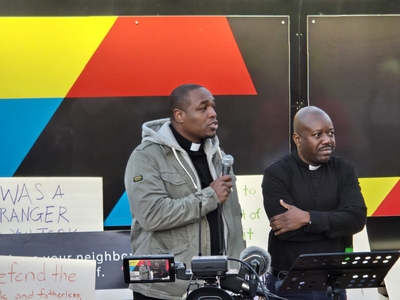
Silencieux said he’d been in communication with some of his congregants since their forced return to Haiti.
“It’s a tragedy,” he said. “Can you imagine? You come to Springfield. You work to build the economy. You grow your family. You do everything right, and they just snatch everything away from you. They take away your house. They take away all your belongings. Now (I’m) witnessing their suffering in Haiti. They’re not able to make it. It’s a catastrophe.”
The influx of Haitians to Springfield helped revive a shrinking city and its economy as they filled jobs in warehouses and other places that native-born residents didn’t want.
With their loss, Springfield now leads the state in year-over-year job losses. Federal job reports show the city’s labor force lost 1,100 manufacturing, leisure and hospitality jobs, contracting 2.2% in 2025 alone.
Now, the International Rescue Committee reports, Springfield’s Haitians are forced to return to a place where not only can’t they find jobs, they’re adding to a humanitarian crisis in a country where half the population lives in acute hunger.
As they undertook the first leg of a four-day journey to Columbus, the Haitians and their supporters were demanding more than just a reinstatement of protected status, which was taken away on a controversial legal basis.
Silencieux said the abuse of Haitians who had protected status starts well before deportation.
Some have been arrested by masked Immigration and Customs Enforcement agents and locked up in private, for-profit prisons or county jails run by sheriffs seeking federal money to pad their budgets. Others were summoned to ICE offices to be fitted with ankle monitors.
Silencieux said the former is breaking up families and the latter is a deep insult to descendants of slaves.
“This system of prisons in America, we’re not used to that,” he said. “And the ankle monitors (are) dehumanizing. It’s made us feel that we’re less than human. It makes us remember that these are the same shackles that were used in the time of slavery.”
Wearing an ankle monitor was so humiliating to Pierre Damas Bel — a 20-year-old Wright State University student who was bullied for wearing one — that he took his own life on Aug. 31.
It’s understandable that aside from organizers and clergy, few Haitian immigrants still in Springfield participated in the march. They’re afraid to go out in public, organizers said.
Among the changes the marchers are demanding, they want the ankle monitoring program officially ended, imprisoned Haitians returned to their families and ICE agents out of Springfield.
Even before his second presidency started, Trump was victimizing Springfield’s Haitians.
In a Sept. 15, 2024 debate, he repeated the false, racist claim that the city’s Haitians were stealing their neighbors’ pets and eating them. Then, with bomb threats shutting down Springfield schools and civic buildings, then-Sen. JD Vance repeated them, doubling down on the threat to his own constituents.
Michaelle Louis had an obviously sunny demeanor as she led songs on the Springfield City Hall Plaza just after dawn Wednesday. But ask about what’s happened to her and her neighbors and a deep anger becomes apparent.
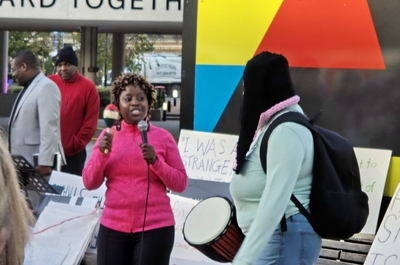
She declined to say whether she held protected status or whether she faces deportation.
Louis said she came to the U.S. in 2014 after her brother was assassinated in Port-au-Prince, the Haitian capital, and moved to Springfield in 2021.
She won’t discuss what’s happening to Haitians in the U.S. in terms of immigration status.
“If you’re not born here, you’re faced with deportation,” Louis said. “They don’t care about your citizenship, they don’t care. There have been so many citizens who weren’t born here who have been in detention. It’s not about your status. It’s about what you look like. Are you are Black? This is why I don’t want to talk about immigration. It’s about skin color.”
Perhaps bolstering her point is the fact that amid his mass deportations and restrictions on refugees, Trump in May said he would admit an additional 10,000 white South African refugees this year. They or their ancestors were the architects of the apartheid policy that allowed a tiny white minority rule over the Black majority there until its end in 1994.
The clear racial overtones and the harshness of Trump’s crackdown appear to be backfiring politically, Minister Archange Antoine said as he marched along an overpass leading out of Springfield. Polling has shown that voters have turned against Trump on immigration and staunchly support a path to citizenship for immigrants.
“I definitely think it’s that people are witnessing families being separated,” Antoine said. “They’re seeing citizens being detained. They’re seeing citizens killed. They’re seeing that children are being left alone, hanging. And the question is, ‘Am I responsible for this?'”
The march will culminate in a closing rally in Columbus at 1 p.m. Saturday. It will be held at West Bank Park, 303 W. Main St.
Columbus, OH