Kentucky Court of Appeals hears latest arguments in Kinship Care dispute
Oct 23, 2026 | 4:34 pm ET
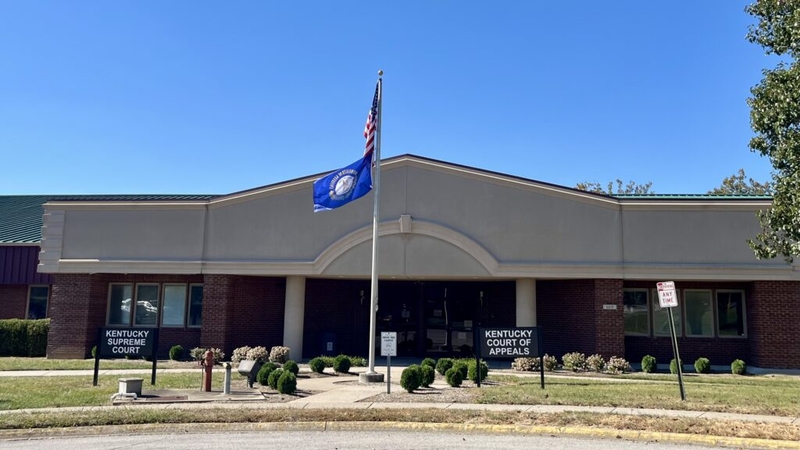
Description
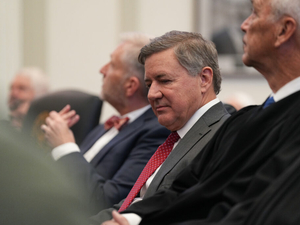
The Kentucky Court of Appeals in Frankfort, Kentucky, on Oct. 23, 2026. (Kentucky Lantern photo by Sarah Ladd)
FRANKFORT — Kentucky’s auditor has asked the Court of Appeals to send her lawsuit against the Beshear administration back to Franklin Circuit Court so she can iron out the kinship care dispute that’s kept them in court for more than a year.
In October 2024, Auditor Allison Ball, launched an inquiry into the financial viability of a 2024 law that aimed to give much-needed relief to kinship care families, which the Beshear administration said it couldn’t implement without specific funding from the General Assembly. (It has since started implementing the law after receiving funding during the 2026 legislative session).
Alleging that the administration did not cooperate with that inquiry, she sued and asked the Franklin Circuit Court to rule that the administration must implement the law.
Ball argued on behalf of her own office before the three-judge panel that met inside the Judge Sara Walter Combs Courtroom Friday afternoon.
The judges on the panel were Allison Jones, who was appointed to the bench by former Gov. Steve Beshear in 2013 and Lisa Jones and Susan Cetrulo, who were both appointed to the bench by Gov. Andy Beshear.
Ball said her office, which is constitutionally tasked with auditing state agencies and county governments, is “at risk of becoming an empty shell” if she cannot have confidence that she will receive documentation she requests in the course of audits.
Wesley Duke, the general counsel for the Cabinet for Health and Family Services, said the cabinet did indeed work with the auditor in the inquiry process.
“There were … particularly two responses I don’t think the auditor’s office liked, but we did not decline to respond,” Duke said. “We did not refuse to respond, and there’s nothing that was ever presented in the record of the case that shows that the cabinet ever indicated they would even do so.”
Travis Mayo, general counsel for Gov. Andy Beshear, said the governor should have never been named in the lawsuit because the investigation wasn’t about him. The auditor said she named him because the cabinet based their actions on his interpretation of state law.
“This case has really never been about the implementation of Senate Bill 151 or the auditor’s investigatory authority as to the governor,” Mayo said. “Instead, it’s always been about bringing the governor into a lawsuit to gain media attention based on facts that weren’t justiciable and simply never existed.”
Ball addressed that in her rebuttal: “There can be the impression that we’ve been trigger happy, that we’ve jumped the gun,” she said. But, she said, she would prefer mediation in this case.
“I’m really not interested in being in the courtroom,” she said. “I don’t want that to become a regular practice of what I have to do in order to be able to do my job as an auditor.”
The background
The Kentucky legislature approved and Beshear signed Senate Bill 151 in 2024 to provide financial relief to grandparents and others raising children who otherwise would be in state care by making it easier for the family members to qualify for foster care payments.
Beshear’s administration contended that without specific funding — at one point, an estimated $20 million — it couldn’t implement the law. The General Assembly pushed back, saying he had the responsibility to implement it.
For the next two years the legislature, auditor’s office and Beshear’s administration debated over who is responsible for funding and where the money should come from.
In Beshear’s budget request for 2026, he asked the legislature to appropriate $14.6 million in each fiscal year — nearly $30 million over the biennium — to fund the law.
When the Senate initially added funds for SB 151 implementation, Beshear said “If they provide us $5 million, we’ll provide $5 million to those families.”
By the end of the 2026 session, lawmakers upped the funding, giving Beshear $6 million each year — $12 million total — to fund SB 151.
In a pre-hearing briefing, Ball’s office argued, among other things, that the governor finds money for his priorities — lawyers pointed to the Pre-K for all pilot program, for example — and therefore could do the same for kinship care families.
Beshear’s administration, on the other hand, argued that the General Assembly’s appropriation of funding for the law in 2026 “moots the auditor’s appeal, her investigation or ‘examination,’ and her entire case, warranting dismissal.”
Ball’s office wants a guarantee that kinship care families won’t stop getting payments after that money — $12 million for two years — runs out.
“Once the Governor and CHFS, in their minds, believe the money for executing SB 151 runs out, they will stop executing SB 151, and there will, again, be an entire population of kinship caregivers and kinship care children that they will preclude from receiving the benefits of SB 151,” the auditor’s office wrote in a supplemental brief ahead of the Friday arguments.
Duke, the cabinet’s attorney, called that reasoning “purely speculative” in court Friday.
“We feel this issue is moot as it relates to 151,” he said. “We are implementing today. We have our budget appropriation.”
The judges will deliberate and try to rule within 40 days.
Frankfort