Drake University students say civility comes from open-minded conversations
Oct 23, 2026 | 5:20 pm ET
Description
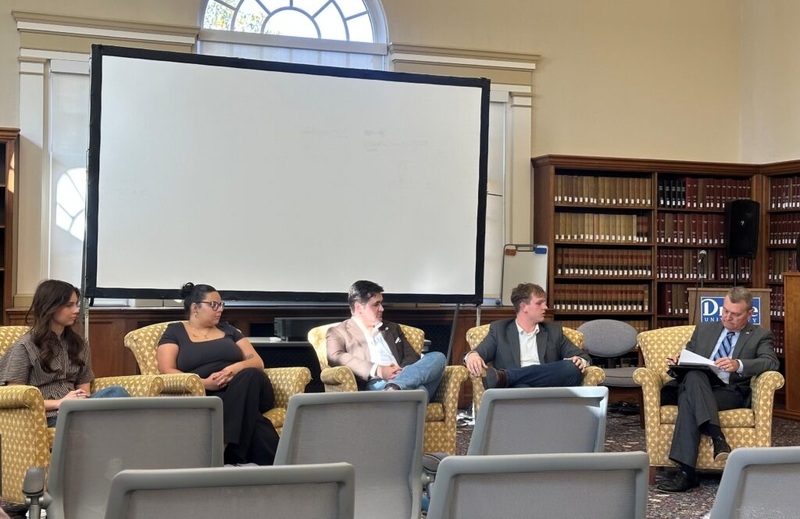
Drake University students, from left, Josie Thompson, Gabrielle Brooks, Jack Harrington and Sebastian Meyers speak on a panel about political civility on Oct. 23, 2026. (Photo by Brooklyn Draisey/Iowa Capital Dispatch)
College Republican and Democratic party leaders at Drake University said Friday they want to see people bring an open mind and an interest in learning to the political conversations they participate in, both before and after ballots are cast in the upcoming elections.
Drake University hosted a teach-in event Oct. 23, with faculty and expert discussions and panels for students to share their thoughts on political civility and their reasons for voting and encouraging others to do the same.
Members of Drake College Republicans and Drake Democrats told panel moderator and Robert D. and Billie Ray Center Executive Director Scott Raecker that national politics and the rhetoric shared in advertisements on social media do impact their lives on campus. They said in order to create a more civil political climate, people need to approach conversations not with the feeling that they’re right and the other person is wrong but with the hope to gain a better understanding of the other’s thoughts and reasonings for their belief.
“Go in with the open mindset that I don’t know exactly how I should feel about this. I want to get more information from this person, and then I can do some self-reflecting and then have my own opinion about that matter,” said Drake sophomore and Drake College Republicans Political Director Sebastian Meyers. “You know, I think that goes hand in hand with respect.”
Meyers, joined by Drake College Republicans President Josie Thompson, Drake Democrats President Gabrielle Brooks and Drake Democrats Political Director Jack Harrington, said the university itself and its proximity to the Statehouse have allowed students to become politically involved and active.
Civility means curiosity, not certainty of who is right
Civility, to these students, means being able to share opinions without the fear of ostracization and have conversations where disagreements are approached with respect. Brooks said that too often these days political conversations either don’t happen at all to avoid tension or end up in verbal “fisticuffs.”
Brooks brought up a recent conversation she and Meyers had on campus about vaccine mandates — an issue she is in favor of, but he is against. Meyers said he didn’t go into the discussion with the idea that he would change Brooks’s mind, but to learn.
“Neither one of us, I think, entered the space thinking or wanting to change the other person’s mind,” Brooks said. “It was more about coming to an understanding, and I think that if I can speak for you, Sebastian, that we ended the conversation with a greater understanding of the other person and where they were coming from within that specific issue.”
Building a connection beyond political discussions is also important in bringing civility to them, the panelists said. The two student organizations work together on programming and events, including efforts that brought back an early voting location to campus this year, which Thompson said has allowed the students to learn more about each other as people and find common ground.
From constant political advertisements to social media giving constant access to political happenings and strife, the students said national politics and rhetoric have come to campus and despite Drake’s good example of civility, Thompson said there could be more done.
Social media allows people to start political debates without having any real interaction with the people on the other side of the screen, the panelists said, and that dehumanization grows even more when posts can be made anonymously.
Thompson brought up the example of social media posts relating to the anniversary of Charlie Kirk’s killing, saying that one “sexually explicit” post about Kirk and Drake College Republicans got 400 upvotes, or the equivalent of 10% of Drake’s student population.
While Harrington proposed getting social media out of politics entirely, Brooks said that as the only person of color on the panel, she believes that social media can provide an important space for disenfranchised people to get their opinions heard. In order to create a “culture of decorum” online, she said that culture first needs to be developed off-line.
Keeping an open mind beyond the election cycle
The lack of civility surrounding politics is something Harrington said he believes comes from the top down, meaning that interactions in national politics trickle down to how political discussions go between peers.
“I can’t really stand either party at the moment, but I think we need to find a way … I think, to cool down the rhetoric up top. We need to find a way to cool that off and find a way to moderate ourselves up there,” Harrington said.
Thompson agreed, saying she didn’t believe so much vitriol would have been posted about Kirk and the student organization if similar things hadn’t happened on a national scale through social media. She said the approach should be “bottom-up” rather than top-down, with students having conversations about politics like this panel and making their own voices heard, rather than letting national political officials and those who comment on politics speak for them.
When asked by Raecker what advice they’d provide for people to be better “bridge builders” and generate more civility leading up to the election, each student voiced the same point in different words — remember the people you’re talking to are human, and don’t start a conversation with your mind already closed to it. As Brooks put it, one side shouldn’t “boogeyman-ify the other side.”
Thompson reminded the group and audience that the respect and open-mindedness needs to last beyond Election Day and into its aftermath. People also need to keep in mind that they may be role models without realizing it, she said, like for faculty and their students or senior students and the freshmen wanting to emulate them.
“There’s always a lot of harsh feelings, especially on college campuses after elections happen, and I think if we’re at least open-minded, like leading up to it, even if we know we can’t change each other’s minds, we have to listen to each other so we can build respect for each other,” Thompson said. “So by the time the election’s over, we’re all not … personally angry at each other. Maybe we can be angry about what happened, but we have to build that respect.”
Des Moines, IA