More than 700,000 WA state voters have cast ballots
Oct 23, 2026 | 5:42 pm ET
Description
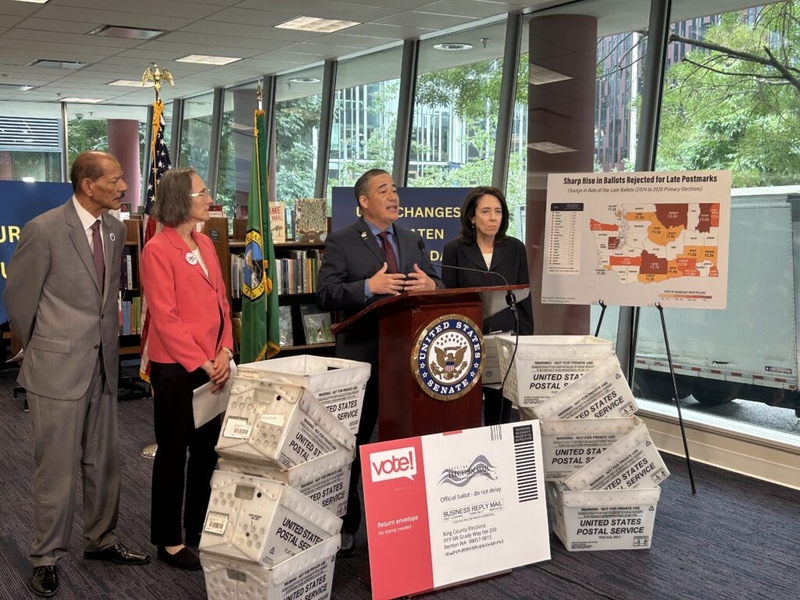
Washington Secretary of State Steve Hobbs speaks about the importance of returning ballots early alongside U.S. Sen. Maria Cantwell, right, and leaders from the Seattle King County NAACP and the League of Women Voters of Snohomish County on Wednesday, Sept. 2, 2026, in Seattle. (Photo by Jake Goldstein-Street/Washington State Standard)
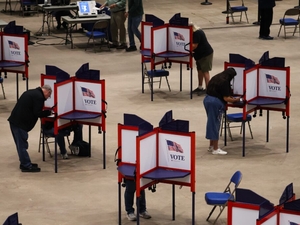
Washington state voters are getting the message: Don’t wait to turn in your ballots.
As of Friday afternoon, 705,231 ballots had been returned with 66.4% arriving via drop boxes, a sign early voters are heeding repeated warnings from state and local officials to steer clear of the U.S Postal Service to ensure their ballots are counted.
Voters are turning in their ballots fastest in Jefferson County in western Washington, which had 32.8% of ballots already in hand. Five other counties — San Juan, Asotin, Thurston, Lincoln and Skagit — topped 20% on Friday.
By sheer volume, the state’s three most populous counties — King, Snohomish and Pierce — accounted for 47% of those mailed in or put in a drop box.
Overall, 13.7% of the state’s 5.15 million registered voters had turned in a ballot. At this stage four years ago, 13.9% of voters had done so.
Secretary of State Steve Hobbs said this week that he’s not expecting final turnout for the Nov. 3 election to eclipse the 64.6% mark for 2022.
“I hope it’s higher,” he said, but some voters only engage when there is a competitive high-profile statewide contest, like for a U.S. Senate seat. There isn’t this time, but there was four years ago when Democratic U.S. Sen. Patty Murray defeated Republican Tiffany Smiley.
Hobbs is pleased drop boxes are the first choice of most early voters. Since August, election officials have sounded the alarm over the Postal Service not postmarking mail-in ballots on the day they’re received due to reduced service and faraway processing centers.
Those who mail their ballots back are being told to do so at least a week before Election Day. And next week, Hobbs said, they should go to their local post office and ask a clerk to postmark it on the spot.
More than 20,000 ballots were not counted in the August primary because of a late postmark. In rural counties, the percentage of rejected ballots this year was much higher than the 2024 primary.
Meanwhile, in the current election, 4,229 ballots have been challenged thus far. Of those 2,026 had a signature on the return envelope that did not match on the voter’s registration form, and 1,374 weren’t signed. Those who voted with those ballots will be given a chance to cure the problem and have them counted.
‘Throwing monkey wrenches at us’
With voting underway, Hobbs said election officers continue to deal with a maelstrom of challenges and threats from a federal government that’s tried to exert more authority over elections.
Unlike past cycles, he said the federal government has not shared as much real-time information on potential security threats and bad actors. On Wednesday, Hobbs said he expected to receive a classified briefing “soon” and that Washington is part of a separate multistate task force monitoring for potential bad actors.
In the summer, the U.S. Department of Justice threatened Washington state election officials with criminal prosecution if they fail to prevent noncitizens from voting in this year’s federal elections. In recent weeks, more than 60 subpoenas for records of individual voters have been received from federal authorities.
Hobbs said the office is reviewing the subpoenas to ensure that the responses comply with applicable state and federal laws.
“We take our responsibility to protect voter information seriously and will only respond to requests that follow due process,” he said. “However, we see what’s happening in California and don’t want Washingtonians to be harassed.”
The Trump administration has sued California to prevent the counting of thousands of ballots that it alleges were cast by noncitizens. Washington Attorney General Nick Brown has filed a legal brief opposing the federal government’s demand.
Hobbs also anticipates federal election observers will be present in some counties, such as in southwest Washington where the hotly contested race for the 3rd Congressional District is taking place.
This week the Trump administration informed King County leaders that federal monitors will be sent there though it’s unclear what role they’ll play. Critics fear they’ll try to interfere with elections, but the U.S. Department of Justice maintains their efforts are routine.
This year’s situation is more difficult than elections two and four years ago, Hobbs said, because of the constant “push and pull” with the Trump administration.
Hobbs and Brown put together a guide to help election officials navigate the terrain.
“The federal government is not really there at the same time they’re throwing monkey wrenches at us,” he said.
This story was updated at 3 p.m. with new ballot return figures.
Olympia, WA