Once a rarity, Latino candidates are now up and down the ballot in local, state races
Oct 22, 2026 | 8:02 pm ET
Description
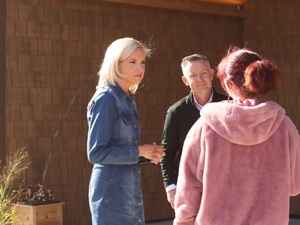
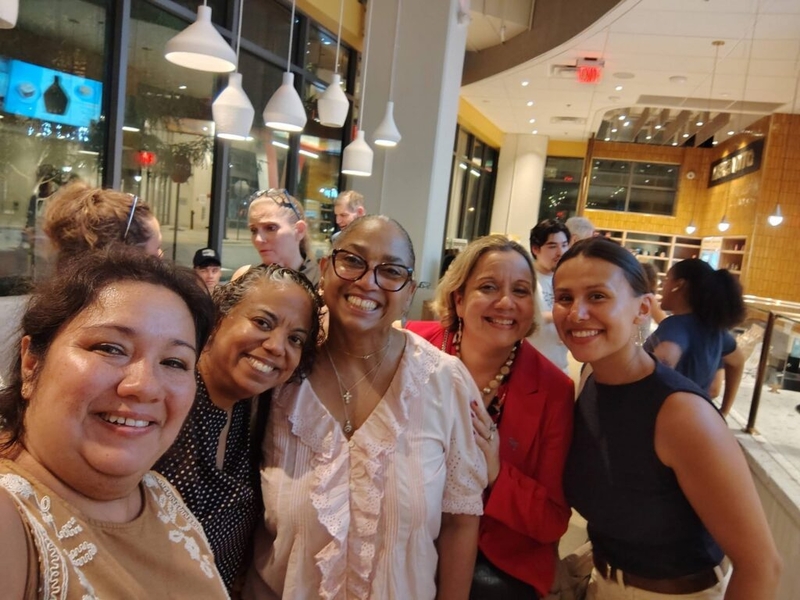
Latina connecting at Arepa Zone in College Park include, from left, Colmar Manor Mayor Monica Casañas, Del. Deni Taveras , House Speaker Joseline Peña-Melnyk, Montgomery County register of wills candidate Barbara Ebel and Nicole Rios, a political strategist. (Photo courtesy Joseline-Peña Melnyk)
When she entered public life in 1990, Ana Sol Gutierrez was a pioneer, serving two terms on the Montgomery County Board of Education before becoming Maryland’s first Latina state legislator when she was elected to the House of Delegates in 2002.
A native of El Salvador, she came to the U.S. in 1949, the daughter of a founding director of the World Bank and International Monetary Fund. A systems engineer by training, she worked for NASA and was deputy administrator at the Department of Transportation in the Clinton administration. But she also saw the surge of Central Americans coming here to flee war and economic hardship.
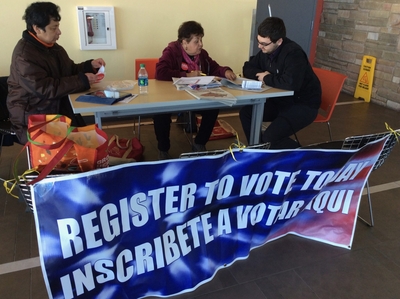
“I saw that Latinos were not really represented. I ran with the idea that I wanted to get the Latinos registered and active in politics,” Gutierrez said recently. “I carried applications in my purse, sent [applications] to the kitchen in restaurants, and [left] four or five at the [cash] register.”
That work apparently paid off.
Today, Latinos hold state positions and local office, and work in staff positions throughout state and local government, Gutierrez said. The Maryland Democratic Party said it is following 21 Latino candidates who are running for state and local offices this fall.
“Nine are incumbents, six are new in safe blue seats, two in competitive races, and four in red seats,” said Carter Elliott, a senior adviser for the party. Those candidates “won their primaries for county council positions in Prince George’s, Montgomery, Frederick and Baltimore counties. This also includes multiple Democratic candidates working to flip some council seats blue.”
Afro-Latina House Speaker sets inclusive agenda
Nowhere is the advance of Latinos more evident than in House Speaker Joseline Peña-Melnyk (D-Prince George’s and Anne Arundel), the first Afro-Latino and first immigrant to hold the job.
The groundwork laid by Gutierrez opened the door for Peña-Melnyk, who was elected in 2003 to the College Park City Council, and three years later was voted into the Maryland House. She was unanimously elected speaker last December.
As a child in the Dominican Republic, she was raised by a single mother in a one-room house with a leaky roof. They escaped poverty for a life in the United States, where young Joseline translated documents for her family and others trying to navigate the complex social welfare system.
“When you grow up that way, it gives you perspective on the struggles of life, and it shapes you,” said Peña-Melnyk, who said that life fueled her activism.
Like Gutierrez, when Peña-Melnyk entered political life, few looked or sounded like her. She soon got to work to change that. She and Del. David Fraser-Hidalgo (D-Montgomery) in 2014 co-founded the Maryland Legislative Latino Caucus, which today has 100 members, including eight Latinos and 92 associate members who support its agenda.
Peña-Melnyk says the effort is paying off in legislation that she says lowers energy bills, reins in prescription drug costs, and extends Medicare coverage to undocumented pregnant women — work accomplished with a greater support team.
“Today you have people that are chief of staffs, committee managers, HR directors, working in the governor’s office, in the comptroller’s office, which is so important to have not just Latinos but to have, you know, the workforce reflect the people of Maryland,” she said.
In the run-up to November, she said she has been on a seven-day-a-week campaign across Maryland to get out the vote, and fulfill a promise.
“I told my members that I was going to come to their districts, that I want to get to know all of Maryland,” she said. In late August, she organized a candidate meet-up at Arepa Zone, a Venezuelan restaurant in College Park. Dozens of activists and supporters showed up to celebrate primary victories and listen to what new candidates like 25-year-old Ruben Amaya had to say.
Getting out the youth vote
Born in the United States to Central American immigrants, Amaya’s history in politics began in high school, where he mobilized classmates to fight for gun reform, and to fix infrastructure problems at the school. By his senior year, he was president of the Baltimore County Student Council and in 2022 he ran for the House of Delegates. He finished fourth out of 12 candidates, but garnered political capital in the process.
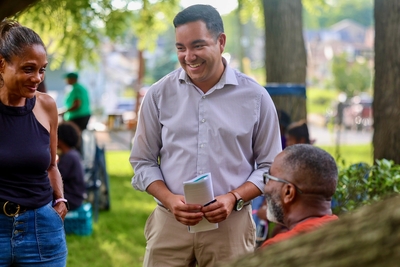
Amaya is currently the third vice chair of the Maryland Democratic Party and president of the Young Democrats of Maryland, while balancing a day job as an admissions counselor at Stevenson University in Baltimore. In June, he won a crowded primary race for the Baltimore County Council from District 2, and is favored to win in the heavily Democratic district.
“I’m running to be the first Latino to hold elected office in our county’s history. Also, if elected, I’ll be the first Gen Z member to hold elected office as well in Baltimore County,” Amaya said. “I think it’s a big moment, not just for Latinos, but for young people. We’ve been able to inspire a lot of young people to get involved.”
Amaya said his priorities are housing affordability, economic and food security and basic day-to-day county services, applying his known-how of what he learned from his immigrant parents.
“I think that coming to this country with nothing, their mindset was never about what can we do to just reap the benefits. It was about what we can do to contribute back,” he said.
Running for council to be an advocate
For Howard County Council nominee Jessica Nichols, her childhood in rural Texas was “very food insecure.”
“I used to call it ‘peanut butter poor’ because we would often [just] have a jar of peanut butter as the only food in our home,” Nichols said. Her parents fled poverty and violence Central America, she said, and her single mother later moved them east, for better work opportunities.
“That really did inform my service both as a teacher and as board chairperson of Columbia Community Care,” she said of the post-pandemic nonprofit she co-founded to combat food insecurity in Howard County. “Care meant that there was one less little hungry Jessica. That was very impactful to me. It still drives my involvement.”
Nichols, a social studies and resource teacher who was named 2024-25 Howard County Teacher of the Year, has become increasingly engaged in civic life over the last decade. She’s been president of the Columbia Democratic Club, a member of the Democratic Central Committee and the Howard County Education Association, the local teacher’s union.
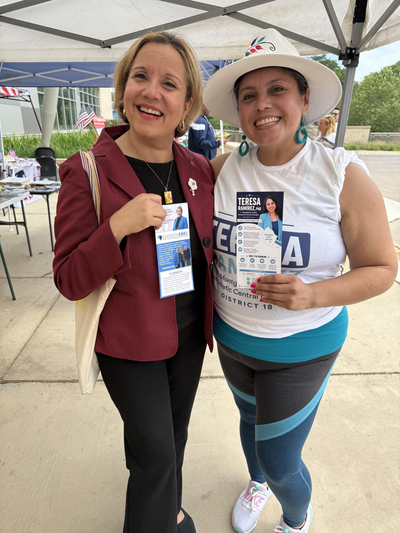
When budget cuts threatened county education “was when I realized that the voice that was missing in the room was the voice of educators, because when the educators’ voices are in the room, there’s advocacy for children,” she said of her decision to run. “There’s advocacy for families.”
With no opponent in the Nov. 3 election, Nichols will likely sworn in Dec. 7 as the first African American woman and the first Latina in the post.
A ‘passion … to continue to help people’
Montgomery County register of wills nominee Barbara Ebel said she ran because she decided it was time, after years helping others.
“I found my passion, and it was to continue to help people,” she said at the August gathering in College Park.
Born in Puerto Rico and raised in the Dominican Republic, Ebel parlayed her bilingual skills into a job in 1996 at the Maryland Department of Labor Workforce Development Office as a career counselor, the only Latina hired at the time. Within eight years she was its Montgomery County director, serving along the way as a trainer, business developer and in supervisory positions.
She was elected to the Montgomery County Democratic Central Committee in 2022 and has also served on boards of several nonprofits that advocate for people with disabilities.
Besides the right timing, Ebel decided the job of register of wills would be a good fit. The office administers the legal process of settling a deceased person’s estate, she said. “And, because I went through the process myself, I knew I could really do this job, and, also because I have 26 years of public administration service, have implemented regulations and [am] able to interpret regulations and polices,” she said.
Ebel faces Republican nominee T. Dolores Reyes for the seat, but is favored in Montgomery County, a Democrat stronghold. If elected, she will leave the Labor Department to devote herself full-time to the new position, where she hopes to make the office easier to navigate, easier to understand and welcoming for all county families.
Ebel, who also spoke at the Latino candidate gathering in College Park, said she came away hopeful.
“It was a beautiful synergy to see so many Latinos that really want to do the people’s work. That they are putting themselves out there, running for office to serve the public and make a difference and impact in the community,” she said.
Despite the gains, Peña Melnyk says the fight for equity and representation is ongoing.
“Now more than ever, the immigrant community needs people to speak up for them, to advocate for them, to advocate for human rights. And, we cannot do it alone,” she said. “We need brothers and sisters from different backgrounds. It’s a way to keep us all connected to make sure we make life better for everyone.”
Annapolis, MD