Hemp businesses don’t have to destroy their stock after federal ban starts. They just can’t sell it.
Oct 21, 2026 | 5:24 pm ET
Description
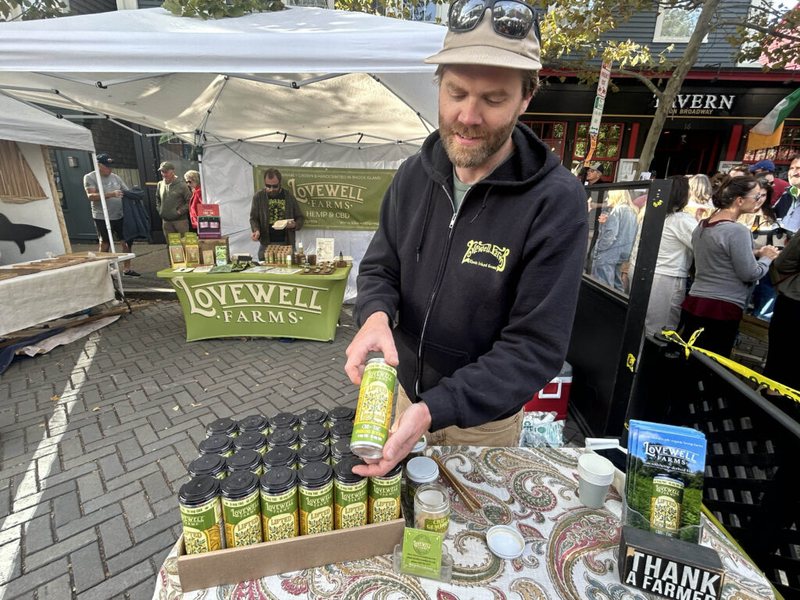
Mike Simpson, cofounder and director of marketing for Lovewell Farms in Hopkinton, displays the company's THC sparkling lemonade at the Broadway Street Fair in Newport on Oct. 10, 2026. (Photo by Janine L. Weisman/Rhode Island Current)
Rhode Island’s hemp businesses can keep all of their intoxicating products after a new federal THC potency limit takes effect in less than two months — they just can’t sell them if Congress doesn’t change course.
An Oct. 8 bulletin from the state’s Cannabis Control Commission gives hemp businesses the option to quarantine existing inventory containing more than 0.4 milligrams of total THC per container. These products are set to become illegal nationwide come Dec. 11. The policy was included in an email the commission sent to all 201 of the state’s hemp licensees on Oct. 9.
“They are not permitted to be further processed, moved, distributed and/or be offered for sale unless explicitly authorized by the federal government and/or the Cannabis Control Commission,” the notice states.
Hemp licensees will have to submit an inventory report to the commission by Dec. 4, according to the bulletin. After Dec. 11, hemp businesses cannot add or remove products from their quarantined inventory. They can request to destroy those products at any time, but the state’s Cannabis Office must supervise the destruction. Regulators may also conduct inspections and inventory audits.
State regulators warned the hemp industry in a Sept. 11 bulletin that products exceeding the new limit “must be removed” prior to the federal deadline or else they faced fines.
The new federal potency limit was originally set to take effect Nov. 12, but lawmakers delayed the effective date one month as part of a short-term government funding bill signed by President Donald Trump in September.
Charon Rose, spokesperson for the Cannabis Control Commission, said state regulators updated the guidance to avoid forcing businesses to destroy inventory amid uncertainty over whether Congress might change course again before the deadline.
“We just want to be mindful,” Rose said in an interview Wednesday.
Some hemp growers and distributors objected to the commission’s September guidance, arguing the rules would force them to destroy products that complied with regulations adopted by the state in 2024.
The end is near for US hemp THC market. But uncertainty continues for Rhode Island growers.
Workers from Lovewell Farms, the state’s only outdoor hemp farm, repeatedly raised concerns with regulators, including at a Sept. 18 commission meeting where they suggested updating the state’s guidance.
Mike Simpson, co-founder of Lovewell Farms, said the updated guidance, while helpful, ultimately does little to clarify what growers like him are supposed to do with their inventory.
“Essentially they say we’re allowed to grow, and none of that is going to be affected… but then I can’t sell any of it,” he said in an interview. “It really makes no sense.”
Craft Collective Homegrown, a Massachusetts-based beverage distributor and wholesaler, also challenged the September guidance in an Oct. 7 letter to the commission, advocating for businesses to hold on to high potency THC products for up to six months, with the inventory tracked and inspected and no sales permitted.
Adam Oliveri, CEO of Craft Collective Homegrown, called the commission’s latest guidance a “meaningful step forward” in preserving Rhode Island’s budding hemp industry, which generated $2.85 million in sales in 2025.
Oliveri and Simpson still questioned whether hemp businesses would need separate approval from the commission to resume testing, processing and selling quarantined products if federal law changes after Dec. 11.
Simpson also wanted to know whether the commission must update its own hemp regulations to align with the new federal definition, which would require a public comment period.
Rose said regulators are continuing to assess how evolving federal requirements could affect quarantined hemp products and the state’s existing regulations.
“Any changes to federal law or guidance could affect the requirements applicable to these products and the steps necessary for licensees to resume activities that are currently restricted,” she wrote in an email.
Providence, RI