After months of roadblocks, Maryland Reparations Commission holds first meeting
Nov 21, 2026 | 2:36 am ET
Description
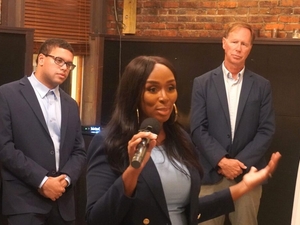
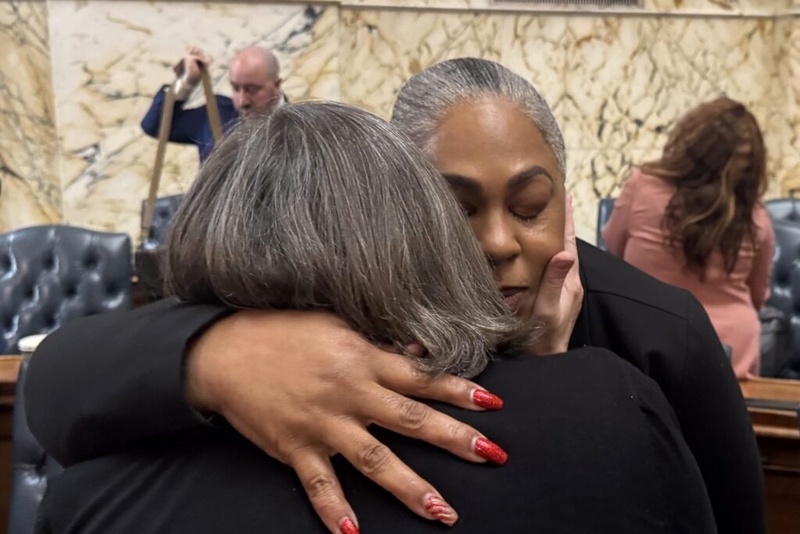
Del. Alethia McCaskill (D-Baltimore County) gets a hug from Del. Catherine Forbes (D-Baltimore County) in December 2025, when the House overrode Gov. Wes Moore's veto of a bill creating a reparations commission. That commission finally held its first meeting Friday. (Photo by William J. Ford/Maryland Matters)
If members of the Maryland Reparations Commission appeared eager to get to work at their first meeting Friday, it’s easy to understand why.
It’s taken them 19 months just to get to this point.
The commission, approved during the 2025 legislative session, had to overcome a series of hurdles, not the least of which was an unexpected veto by Gov. Wes Moore (D), the nation’s only Black governor at the time. But the more than two dozen members who met Friday were more focused on the importance of being part of a “historic commission.”
“This is very important work that is long overdue,” said Stephanie Franklin, a civil rights attorney and one of six people appointed to the commission by Moore.
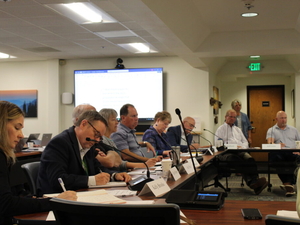
The nearly 90-minute online meeting began with members introducing themselves and talking about the commission’s charge. Members of the volunteer commission include those with expertise in the history of slavery, members of the House and Senate, and community and faith leaders. The State Archives office will help staff the commission, with Archivist Elaine Rice Bachmann serving as one of three ex-officio commission members.
Emily Oland Squires, an assistant state archivist, led the first part of the meeting and read a summary of the commission’s mandate, part of which is “to study and make recommendations relating to appropriate benefits to be offered to individuals whose ancestors were enslaved in the State or were impacted by certain inequitable government policies.”
‘Nearly erased’ Black patriots of the Revolution now enshrined at State House
Sen. Mary Washington (D-Baltimore City and Baltimore County) recommended changing “benefits” to “restitution or something like that. I don’t want us to mischaracterize the nature and the harm and the intent of what we’re doing here.”
The word “benefits” is mentioned five times in the legislation sponsored last year by Sen. C. Anthony Muse (D-Prince George’s) and Del. Aletheia McCaskill (D-Baltimore County). While the Senate bill ultimately passed, McCaskill is seen by many as the lawmaker who led the yearslong fight to get a reparations commission established.
Both bills were among the top priorities for the Legislative Black Caucus last year. Maryland become of the few states in the nation with a statewide body to study the inequality endured by African descendants.
The bill passed the Senate 32-13 in March 2025 and passed the House by a comfortable 101-36 margin almost three weeks later, after a day of failed amendment attempts by Republicans. But it was vetoed on May 16, 2025, by Moore, who said in his veto message that it was time to move past studies of the issue and toward action. That veto was easily overridden in a special session last December, which allowed for the commission to be created.
At Friday’s meeting, commission members discussed for slightly more than 30 minutes part of the group’s mission and the appointment of a chair.
A few members in the virtual meeting said they needed more time to decide on choosing a chair, since many were just meeting for the first time.
“It would be difficult for me to vote for someone as chair for the commission, who I hadn’t had the pleasure of meeting,” said Lawrence Jackson, a professor of English and history at Johns Hopkins University, whose father’s grandfather was born into slavery in Virginia in 1855.
“It would be great to have an in-person meeting to make that final selection, or I hope that that could be a possibility,” Jackson said. “If a person is currently interested in being chair of the commission, it would be appropriate to let us know.”
One member did step up: Dayvon Love, director of public policy with Leaders of a Beautiful Struggle based in Baltimore City. The group agreed that Love, who was appointed to the commission by House Speaker Joseline Peña-Melnyk (D-Prince George’s and Anne Arundel), would serve as interim chair until they convene again next month.
“I would like for us to go into 2027 with a work plan,” Love said.
No date was set on when and if the group would meet in person or virtually.
A preliminary report is due by Sept. 1, 2028, and a final report three months later by Dec. 1 of that year. The commission would sunset by June 30, 2029.
Annapolis, MD