Surprise is not an adequate response to predictable causes, effects of eastern South Dakota floods
Oct 19, 2026 | 3:50 pm ET
Description
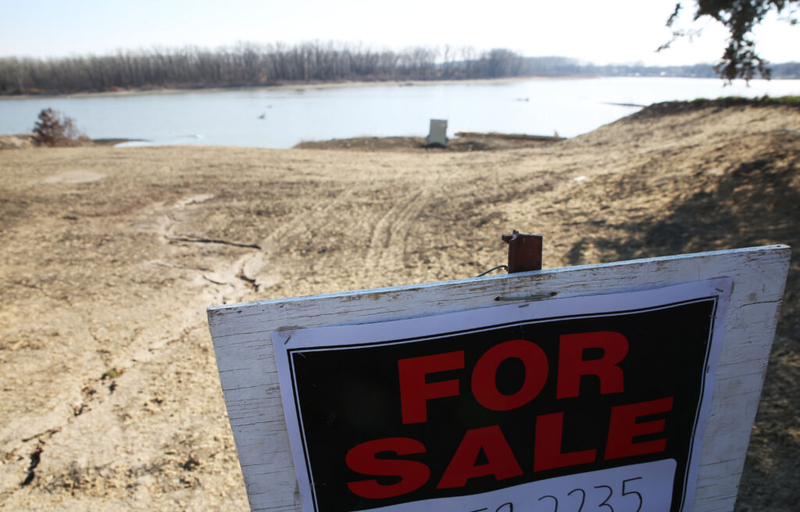
A McCook Lake property owner lists an empty lot for sale on March 28, 2025, after the house was destroyed by the June 2024 Big Sioux River flood. (Photo by Makenzie Huber/South Dakota Searchlight)
As the Army Corps of Engineers prepares to host an open house about its study of Lower Big Sioux River flood risks, I’m reminded of a comment then-Gov. Kristi Noem made two years ago after the river overwhelmed McCook Lake.
“I don’t believe anybody could’ve ever prepared for the amount of water that came down in that 24-hour period,” she said.
In a narrow sense, the comment fell flat because rain had been falling for three days before the river’s floodwaters slammed into the lake. Noem said herself on the day before the flood that forecasters expected a record crest in the river.
Yet, even with a little time and the expectation of historic conditions, the state’s preparations were inadequate. Floodwaters destroyed about 20 McCook Lake homes, damaged dozens more and knocked out infrastructure. Insufficiently warned residents fled for their lives and luckily escaped.
In a broader sense, Noem’s comment reflected an ignorance about the predictability of increasingly severe flooding in South Dakota’s more heavily farmed and more densely populated eastern half.
Granted, nobody can exactly predict whether a river’s next historic flood will be in one year, five years, 10 years, or further into the future. But many of the forces causing ever-worsening floods in eastern South Dakota have been observable for decades.
The longest-standing cause is our society’s impact on a region that was formerly a grassland sponge. Mass-production agriculture and city-building have converted the sponge into a waterslide.
Rain falls on farm fields, and some of it runs off without deeply rooted prairie grass to soak it up. Water that remains in the fields percolates through the ground and, in some cases, enters perforated pipes known as drain tile, which farmers use to usher excess water into ditches, creeks and rivers.
In cities including the sprawling, 80-square-mile metropolis of Sioux Falls, rain falls on hard surfaces and flows into storm sewers, ultimately reaching waterways already swollen with farmland runoff.
Meanwhile, climate change is making heavy rains heavier. Two years before the McCook Lake flood, for example, Sioux Falls experienced its rainiest day since the beginning of modern record-keeping, when 5.4 inches fell on Aug. 7, 2022.
It all adds up to a foreseeable outcome. More water is coursing through eastern South Dakota waterways — 300% more annually than decades ago, according to a study of the James River — and floods are getting worse.
So, what should be done?
We should stop building in flood zones or at least think more strategically about what we build there. We also need better protection for people already living in flood-prone areas. That’s under consideration at McCook Lake, where the Corps is partnering with local governments on a study. An open house is scheduled for 6 p.m. Central time on Thursday at the North Sioux City Community Hall.
Two years after McCook Lake disaster, Corps of Engineers agrees to help with new flood-control plan
Much of the remaining answer lies in conservation, one of the few issues capable of uniting South Dakotans across the political divide.
Federal and state agencies and nongovernmental organizations are doing some positive things on that front, and their efforts could be expanded. That includes the Conservation Reserve Program, which pays rural landowners to maintain some land in a natural state, and buffer-strip programs, which pay landowners to maintain grassy vegetation along streambanks.
U.S. Sen. Mike Rounds, R-South Dakota, proposed legislation recently that would pay farmers to convert less-productive cropland to grassland for cattle. Perhaps the state could partner on the program to encourage the federal legislation’s passage and make it more attractive to landowners.
The state and federal government could also do more to incentivize better drain-tile practices, such as upgrading free-draining systems with equipment that retains more moisture in farm fields or diverts it to a holding area that could be tapped later for irrigation.
Cities could install more water-absorbing green spaces and incentivize more green roofs that use vegetation to absorb and reduce the volume of water running down drainpipes.
Endorsing these and other ideas does not require a belief that humans are causing climate change. The ideas can stand on their own merits. For those who do believe humans are changing the climate, actions such as restoring and conserving grasslands carry the added benefit of pulling heat-trapping carbon dioxide out of the atmosphere and storing it in roots and soil.
The benefits of all these actions are clear, and so are the consequences of inaction and unpreparedness that were displayed at McCook Lake.
We may not know exactly when the next historic flood will strike eastern South Dakota, but whenever it happens, there will be no excuse for acting like nobody could’ve prepared for it.

Pierre, SD