Who pays when a remote Alaska village can no longer stay?
Oct 16, 2026 | 9:30 am ET
Description
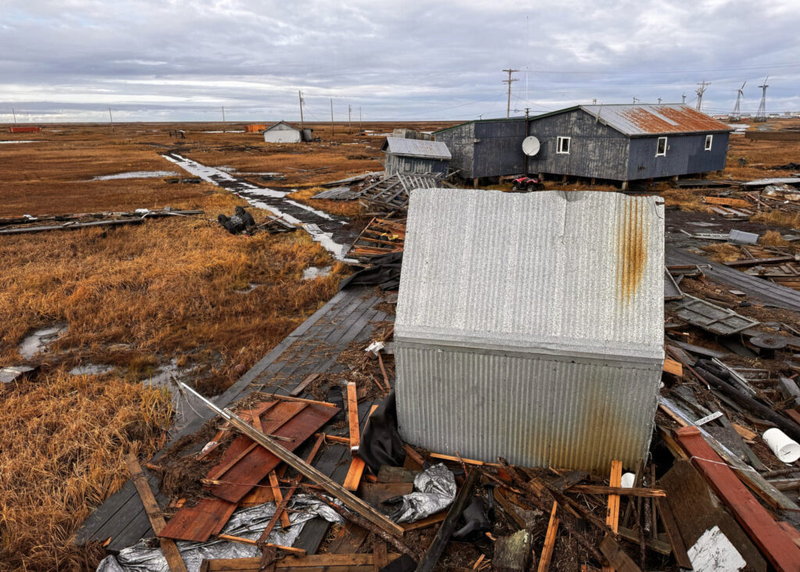
Damage in Kwigillingok from ex-Typhoon Halong is seen on Oct. 16, 2025. (Photo provided by the Alaska National Guard)
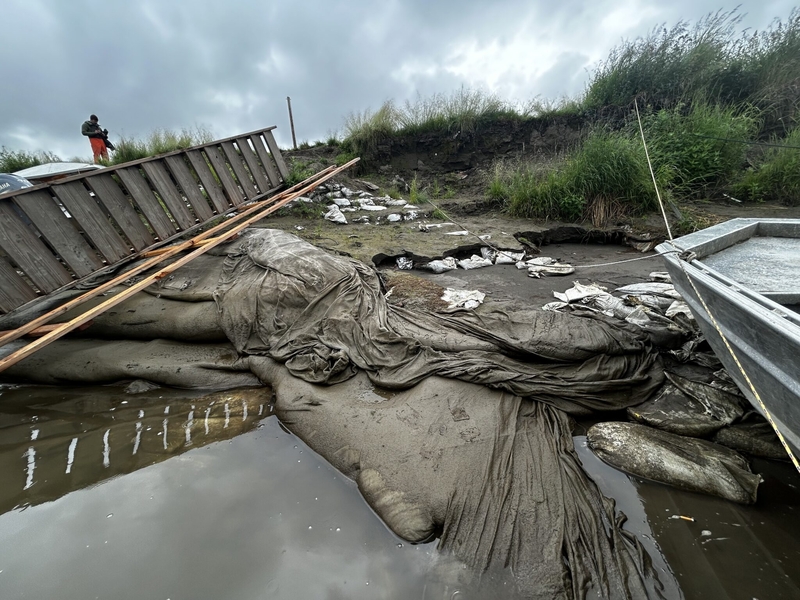
In Kipnuk and Kwigillingok, schools in the flood zone remained closed. Homes swept away are still scattered across the tundra. Where crushing waves snapped essential boardwalks, the days now carry the drone of power tools worked by young Yup’iks determined to rebuild them.
From a bird’s eye view, the land seems to signal it has finally relaxed. You’d have to look hard to see where wind and water once forced their way across the coastal channels—the wild grasses among the riverbends have since smoothed over.
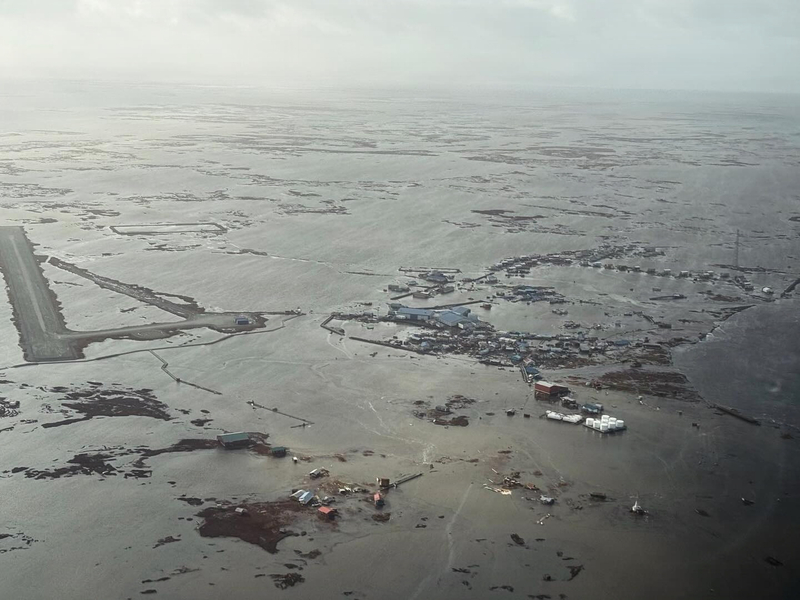
A year after the remnants of Typhoon Halong unleashed a historic fury across Alaska’s Lower Kuskokwim Delta, few of the estimated 1,500 evacuees have returned. The storm, which struck Oct. 11 and 12, 2025, claimed at least three lives, destroyed more than 150 homes and affected 45 other communities across Western Alaska. It all but upended the Native Village of Kipnuk and neighboring Kwigillingok, two Yup’ik villages separated by a stretch of delta fringe hugging the Kuskokwim Bay. The Federal Emergency Management Agency, FEMA, has provided rental assistance to nearly 200 households, but that relief expires in April. State officials now plan to request an extension that could stretch as far as October 2027.
Across Alaska, two tight-knit communities have scattered like marbles to cities where costs are high and traditional subsistence is next to impossible. Voting has been disrupted, and children struggle to adjust to unfamiliar schools.
In February and March, tribal members in Kwigillingok and Kipnuk voted to move their wetland villages entirely. For Kipnuk, 92 percent of participating voters supported the migration. For Kwigillingok, Dustin Evon, the village climate resilience coordinator, said the decision boiled down to a single fear: “Another storm.”
When he was growing up in the village in the 1990s, Evon recalls hardly any swamps. The land was firm and there were hills. You could also count on the bay to turn to slush at the start of fall freeze-up—what kept stormy seas from spilling across the sedge meadows.
But over the past two decades, Arctic waters have become a vast, iceless expanse. Rolling waves waterlog riverbanks and accelerate permafrost melt. Today, Evon’s boyhood village is a marshy mess. The tundra hills have all collapsed, leveling with land that residents describe as stepping onto a waterbed.
“It’s gonna take a while,” Evon said, his voice flat with the weight of the challenges ahead.
For decades, Alaska’s frontline climate communities have grappled with two questions: Where to move? And who pays?
In August, the Native Village of Kwigillingok took a bold approach, telling the U.S. Supreme Court that Big Oil should be the one to foot the bill.
***
Over the summer, a sprawling array of amicus briefs filled the docket in the landmark climate case, Suncor v. Boulder, a lawsuit testing whether the fossil fuel industry can face climate-damage claims under state law. The Colorado city of Boulder and surrounding Boulder County sued Canadian energy company Suncor and U.S. oil giant ExxonMobil, alleging the companies knowingly contributed to climate change while misleading the public about its dangers. Nearly 70 filings came from a diverse pool of state attorneys general, members of Congress, the petroleum industry, environmentalists and more.
In an Aug. 3 brief supporting Boulder, Colorado, the Native Village of Kwigillingok joined twelve other federally-recognized tribes, including three Y-K Delta neighbors, Akiak, Akiachak and Kwethluk. Its message to the justices was both urgent and distinct: “It is accordingly no exaggeration to say that the very survival of many Alaska tribes and their cultures is at stake,” read the brief.
Alaska’s acting attorney general, Cori Mills, however, joined a coalition of states backing the oil companies, arguing that state-law-related climate damages claims threaten states’ authority over energy policy. The position reflects a defining paradox for Alaska: a state heavily dependent on oil and gas revenues, yet warming three to four times faster than the global average, with nearly 65 percent of the state’s Indigenous population facing the prospect of displacement.
The Supreme Court opened its new term Oct. 5, hearing Suncor, a complex dispute over whether Boulder’s climate-damages lawsuit can proceed under Colorado state law or are preempted by federal law leaving no grounds to sue. The outcome could affect more than 60 similar lawsuits nationwide, including one brought by the Makah and Shoalwater Bay tribes in Washington state court. Both lead the amicus brief joined by Kwigillingok.
The lawsuits seek billions of dollars in damages from fossil fuel companies, alleging consumer product deception. The industry counters that these cases amount to an attempt to regulate emissions through litigation rather than Congress, which has never enacted a framework to hold energy giants liable for climate change.
Should the conservative Court side with the oil industry, it could effectively shield fossil fuel companies from a growing wave of state-law climate-damages lawsuits, closing off a potentially vital path to compensation for communities like Kwigillingok.
Such a ruling, warned legal advocates who joined the tribes, would expose a deep moral bankruptcy in the climate crisis: forcing ancient nations to shoulder the cost of securing an Indigenous future against a catastrophe they neither created nor can afford.
Gerald Torres, a Yale professor who co-signed the brief with Kwigillingok, framed the issue as a test of the nation’s commitment to tribal sovereignty. “Without a means of securing the resources through litigation or legislation to address these issues, it challenges our commitment to tribal sovereignty and self-governance,” he said.
A decision is not expected until next year.
***
Alaska embodies the contradictions at the heart of Suncor. As the nation’s fifth largest oil producer and home to 229 federally-recognized tribes, it is also among the fastest-warming places on Earth. It is also the birthplace of an early lawsuit seeking damages for climate change, which is considered a landmark case.
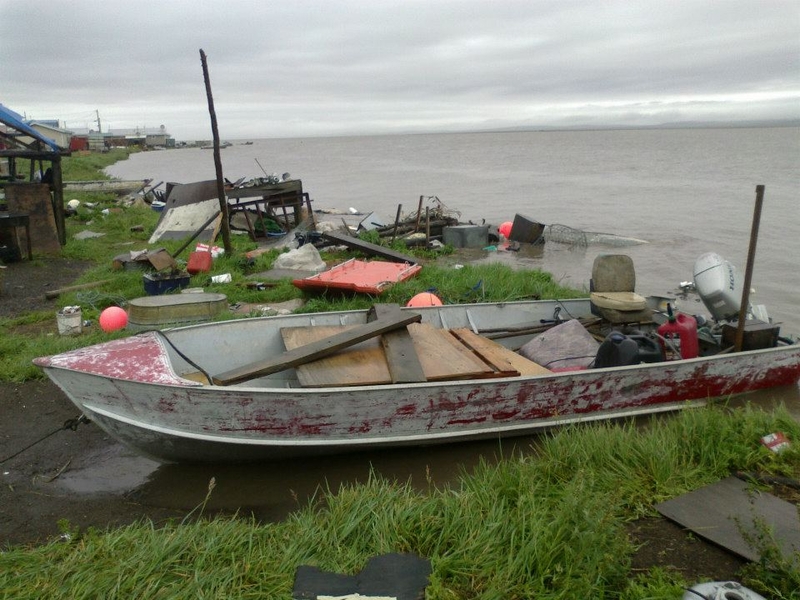
Nearly two decades ago, in 2008, the Native Village of Kivalina sued 24 oil and energy companies, alleging that corporate deception over greenhouse gas emissions contributed to warming and the chronic erosion of their eight-mile-long island. Unlike Boulder, Kivalina brought its case under federal law. In 2012, the Ninth Circuit dismissed the suit, ruling that the Clean Air Act displaced federal common-law claims over greenhouse gas emissions, but it provided no means for the village to sue. The defeat helps explain why climate-damages litigation has increasingly turned to state law—and why Suncor matters.
Today, Kivalina is inching toward relocation along an eight-mile gravel road completed in 2021. At its end stands a new school tucked into the foothills of the Brooks Range where classes began the following year. Without this infrastructure, the village might still be marooned in its escape from the encroaching Chukchi Sea —trapped between a broken federal aid system and the improbable demands of funding its own protection.
In a text exchange, Millie Hawley, Kivalina’s tribal administrator, described what it takes to move a village: “Tremendous time and effort.”
On any given day, Hawley coordinates a patchwork of government officials, private consultants, archeologists, lawyers and the operators of the nearby Red Dog zinc mine.
“Obtaining the funds to move a village is daunting,” she said. “But we expect no less from the agencies. After all, we are United States citizens as well as a tribal community under agreement with the United States Constitution.”
For two years, Hawley and the tribal council fought to secure state funding for the new school and access road. The project was already legally owed to them, but the 2015-2016 Republican-controlled state legislature resisted the cost, bristling at how the tribe had cleverly secured an emergency evacuation route through an unrelated civil rights settlement with the state.
In one of Alaska’s more remarkable climate twists, Kivalina cleared a multi-million dollar infrastructure hurdle through, of all things, a school discrimination lawsuit—hardly a replicable model for relocation. A judge found that the state had systematically shortchanged rural, predominantly Indigenous schools in favor of mostly white, urban ones. The court-ordered remedy was a new school for Kivalina, ultimately forcing lawmakers to earmark $43 million for the project in a community already threatened by the encroaching sea.

Mike Dunleavy, then a Republican state lawmaker on the Senate Finance Committee, made several attempts to delay, reduce or roll back funding for Kivalina’s school, questioning what he called the “whole Kivalina concept.” Years later, as governor in the immediate aftermath of Halong, Dunleavy downplayed the role of climate change, describing the devastation across the delta as a wildly unexpected “act of God.”
Two decades earlier, another Alaska lawmaker had taken a different approach. Mere months into her tenure in 2003, Senator Lisa Murkowski introduced a novel land swap to help the Native Village of Newtok escape the eroding banks of the Ninglick River. Through its Native corporation, the tribe traded 12,000 acres for higher ground nine miles upriver—land that, ancestrally, was already theirs. Though not entirely climate-driven, the bargain helped Newtok bypass a wall of bureaucratic gridlock to begin one of America’s first modern community-wide climate migrations.
But securing land was only the beginning. A generation later, Newtok’s move to Mertarvik was separating families and straining tribal governance. Jackie Schaeffer, who leads climate initiatives at the Alaska Native Tribal Health Consortium, described it as running “two communities and one government” and with no established framework to pull it off. At the 2024 Arctic Encounter conference in Anchorage, Newtok tribal member Carolyn George described the agony of remaining in the village to keep her job at the school while her husband and five daughters lived in Mertarvik. “Being alone, I get anxiety and I miss my girls,” she said. “Especially at night.”
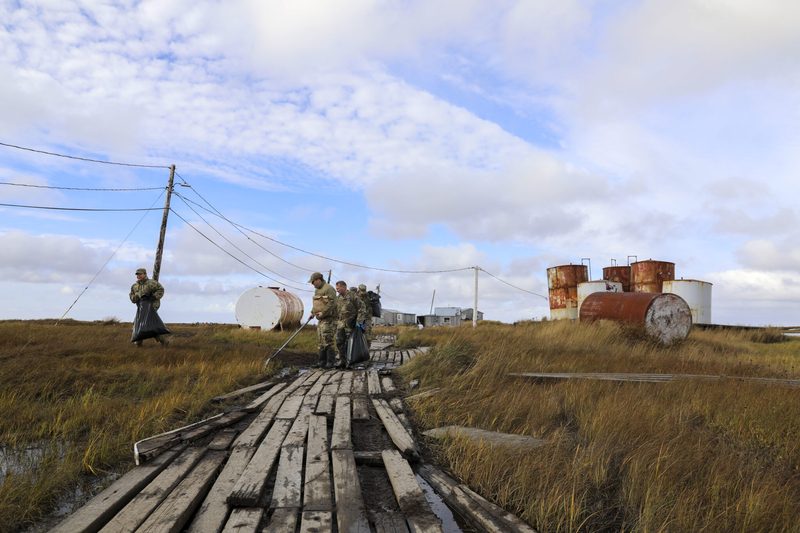
A year after ex-Typhoon Halong, Kipnuk and Kwigillingok are drawing lessons from Newtok and Kivalina as they contemplate their own futures. Neither community has determined what relocation will cost. Kipnuk is exploring land options, while Kwigillingok has deployed drones to identify suitable ground near its storm-ravaged village. According to Dustin Evon, one prospective site sits on federal land requiring an exchange similar to Newtok’s. “We can’t do anything until we have land,” he said, adding the tribe has already contacted Murkowski.
But securing land is only the first hurdle. Neither village has a clear path to financing its migration. Federal disaster-recovery programs largely focus on repairing damaged communities and providing temporary housing, not building new villages. “The programs that we have for disaster recovery really can’t relocate a community with those types of funding,” said Jeremy Zidek, public information officer with the Alaska Division of Homeland Security and Emergency Management.
As climate disasters multiply, communities compete for limited federal relief. For the majority of tribal governments across Indian Country, which lack local tax bases available to cities and states, the costs of resilience present an especially oppressive burden.
In 2006, the U.S. Army Corps of Engineers estimated moving Kivalina, Newtok and Shishmaref, another threatened village, would cost between $80 million and $200 million—roughly $160 million to $330 million in today’s dollars. But the cheapest scenarios assumed “co-location”—a concept of folding whole villages into existing towns rather than rebuilding them as distinct communities. In its 2024 Unmet Needs report, the Alaska Native Tribal Health Consortium rejected this approach as “nonviable,” citing the federal government’s mid-century Urban Relocation Program which uprooted Natives to American cities resulting in loss of land-based language and lifeways.
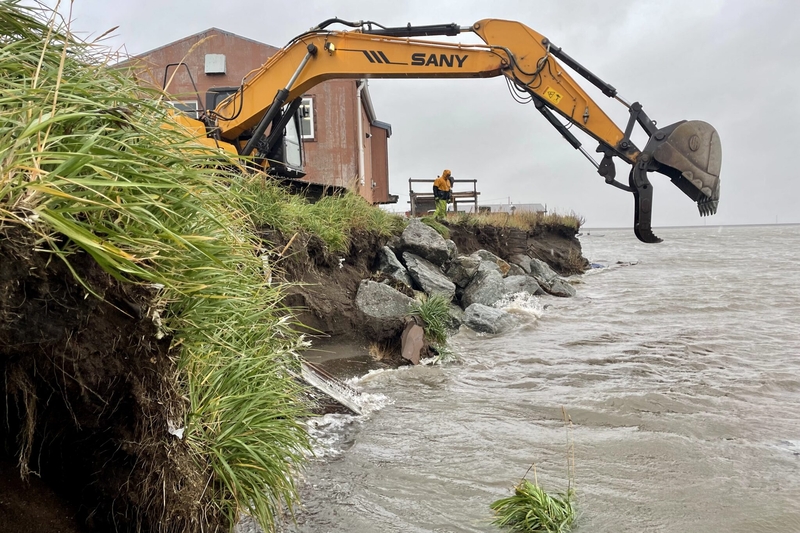
The funding system offers little reassurance. The same report found that of $93 million in federal spending for Fiscal Year 2019, just $17 million reached Alaska’s 144 environmentally threatened communities. A separate Government Accountability Office analysis reinforced the disparity, finding that an annual average of $18.4 million reached these communities between 2016 and 2020. The money is scattered across agencies and programs, often requiring technical expertise and grant-writing capacity that small tribal governments can scarcely afford.
Only two federal agencies—the Bureau of Indian Affairs, BIA, and the Department of Housing and Urban Development—have dedicated programs supporting community-wide migration.
The tribal brief in Suncor puts the shortfall in stark relief: From 2012 through 2024, the BIA’s Tribal Community Resilience program, TCR, awarded $368.5 million nationwide—a sum that wouldn’t even cover Kivalina’s $400 million upper-end projections, alone. In Alaska, the brief estimates that the BIA program has met just two percent of $5.5 billion in identified needs.
And it seems this funding pipeline has since stalled. After years of recurring grant solicitations, the Bureau has issued no new TCR grants beyond the Fiscal Year 2024 cycle, and federal award data show no new grants in 2025, the first year of Trump’s second administration. The Native Village of Akiachak confirms this lull as it still awaits $250,000 in erosion mitigation funding which was awarded under the Biden administration, as first reported by the Alaska Beacon. The BIA did not respond to a request for an explanation.
Despite floodwaters rushing in, funding still flows at a trickle—and lost in this imbalance is precious time.
***
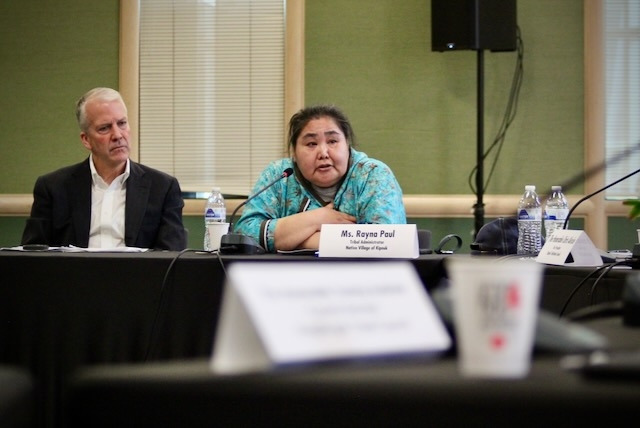
In the second week of September, Rayna Paul, Kipnuk’s tribal administrator and environmental coordinator, returned to inspect the damage. Apart from a few hours in May, it was her first extensive tour of the village since Halong—the night she dodged flying debris in violent floodwaters to reach safety at the local school. On this trip, she spent several days on the ground and struggled to sleep each night.
“It was a fast week with the inspectors, but it was still hard to see,” Paul said, describing the unearthed graves, missing boardwalks and severed power lines. Her home was among twenty or so that remain stranded along the distant riverbends like castaway ships.
FEMA and state officials accompanied Paul, assessing Kipnuk’s public infrastructure to determine its eligibility for recovery funding. Destroyed buildings could qualify for replacement; repairable structures, only rehabilitation. An initial assessment found that 95 percent of the village’s public infrastructure was a total loss.
Across Western Alaska, the storm’s damage was initially estimated at $125 million. But Zidek said FEMA expects long-term recovery costs to exceed $250 million. The losses that cut deepest, however, will likely never appear on a federal balance sheet.
“There’s that piece missing where we’re not even teaching our youth,” Paul said, describing the quieter erosion of traditional knowledge. “Like filling our freezers and teaching them how to cut a seal.” Paul picked up on this grief at the twice-monthly gatherings of storm survivors in Anchorage, where displaced villagers come together to laugh, commiserate and stay connected. But the reunions have turned bittersweet for the ways they reveal the hidden toll of being separated from homelands and one another.
Paul said she dreams of an interim village where aunties and grandpas are only a few doors apart, where snowmachines and Honda ATVs—the all-terrain version of the family Buick—roam freely, and children can once again speak Yup’ik in the classroom. Perhaps in the Mat-Su-Valley, north of Anchorage. Perhaps with modest paths lined with tiny homes paid for, in part, by the tiny payouts from FEMA. A legal advocate for Kipnuk and Kwigillingok, Sheryl Musgrove, suggested that the $44,800 available through federal housing assistance might almost cover the cost of a single tiny home.
But even the possibility of shelter comes with profound sacrifice. To leave Indigenous lands is akin to abandoning a relative.
“We are losing our close ties and relationship to the lands,” Paul testified at a May field hearing in Anchorage, convened by Sen. Murkowski as chair of the Senate Committee on Indian Affairs. “Our heritage, our culture, our very way of life is under threat.”
Her warning carried well beyond that gathering. Though Kipnuk did not join the tribal brief in Suncor, its authors quoted Paul’s testimony directly, invoking her words to illustrate what was at stake for Alaska Native communities. Days later, Murkowski took to the U.S. Senate floor to recount the hearing and warn that public compassion could fade as the disaster slipped from the headlines.
She recalled the terror of families whose homes had been swept from their foundations, spinning through white-capped waters with people still inside. “We should all be listening,” Murkowski told her colleagues.
Alaska’s senior senator went on to criticize the Stafford Act and its federal disaster-recovery mandate that, she argued, pushes displaced communities back toward danger. “We’ll help you, but you have to return to the site of the tragedy,” she said, paraphrasing the government’s response. “Rebuild where you are.”
Pointing to Newtok’s decades-long migration, she renewed calls for a lead federal agency to coordinate such moves. She also acknowledged the federal government’s historical role in forcing Native peoples into settlements that have since become increasingly vulnerable. This historic weight came through in her memoir as a debt still unresolved. “By every measure, the federal government owes it to the people to help them move to a new, safer place,” she wrote.
Yet, Murkowski’s position reflects a larger political contradiction. A longtime advocate for Alaska’s oil industry, she has called for greater responsibility in helping communities escape climate danger—but without embracing the tribal effort in Suncor to hold fossil fuel producers financially accountable. Her appeal for reform comes as federal disaster policy continues to leave communities like Kipnuk and Kwigillingok navigating an uncertain future with no clear means of financing migration. Murkowski was unavailable for comment.
For Paul, the urgency extends far beyond Kipnuk. Her community has endured three federally declared disasters in a short span. And she knows: more storms are coming.
“We’re paving a way to navigate through all of this,” she said. “These storms are not going to be the only ones, and we need to come together and sit down at the table and make the right decision for all Alaskans.”
Juneau