NJ jail guards push to expand isolated confinement. Critics call for ‘humane’ alternatives.
Oct 16, 2026 | 7:10 am ET
Description
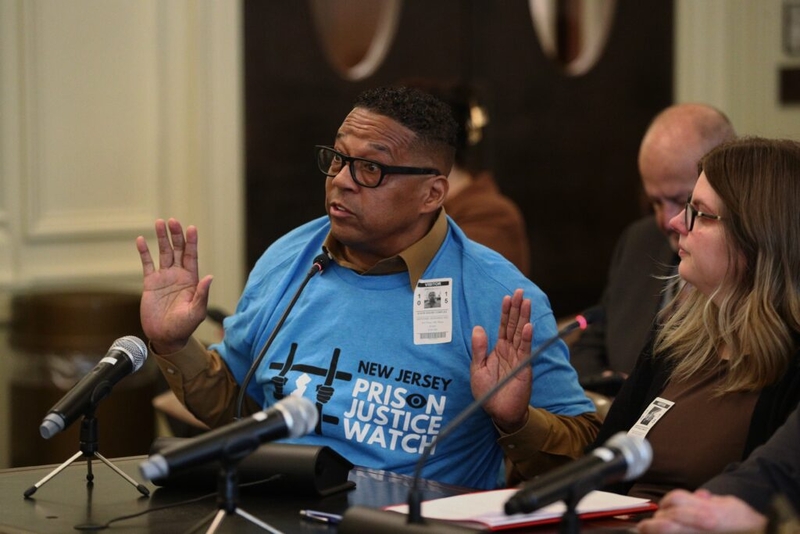
Antonne Henshaw, who served 30 years in New Jersey prisons, urged legislators to not pass a bill that would expand isolated confinement for people who assault correctional officers. Beside him is Brittany Bower, a Pemberton teacher who also opposes the plan. (Photo by Dana DiFilippo/New Jersey Monitor)
New Jersey lawmakers and prison officials have tried multiple strategies to stop inmates from assaulting officers behind bars, from installing “splashguards” in cells’ food ports to prevent troublemakers from hurling bodily fluids at staff to heightening penalties against attackers and requiring them to be tested for contagious diseases.
But a state legislator who wants to further punish abusive inmates by expanding isolated confinement encountered impassioned pushback Thursday — about two hours’ worth from prison justice advocates, civil rights defenders, and former inmates who testified against the proposal at a public hearing at the Statehouse in Trenton.
The common theme from critics: isolated confinement is torture and those held there, especially for prolonged periods, suffer mental damage that shapes the person they are when they eventually leave prison.
“Your humanity gets stripped away from you. You start losing sense of who you are,” said Antonne Henshaw, who spent 30 years in prison before being released in 2018. “We bring this home with us, and this not only makes the officers unsafe; it makes the community unsafe. Isolated confinement as currently running in New Jersey Department of Corrections is one of the biggest public health threats to people being released.”
Bill sponsor Sen. Linda Greenstein (D-Middlesex), who chaired the Senate law and public safety committee where the bill was heard Thursday, said she would use the testimony to further shape the bill before putting it up for a vote. She said she did not know when that would be.
Union leaders implored lawmakers to act soon.
William Sullivan heads the New Jersey Policemen’s Benevolent Association Local 105, which represents nearly 4,500 correctional and parole officers.
He told the committee assaults on officers have risen over 300% since 2018, with bodily-fluid assaults spiking more than 700% in that time. Nearly half of all attacks involved bodily fluids and more than 10% of the prison workforce was out on leave in 2024 because of assaults, Sullivan said. He attributed the bulk of assaults to a small group of repetitively violent inmates and brought with him more than two dozen photos of officers bruised and bloodied or soiled from inmate assaults.
Jason Cook, the union’s vice president and a correctional officer at New Jersey State Prison in Trenton, shared his experience as someone hit by bodily fluids.
“Your natural reaction is to immediately get it off you. You want to wash yourself. You want to take your contaminated uniform off. You want to get into clean clothes. But you are a correctional police officer. You cannot simply walk away,” Cook said. “You still have a unit to secure, you still have inmates to supervise, you still have responsibilities to your fellow officers.”
Sullivan blamed the Isolated Confinement Restriction Act, the 2019 state law Greenstein’s bill would amend, for contributing to the rise in attacks.
“We now encounter inmates who deliberately assault officers because they believe doing so will get them removed from the general population. Think about that: an inmate afraid of another inmate assaults a corrections officer to escape the situation,” Sullivan said.
On the flip side, he added, some incarcerated people fake a vulnerability to dodge discipline for assaulting officers.

The Isolated Confinement Restriction Act prohibits isolated confinement altogether for vulnerable people, defined as those who are young or elderly, pregnant or postpartum, LGBTQ, mentally ill, developmentally disabled, significantly visually or hearing impaired, or diagnosed with serious medical conditions. It also restricts it for everyone else to no more than 20 hours a day, 20 consecutive days, or 30 days during a 60-day period.
Greenstein’s bill would amend the law to allow prison officials to isolate more people for longer periods of time by:
- Expanding how many hours anyone can be held in isolation in state prisons from 20 to 22 hours a day.
- Creating a new definition of “repetitively violent inmate” as someone who’s already served two or more stints in solitary or close custody or who’s believed to pose “substantial risk of serious harm” to themselves or others.
- Removing restrictions on how many days repetitively violent inmates can remain in isolated confinement.
- Requiring people who say they’re LGBTQ to be proven so by a medical or mental health examination, or a judicial determination that they’re in imminent danger of being abused or harassed because of their sexual orientation.
- Allowing officials to isolate vulnerable people if staff believes they will seriously harm an officer, other staffers, or themselves, or if the inmates want to be placed there and provide informed, voluntary, written consent.
The bill’s critics complained that Department of Corrections officials never fully implemented the law, due to pandemic-related challenges, ongoing staffing shortages, and cramped facility conditions. A state prisons watchdog revealed in 2023 that officials routinely flout its requirements.
Thursday, the legislation’s supporters and opponents disagreed so much that Greenstein began asking each if they had any “creative” ideas to solve the problem.
They did.
The Rev. J. Amos Caley, a pastor at Reformed Church of Highland Park and an organizer with New Jersey Prison Justice Watch, suggested expanding mental health treatment and restorative justice interventions between staff and people in their custody, saying such approaches have worked in other states.
“Officer safety and humane treatment are not competing priorities. They are mutually reinforcing responsibilities. If we want safer prisons, we need to make the prisons more functional, not increase the practices that further erode that safety, which isolation is documented to do,” Caley said.
Ron Pierce, a former prisoner who now works in the state corrections ombudsperson’s office, suggested lawmakers do nothing, for now.
Besides the splashguards, officials have implemented a mail-scanning system to prevent drugs — a common instigator of assaults — from entering prisons, and legislators should wait to see if those reduce assaults, which would render Greenstein’s bill unnecessary, Pierce said.
Jim Sullivan of the American Civil Liberties Union of New Jersey urged legislators to require fuller public reporting on out-of-cell time, create independent oversight of county jails (which now have none), invest more in staffing and de-escalation training, and hold regular oversight hearings to ensure Isolated Confinement Restriction Act compliance.
Sean Washington was exonerated in 2020 after spending 25 years in prison for a Camden double murder he didn’t commit. He urged legislators to visit the prisons — especially New Jersey State Prison in Trenton, with wings dating back to the early 1800s — before considering anything that could worsen confinement for those in state custody.
“Go look at them cells. That’s not good for human beings,” Washington said. “If they had animals in there, PETA would be protesting and filing lawsuits against New Jersey for the way those cells look.”

Trenton, NJ