Third party-candidate, massive campaign donations fuel Southern Oregon Senate race toss-up
Oct 16, 2026 | 9:00 am ET
Description
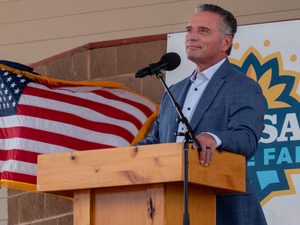
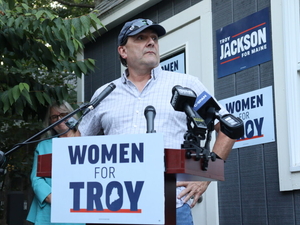
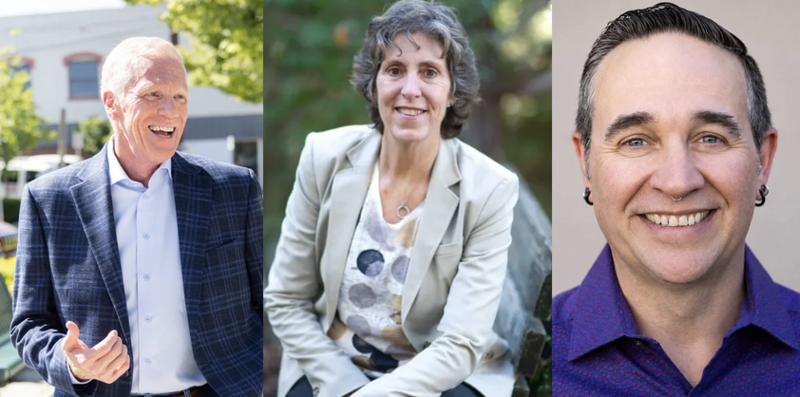
Republican Brad Hicks (left), Democrat Denise Krause (center) and Independent and Green Party candidate Clay Bearnson are all running to represent Oregon's 3rd Senate District in the 2026 midterm election. (Photos courtesy of the candidates)
More than $1 million in just the last month has poured into two candidates’ campaigns for a southern Oregon state Senate seat being vacated by a Democrat who narrowly won it in 2022.
Major corporate donors have bet on Republican business consultant and former Medford Chamber of Commerce president Brad Hicks to win Oregon’s 3rd Senate District, while the majority in Oregon’s Legislature and the state’s major labor unions have put their money on Democrat and healthcare worker Denise Krause. The area encompasses southern Jackson County and part of the Rogue Valley, including the cities of Medford and Ashland.
Retiring incumbent Jeff Golden, D-Ashland, has represented it since 2019, and it has become more competitive since redistricting in 2021. Golden won in 2022 by fewer than 3,000 votes, and has so far not endorsed a candidate currently running, though he endorsed one of Krause’s challengers in the May Democratic Primary.
Upping the stakes, a third-party candidate, bar-owner and former Medford City Councilor Clay Bearnson, backed by the Independent and Pacific Green parties, entered the race in late July. Although he’s drawn far fewer campaign dollars than his major-party peers, his name on the ballot could ultimately draw enough votes from either Hicks or Krause to determine their fates.
All three of the candidates, like nearly every person running for election in Oregon’s Nov. 3 midterms, said tackling voters’ affordability concerns would be their priority if elected.
For Krause, jumping into the race had a lot to do with concerns about the impact of federal policies passed by the Republican majority in Washington, D.C., particularly cuts to health insurance for low-income Oregonians.
“We have such crises going on everywhere, and I’m very well equipped to deal with the challenges in healthcare and education,” she said. “People are losing their insurance, or their premiums are too high, and our services have been cut here,” she said.
Asante, the region’s largest healthcare provider, has said it’s facing a $50 million budget deficit that could lead to 300 job cuts within the year.
For Hicks, it was about seeing people and businesses he grew up with leave the area or the state due to rising costs, he said, and to take on a supermajority in the Oregon Legislature that he believes few voters want.
“What we’ve been hearing on the doorstep from Democrats, Independents, NAVs (nonaffiliated voters) and Republicans is they are tired of one-party rule and supermajorities,” he said. “And they feel that way about both parties, right? I mean if the Republicans had decades-long supermajorities, they’d be just as frustrated by that.”
For Bearnson, running as a third-party candidate with less than one-half of 1% of the campaign money his competitors have, frustration with the current system compelled him to join and stay in the race. He said many voters he talks with are tired of the two-party system and tired of big money in politics.
“My race right now absolutely 100% demonstrates the problems in our politics, the two cancers in our government: money in politics and this mythical two-party system,” he said.
Denise Krause
Former healthcare consultant, two-year member of the Rogue Valley Transit District and retired professor Denise Krause won a crowded Democratic primary in May, beating lawyer Tonia Moro — endorsed by Golden — by just more than 200 votes.
Among her priorities if elected would be to find ways to boost healthcare access in the region and to keep Southern Oregon University open and solvent. She has a plan that could do both, she said.
“We have a very successful nursing program in partnership with OHSU (Oregon Health and Science University), and so if we added a physician training program, that would be complementary, and would also help anchor SOU (Southern Oregon University) and save jobs, bring in students, and help our whole community,” she said.
She has proposed resurrecting the now closed Ashland Community Hospital to serve as a teaching hospital for third- and fourth-year medical student rotations and set up residency programs throughout the Asante, Providence and La Clinica healthcare networks.
“It could bring jobs and start a pipeline for healthcare professionals into our community, which we need so desperately,” she said.
Krause most recently ran for Jackson County commissioner in November 2024 but lost to Republican Randy Sparacino. For her Senate race, she received more than $1 million in campaign contributions, including more than $372,000 from the Senate Democratic Leadership political action group, more than $141,000 from the Oregon Democratic Party and nearly $130,000 from SEIU 503, the state’s largest public service workers union.
Clay Bearnson
Despite old adages about not talking religion or politics in a bar, Bearnson, a former Medford city councilor and bar owner, said it happens often. Conversations with many patrons of the Gypsy Blues Bar inspired him in part to run, he said, after hearing dissatisfaction with government in Washington, D.C., and in Salem from people across the political spectrum.
He said his priorities if elected would be expanding access to healthcare for Oregonians losing Medicaid under new federal reporting and work policies, stopping the expansion of data centers in the state, outlawing Flock surveillance cameras and pushing for campaign finance reform and ranked-choice voting.
Bearnson said he lives paycheck to paycheck and has no health insurance because it’s too expensive to buy on the open market and he doesn’t qualify for Medicaid due to the low income threshold.
He said as a small business owner he is uniquely positioned to understand the difficulties of policies passed in the state Legislature that don’t hit businesses of different sizes the same.
“My business is subject to the economic turns and ups and downs. When prices go up, we have to raise our prices. When minimum wage goes up, we have to raise our prices,” he said.
He’d like to address business policy in Salem that, he believes, should focus on taxing large corporations as opposed to smaller enterprises.
“Small businesses get punished for showing profits, and yet your largest tax-evading companies get incentivized, and get corporate welfare checks, and that’s just fundamentally wrong,” he said.
Bearnson has raised just over $4,000 so far, most of it made up of loans he’s issued to himself and through his business, as well as individual contributions.
Brad Hicks
Hicks spent more than 20 years as the president of the Medford Chamber of Commerce and retired in 2021 with little interest in running for political office, he said.
But in recent years, following the departure of some area businesses to other states, including Medford-born Dutch Bros., and wildfire policies passed by the state Legislature that he said drove up property insurance premiums and raised risks in the area, he agreed to run.
Hicks said he is most interested in tax policy — particularly revisiting the corporate activity tax on businesses with $1 million in Oregon commercial activity to help fund schools — and in taking a close look at state education and transportation spending, which he feels has cost Oregonians too much for too little in return.
“Student outcomes and reliable transportation are both shining examples of things we all desperately want and need to be successful as a state, and Salem is really undeserving us in both of those areas,” he said.
When it comes to the corporate activity tax, he said it is punishing businesses by taxing their activity rather than their profits.
He said his parents ran a high-volume grocery store in the 1980s that had very slim profit margins, and the tax would have been insurmountable for them.
“Taxing a high volume, low margin business — and there’s a lot of them out there — leaves a business owing that tax even when it’s barely profitable. So I think we need to raise the index on the small business threshold,” he said.
Like Krause, Hicks said keeping Southern Oregon University in the area and solvent is also a priority he’s already been talking with lawmakers about. Wildfire policy is also a priority, and he’d propose making it easier for prescribed burns and logging to take place in high wildfire risk areas, he said.
Krause has received more than $1 million from the Bring Balance to Salem PAC, whose largest contributors include Nike cofounder Phil Knight and Sierra Pacific Industries, among the largest timber companies in the country. He’s also received $50,000 from Senate Minority Leader Bruce Starr’s political action committee, $42,000 collectively from Ashland’s Karen and Sid DeBoer, former CEO of Medford-based Lithia Motors, and $31,000 from Don H. Jones Jr., former senior vice president at Lithia Motors. Other major backers have been the commercial construction industry and the Medford Chamber of Commerce.
Salem, OR