Missouri’s ‘constitutional sheriff’ push reaches voters with Amendment 8
Oct 16, 2026 | 6:55 am ET
Description
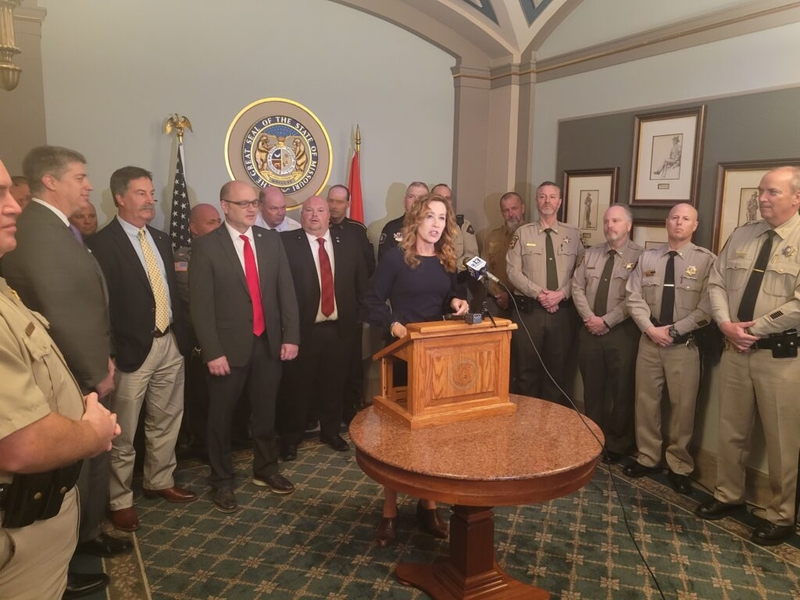
State Sen. Jill Carter speaks to the media surrounded by local sheriffs from around the state and a handful of GOP senators on April 5, 2023, regarding SJR 42. The goals of the legislation “would be to provide local sheriffs with the legal backing to defy COVID-era lockdowns, protect concealed carry information and oversee federal investigations,” the accompanying news release stated (Jason Hancock/Missouri Independent).
When MyPillow founder Mike Lindell visited the Missouri Capitol in January 2023, the conversation was focused on election security.
Lindell, a Donald Trump ally who has repeatedly promoted false claims that the 2020 presidential election was stolen, offered a suggestion to lawmakers and activists: Contact your “constitutional sheriff.”
Craig and Linda Rantz, who were there that day, pointed out a problem. Missouri’s Constitution doesn’t establish the office of sheriff. State law does.
Nearly four years later, Missouri voters will decide whether to change that — and whether to make the state attorney general the only official who can initiate proceedings to remove a county sheriff.
Amendment 8 would make the elected office of county sheriff a constitutional requirement and place certain duties already spelled out in state law into the Missouri Constitution. That would prevent lawmakers from eliminating the office or changing those constitutional duties without voter approval.
But the proposal would also change how sheriffs can be removed from office. Under current law, a county prosecutor or the state attorney general can initiate a legal action known as quo warranto seeking a sheriff’s removal. Amendment 8 would reserve that authority to the attorney general, with a court ultimately deciding whether a sheriff should be removed. The amendment would not apply to St. Louis city, St. Louis County or St. Charles County.
The final proposal is narrower than earlier versions, which sought to give sheriffs authority to oversee federal and state investigations. But the debate surrounding it has continued to reflect a broader political movement that sees county sheriffs as a check on government overreach.
Craig and Linda Rantz recalled meeting with Lindell and then-Secretary of State Jay Ashcroft on Jan. 5, 2023, to discuss a method they had developed for hand-counting election results. The Rantzes and Lindell then walked to the Capitol, they said, and met with lawmakers, including Republican state Sen. Jill Carter of Granby.
A few weeks after the meeting, Carter introduced legislation for the first time to amend the Missouri Constitution and enshrine a provision already in state law: that each county elect a sheriff to serve as its chief law enforcement officer.
But her initial proposal also included a provision not found in state law that would have required sheriffs to “oversee all federal and state investigations in his or her county.”
Carter argued during an April 2023 Senate hearing that sheriffs should serve as “a hedge of protection” against violations of civil liberties and what she considered unconstitutional actions by the federal government. Her news release that April further stated the goal of the legislation “would be to provide local sheriffs with the legal backing to defy COVID-era lockdowns, protect concealed carry information and oversee federal investigations.”
That broader vision of sheriffs’ authority didn’t survive the legislative process. Lawmakers eventually stripped out the provision giving sheriffs oversight of federal and state investigations.
“We’re not giving them any more power, any more authority than they currently statutorily have,” Carter said of Amendment 8.
The question appearing on the ballot as Amendment 8 asks voters whether they want to “support law enforcement by preserving the right of citizens to elect a county sheriff, prohibiting the removal of a county sheriff except by a writ of quo warranto, and recognizing the office of sheriff as part of the administration of justice.”
Constitutional sheriffs
For Osage County Sheriff Michael Bonham, the fight to take Missouri from statutory to constitutional sheriffs started before the meeting with Lindell. He said more than 30 states already enshrine the sheriff’s authority in their constitutions and argued that Missouri should do the same.
But, he said, he struggled to get a legislator to “pick up” the issue.
“It is a pure motive to be able to protect the legitimate office of the sheriff in the state of Missouri,” he said, “that legislators can’t come in and [say] ‘We’re mad at the sheriffs’ and that’s it. We’re going to make a state police.”
From Bonham’s perspective, a 2023 showdown between Illinois sheriffs and the governor also helped propel the legislation into the spotlight.
On Jan. 10, 2023, Gov. JB Pritzker signed the Protect Illinois Communities Act, which banned the sale of new assault weapons, high-capacity magazines and devices known as switches. The law also required existing owners to register their weapons or face criminal penalties.
The legislation followed a mass shooting at an Independence Day parade in Highland Park, Illinois, in July 2022.
Dozens of Illinois sheriffs announced they would not enforce the new restrictions or check compliance. Bonham supported their stance.
“I live in a rural area that is very pro-Second Amendment,” he said, “and to go to their house and say, ‘Look, you need to give up all your guns.’ That’s not going to happen.”
The Illinois law allowed people who already owned covered weapons to keep them, if they complied with registration requirements. But if they didn’t comply, a court could order them to surrender their covered firearms.
The Illinois sheriffs gained strong support from the Constitutional Sheriffs and Peace Officers Association, a national organization that promotes the belief that sheriffs have the authority to refuse to enforce laws they consider unconstitutional.
The group was founded by Richard Mack, a former Arizona sheriff and Oath Keepers board member who has been a prominent figure in the national constitutional sheriff movement.
Bonham said his support for Missouri’s measure was not inspired by Mack’s work or the association.
This spring, the term “constitutional sheriffs” was used repeatedly during hearings and debates in both Missouri legislative chambers, but what that term truly represented wasn’t discussed until Republican State Rep. Bryant Wolfin of St. Genevieve raised the issue right before the House passed the measure in May.
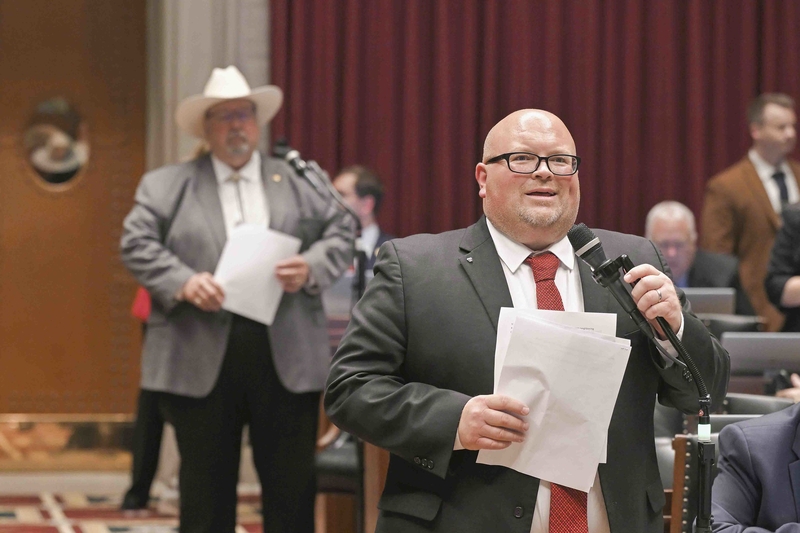
Wolfin asked Republican state Rep. Bennie Cook of Houston, who handled Carter’s bill in the House, why lawmakers call this the “constitutional sheriff” bill.
“That’s what basically we’ve been calling it for the past three to four years,” Cook replied, “is a constitutional sheriff bill to ensure it’s in the Constitution.
Wolfin said he understood the term to mean how sheriffs are not only defending the constitution but also “defending our rights from the federal government or from state overreach.”
Cook said that Wolfin was “hitting the nail on the head.”
“The sheriff is there to protect us from other entities,” Cook said. “They’re the chief law enforcement of the state or of the county, so they’re there to protect us from any type of overreach and kind of what you’re talking about there. That’s already in statute. This just moves it into the constitution to ensure that our sheriffs can never, never be taken away from us.”
Wolfin ultimately voted against the amendment, saying that it didn’t go far enough to empower constitutional sheriffs.
In an interview with The Independent last month, Wolfin said the bill does not align with what the grassroots conservatives movement has been pushing and why many wanted this legislation in the first place.
“Quite frankly, I think most of the people in our (legislature) were a little confused by what we were trying to do and why we were doing it,” he said.
He also objected to the provision that would take away local prosecutors’ authority to seek a sheriff’s removal.
Carter told The Independent the attorney general has been the one to initiate a quo warranto process in the most recent cases when a sheriff has been removed in St. Louis and Ray County. Amendment 8 essentially solidifies the process that is currently in place. Bonham said county prosecutors can and have asked the attorney general to initiate the proceedings.
“Right now, as far as removal, it defers to the AG’s office because prosecutors have a strong relationship, usually with their sheriffs in prosecuting criminals,” Carter said.
During the House debate in May, other lawmakers raised concerns about the duties that Amendment 8 would elevate from state law into the Constitution.
Among them is a requirement that sheriffs “apprehend and commit to jail all felons and traitors,” language already found in Missouri statute. Putting it into the Constitution would mean lawmakers could no longer change that requirement without voter approval.
Several Democrats questioned the wording, particularly the reference to “traitors.”
Democratic state Rep. Aaron Crossley of Independence noted that the word “traitor” isn’t defined in state statute.
“Is a traitor a protester?” he said. “Is it a political dissenter? Is it someone who disagrees with whoever is in power? I’m already uncomfortable with it being a statute, but putting it in our constitution where it can never be changed – or it can be but with a lot of hassle – I think that we’re really treading down a dangerous, dangerous road.”
Jefferson City, MO