Appeals court permits Kansas law barring prefilled mail-in ballot applications
Oct 16, 2026 | 9:10 am ET
Description
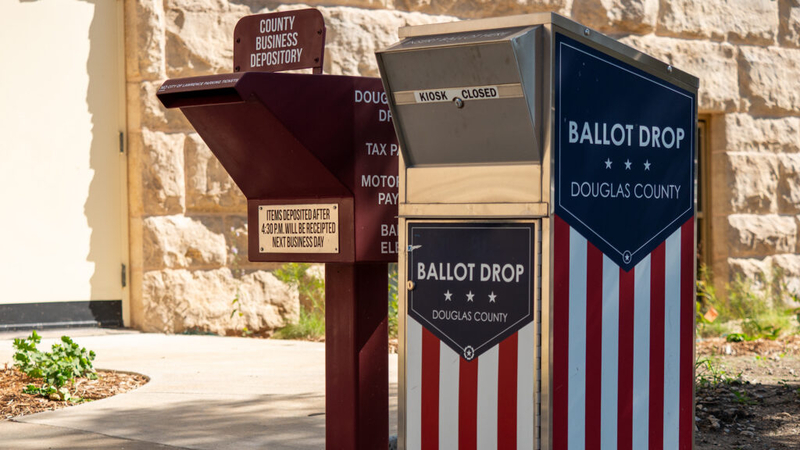
A ballot drop box appears Oct. 12, 2026, in downtown Lawrence, Kansas. (Photo by Sherman Smith/Kansas Reflector)
TOPEKA — A federal appeals court for the second time reversed a prohibition on a Kansas law that bars organizations from prepopulating applications for mail-in ballots before the applications are sent to voters.
A three-judge panel for the 10th Circuit Court of Appeals found that a lower court didn’t strike down the law based on its justifications, text or legislative history.
“It instead inferred an improper purpose from the national political debate on mail-in voting,” the Wednesday decision said.
The Kansas Legislature passed in 2021 the prohibition on prefilling mail-in ballot applications, which also bars out-of-state organizations and individuals from distributing applications. Two voting rights organizations — VoteAmerica and the Voter Participation Center — challenged the law, suing Secretary of State Scott Schwab, Attorney General Kris Kobach and Stephen Howe, district attorney of Johnson County, arguing the state law infringed upon their free speech rights.
Voter Participation Center and its sister organization, nonprofits with the goal of boosting voter registration, sent partially prefilled mail-in ballot applications to about 510,000 Kansans in 2020, according to the decision. County officials expressed frustration that the prefilled ballot information didn’t match the state’s voter registration database.
The appeals panel rejected the Voter Participation Center’s argument that the law was created with the intent to suppress advocacy for mail-in voting.
“While we may reasonably infer that the enjoined distributor ban was enacted to restrict mail-in voting, we cannot infer that the ban was enacted to suppress speech supporting mail-in voting,” the 33-page decision said. “The ban prohibited the mailing of mail ballot applications, not messages supporting mail-in voting.”
The Voter Participation Center said it was “disappointed” in the decision, calling the underlying law “dangerous.”
“The provisions upheld by the court will make voting more difficult for Kansans by threatening their ability to vote-by-mail,” said Tom Lopach, president and CEO of the center.
“In the 2020 election, we saw firsthand the urgency of vote-by-mail in the midst of the pandemic. That’s why we fought back — to protect Kansans and their right to vote. We will keep working to ensure every American can make their voice heard.”
Honest Elections Project, a nonpartisan group with a history of advocating for restrictive voting laws, filed an amicus brief in the case in support of Schwab. Its executive director, Jason Snead, said the appeals court “got it right.”
“Judges cannot simply assume that legislatures acted in bad faith in order to kill reasonable, common sense election integrity laws,” Snead said. “Kansas acted after error-filled, prefilled mail-ballot applications flooded voters and overwhelmed county election officials in 2020. Protecting voters from confusion and keeping elections orderly is commonsense, not suspect.”
The court’s decision came after voter registration ended Tuesday and early voting began Wednesday for the Nov. 3 midterm elections.

Topeka, KS