‘Antithesis to that chaos’: 15-petition effort will soon launch, seeking Nebraska’s 2028 ballot
Oct 16, 2026 | 6:45 am ET
Description
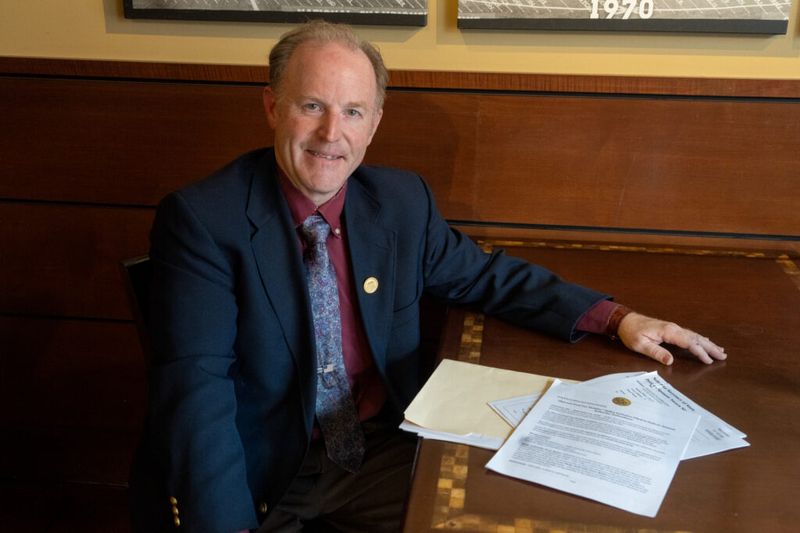
Eric Underwood of Lincoln, leader of the groups Advocates for All Nebraskans and Make Nebraska Even Better, sits in a downtown bar and grill on Sept. 29, 2026. In front of him are a variety of documents for petitions he aims to file and run for the 2028 general election. (Photo by Zach Wendling/Nebraska Examiner)
LINCOLN — Before announcing a statewide 2028 petition last month to suspend Nebraska’s fuel tax for two months each year, Eric Underwood had spent a week to 10 days finalizing the idea.
That same day, on Sept. 24, Nebraska Gov. Jim Pillen allowed Nebraska agricultural producers to request refunds on state taxes for diesel fuel until Dec. 23, unless extended. The refunds in the executive order include one on a new 0.25-cent-per-gallon tax on dyed diesel signed into law this year. President Donald Trump issued a similar order for federal diesel taxes when he visited Grand Island on Oct. 5.
Underwood’s idea, by contrast, would extend relief to all drivers in Nebraska between Sept. 1 and Oct. 31. The proposal would also cap the maximum state fuel tax at 35 cents per gallon in perpetuity.
The state tax is currently 31.8 cents, but Underwood expects an effort to increase it.
“State statutes can be a lot like Shakespeare when you’re diving into them,” Underwood told the Nebraska Examiner. “Amending them can be even worse, trying to edit Shakespeare or try to be the CliffsNotes of Shakespeare.”
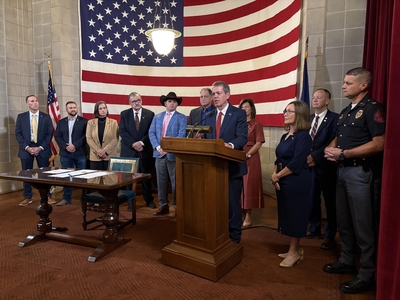
But the “Harvest Fuel Tax Holiday,” aimed at a period of more local travel for harvesting and school activities, is just the opening salvo to a multi-act “statutory audit” aimed for 2028.
Just days after announcing his first petition, Underwood sat down with the Examiner at the steakhouse he manages in downtown Lincoln to explain a network of 15 petitions. The petitions are united under the label “Make Nebraska Even Better.”
Among the topics Underwood is pursuing — a collection he says goes from relief to reform — are property taxes, local unfunded mandates, education and election administration.
“You can’t have the conversation if it’s not on paper, and if it’s not going to be willed into paper form at the Legislature, now it is,” Underwood said.
The statutory ‘audit’
This isn’t the first time Underwood, a former chair of the Nebraska Republican Party, has led a multipronged petition effort.
Last year, Underwood and a small team announced “Advocates for All Nebraskans” with three property tax petitions, which are the same this time around: cap annual property valuation growth at 3%, halve taxable valuations by 50% and create a $50,000 minimum base salary for all public school teachers by repurposing state funds already going to K-12 schools.
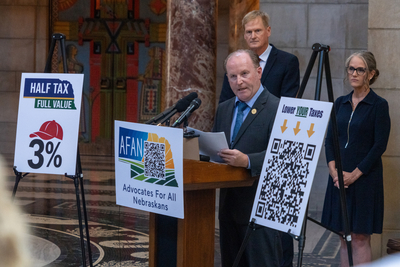
The 2026 petition effort also sought to return Nebraska to a “winner-take-all” system for awarding Electoral College votes at the 2026 election, which is returning for the 2028 cycle. If passed, the earliest it could affect a presidential election is 2032, unless the Legislature steps in sooner. The 2026 effort would have also required hand-counting of paper ballots, which isn’t returning in the 2028 crop at this time.
Supporters ultimately did not submit signatures for any of its 2026 statewide petitions.
For 2028, Underwood said, he met with local taxing authorities and is now proposing to:
- Lower maximum property tax levy limits for the largest taxing authorities while increasing authority for smaller subdivisions, such as natural resource districts, rural fire departments, and airport authorities.
- Cement voter approval before any political subdivision could exceed certain property tax limits in law.
- Legally block state lawmakers from shifting state costs to local property taxpayers. A similar legislative effort to let the voters decide the fate of future unfunded mandates has repeatedly failed to move forward. It fell short 23-20 in January.
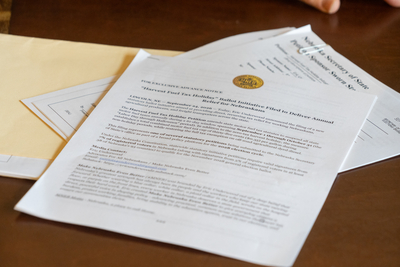
“For any elected official, I don’t care who you are, to say that it is not within state statutes to solve these problems is either being obtuse, ignorant or purposely deflecting of the effort needed to solve these problems, to fix them,” Underwood said.
The 2028 petition effort is Underwood’s own statutory audit, a multistep approach because of the Nebraska Constitution’s “single subject” requirement.
“It can’t just throw everything into one petition and say, ‘let’s audit everything,’” Underwood said.
How many signatures needed?
Most of the 2028 efforts seek to amend or create new laws. The petitions would need valid signatures from at least 7% of registered voters at the time petitions are due in July 2028. Some are constitutional amendments, which would require signatures from at least 10% of voters.
In both cases, the signatures must include a geographic distribution of at least 5% of voters in at least 38 of Nebraska’s 93 counties. The 2028 due date would be the first week of July.
You can’t have the conversation if it’s not on paper, and if it’s not going to be willed into paper form at the Legislature, now it is.
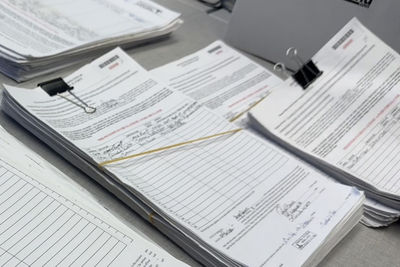
A new Nebraska-based signature-gathering firm with only Nebraska circulators will assist the effort, Underwood said, and his team will use a prioritized list of voters — Republicans, Democrats, nonpartisans and otherwise — to pursue the ballot. The list includes more than 200,000 voters across 150 cities statewide. Underwood said the two-year window gives room to prioritize petitions and go door to door.
As Underwood eyes 2028, he expects more advocates nationwide to also lean into petitions.
“Whether it’s good, bad or ugly, the part that I believe the most in is that if it gets on the ballot, at least the people have a choice,” Underwood said.
The exact wording of Underwood’s petitions is subject to change as they work through the Nebraska Revisor of Statutes. The launch of petitions and the release of the exact wording of each effort are expected after the Nov. 3 election.
The people and the lawmakers
Though a public vote is more than two years away, Underwood said an initial goal is conversation.
Ideally, all of the changes could come at the 49-person statehouse, which isn’t necessarily a bad process, Underwood said. But he said the legislative process adds other variables.
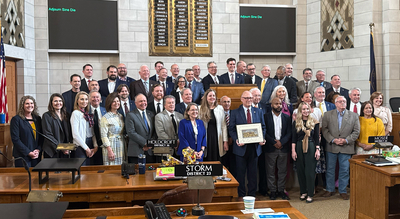
“If I truly believe in these, why wouldn’t I go through a path that is constitutionally aligned, that’s a right to the people, and it would allow me to present to the ultimate voice of the outcome of Nebraska’s future: the people?” Underwood said.
State lawmakers would also be free to take up any of the ideas Underwood is pursuing, as state Sens. Loren Lippincott of Central City, Dan Lonowski of Hastings and Barry DeKay of Niobrara did in the 2026 legislative session with previous Underwood-offered petitions. Doing so also helped get fiscal estimates for Underwood’s efforts.
“From that moment forth, I realized that there is just as much an opportunity that these can become state statutes that they (senators) amend,” Underwood said. “And I don’t care who gets the credit. The people in Nebraska need this, and let’s make that our focus.”
‘Antithesis to that chaos’
Underwood doesn’t expect much progress in the 2027 or 2028 legislative sessions, in part because of likely changing margins between Republicans — who have a 33-vote supermajority now — and Democrats. He said Republicans might lose one to three seats. Democrats and Democratic-endorsed registered nonpartisans are aiming to pick up even more.
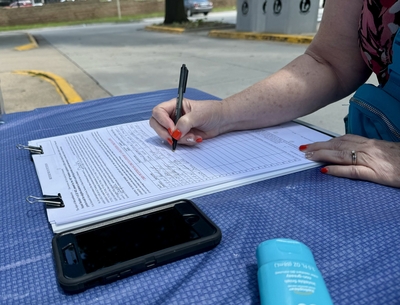
It takes 33 votes to overcome a filibuster. Overriding a governor’s veto requires 30 votes.
“I’m not predicting outcomes, I have no say on it,” Underwood said. “These are variables we have never seen before and so, if anything, maybe petitions become the antithesis to that chaos. Maybe petitions cut through all the noise, all the winter of discontent, as I called it, and get to a level of, ‘Is this what people want?’”
Nebraska’s one-house Legislature is, by design, officially nonpartisan, so a legislative candidate’s party doesn’t appear on the ballots and lawmakers don’t officially organize by party.
Underwood said if it’s supposed to be a nonpartisan group, and if a petition starts to gain support, that could lead to action at the statehouse.
Working toward solutions
Since 2008, Republicans have won every single statewide election in Nebraska, and for years, Republicans had been gaining on solidifying a 33-vote supermajority in the Legislature. In that time, some lawmakers worked to incrementally impose change, but Underwood said incrementalism risks nothing happening.
Nebraska Democratic Party Jane Kleeb and others have argued that Nebraskans should try something different because of the repeated GOP control. But Underwood, while he was an envied party chairman nationally in keeping dozens of Nebraska’s top elected positions in GOP hands, said Democrats do control more than 1,000 local positions, including seats dealing with property taxes.
“If we’re fighting more in the conversation as to whose fault it is, we’re not even looking at solutions,” Underwood said.
Underwood said he has heard from voters in the past year frustrated with legislative changes to ballot measures, some they supported and others they didn’t but didn’t like the changes. He worries this reflects the state is being “very obtuse” and, at times, “oblivious” to its electorate.
“Maybe this actually helps with that as well, because if the people start to sign on to something and they start to make their voice louder and louder through one singular paper on a certain principle, you can’t be ignored at some point,” Underwood said.
‘A potential bookend’
On the fuel tax holiday idea, Underwood said, Pillen’s proposal left other Nebraska drivers wondering, “What about us?” Underwood pointed to concerns expressed by state Sen. Danielle Conrad of Lincoln, a Democrat, who told KETV Newswatch 7 that Nebraska is either in a budget crisis or it’s not.
If the state executive order doesn’t have a huge impact on the state budget, Conrad asked, what impact will it have on farmers?
“Let’s move away from reactionary,” Underwood said. “Let’s become proactive.”
Whatever happens in the 2027 and 2028 legislative sessions, Underwood said, people could have a different choice come November 2028.
Said Underwood: “I believe that this provides a potential bookend to what needs to happen in this next legislative cycle.”

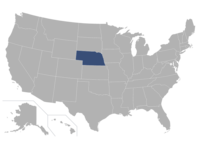
Lincoln, NE