California sued by Trump administration over demand to purge 20,000 voters from rolls
Oct 15, 2026 | 5:00 pm ET
Description
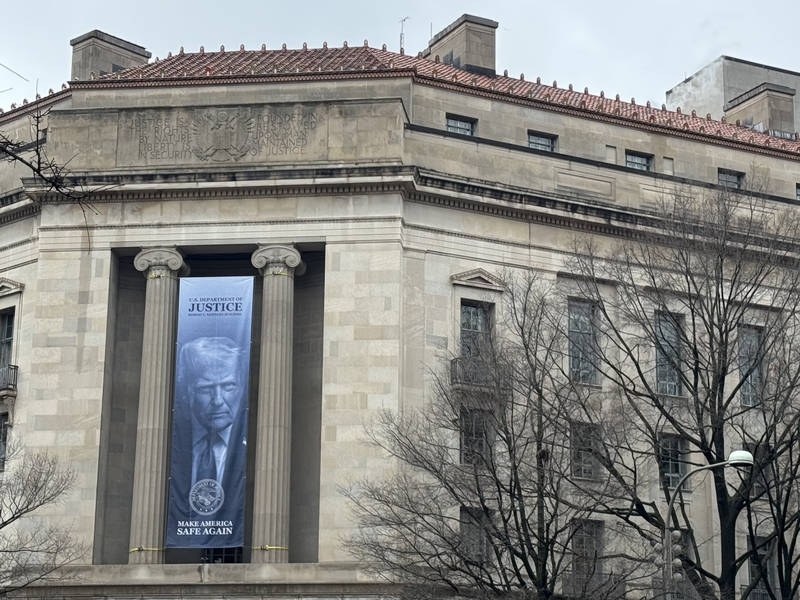
A banner showing President Donald Trump hangs on the Department of Justice in Washington, D.C., on Feb. 20, 2026. (Photo by Shauneen Miranda/States Newsroom)
The Trump administration sought a federal court order Thursday to force California to purge 20,000 people from its voter rolls over claims they are not U.S. citizens, a major development less than three weeks before the midterm elections.
The U.S. Department of Justice sued the state, asking a judge to validate its claims that the state is willfully allowing noncitizens to vote in the Nov. 3 elections. California law requires that ballots have already been sent to registered voters.
California Secretary of State Shirley Weber and Los Angeles County Registrar-Recorder/County Clerk Dean C. Logan on Wednesday declined to open a thumb drive the federal government sent them containing a list of suspected noncitizens registered to vote in California.
Logan said the drive was unvetted and opening it would violate the office’s security protocols.
The Justice Department’s complaint said the refusal to open the drive was a major obstacle to enforcing federal voting laws.
“By sending ballots to likely noncitizens despite the Federal Government notifying California of serious concerns, Defendants (collectively, California) have made it nearly impossible for the United States to investigate and enforce federal law,” the suit said. “This is a substantial drain on federal resources. In addition, when aliens illegally vote in elections, they dilute the votes of citizens and unduly influence who runs the Federal Government. That also undermines public faith in federal elections.”
The suit seeks a judicial order blocking the state from counting mail ballots sent to registered voters that the administration says are noncitizens.
California sends ballots to every registered voter in every election without distinguishing among state, local or federal elections, the suit says. Ballots for this year’s general election went out Oct. 1.
Only citizens can vote in state and federal elections. San Francisco allows noncitizens to vote in some local elections.
In Thursday’s complaint, the administration said the Department of Homeland Security had identified 20,000 noncitizens who were registered to vote in California. The department warned California “months ago” that noncitizens may be registered to vote in the state, which “made no serious attempt to” determine if that was true, according to the suit.
Many of the people the administration says are noncitizens and registered to vote live in Los Angeles County, the suit says.
Representatives for Logan and Weber did not immediately return messages seeking comment Thursday.
Motivation questioned
The suit omits efforts by the state over the past few months to work with the federal government to identify noncitizens on its voter rolls, David Becker, the executive director of the nonpartisan Center for Election Innovation & Research, said on a press call Thursday afternoon.
The administration estimated several months ago that 190,000 noncitizens were registered to vote in the state. State officials asked for the federal government’s methodology and for the names of the individuals. They did not receive a response, Becker said.
Instead, the DOJ blindsided California and Los Angeles County with a letter demanding voter files be removed just weeks from Election Day, Becker said.
Becker suggested that the administration’s objective was not to deny noncitizens from voting, but to sow doubt about the election results. If the DOJ had a “legitimate concern” and was operating in good faith, it would have worked diligently starting at the beginning of last year, he said.
“I don't know what their motivation is, but I can tell you what their motivation isn't, because if they were seeking to work in good faith to clean up the voter list that they believed had issues, they would have done this months ago in a much different fashion,” he said.
“It does raise questions as to whether or not the sole purpose of this is to set the stage for false claims about election theft after an election that the president might be worried his party was going to do poorly in.”
He added that the thumb drive was sent in an envelope that included a handwritten note with a password written on it, which is a serious red flag for cybersecurity experts.
“I don't know how much you're aware of the cybersecurity protocols in election offices,” he said. “Election offices do not just stick thumb drives into their technology — for very good reason.”
All States Newsroom content is free to republish. Read our republishing policy for more information.