Ramaswamy discusses death and taxes in Ohio at Columbus Metropolitan Club
Oct 15, 2026 | 11:13 am ET
Description
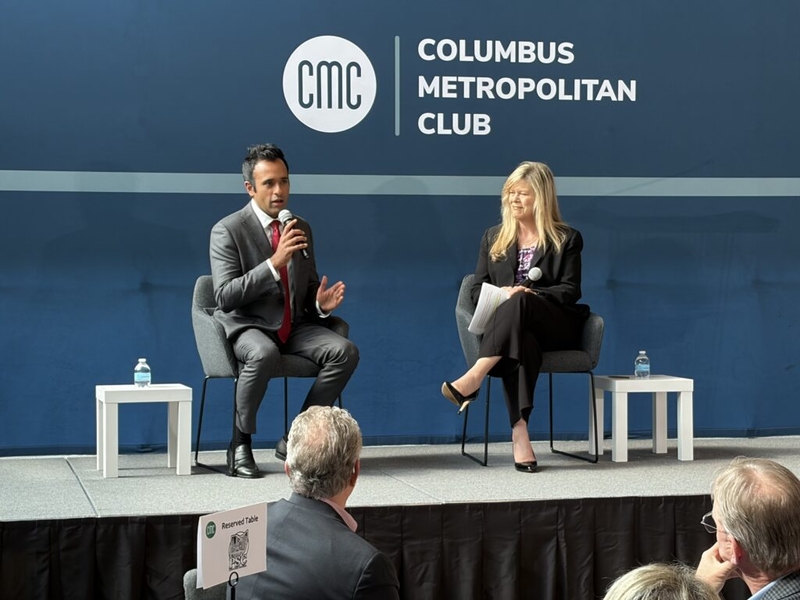
Republican candidate for governor, Vivek Ramaswamy (L) speaking with Statehouse News Bureau Chief Karen Kasler at the Columbus Metropolitan Club. (Photo by Nick Evans/Ohio Capital Journal)
Republican candidate for governor Vivek Ramaswamy touted his plans to cut taxes without, he says, sacrificing on schools and local services, during an appearance in Columbus on Wednesday.
He promised to respect the Second Amendment “to the fullest extent” and advance “medical freedom. Ramaswamy also said he plans to resume death penalty executions.
Ramaswamy spoke at a Columbus Metropolitan Club meeting at the National Veterans Memorial and Museum, moderated by Statehouse News Bureau Chief Karen Kasler.
Before the event, CMC CEO & President Sophia Fifner explained they’d invited both candidates to participate in CMC forums, but Democratic candidate Dr. Amy Acton has not agreed to one.
The Ohio Capital Journal reached out to Acton’s campaign about not accepting the invitation and requested responses to some of Ramaswamy’s comments. The campaign did not immediately respond.
Cutting taxes
Ramaswamy told attendees the root of Ohio’s property tax crisis wasn’t local levies and expanding district budgets — it was government spending in the wake of the COVID-19 pandemic.
“Your home is worth more on paper, but that doesn’t feel like a financial blessing. It’s a financial curse,” Ramaswamy said. “Because your Social Security payments, your pension payments, your wages have stayed flat while you owe as much as twice as much in property taxes.”
A Brookings study contends the Federal Reserve’s purchase of mortgage-backed securities played a significant role in housing inflation.
While Ramaswamy promises a rollback of property taxes in Ohio to pre-pandemic levels, the mechanism for such a reduction by state government is unclear. Property tax rates are set at the local level, and anything beyond the 10 mills (or 1%) allowed by the state constitution goes before voters for approval.
Those taxes support a wide array of local services including schools, which make up the largest share, first responders, and libraries.
Estimates suggest his rollback could cost $4 billion, but he insists vital services won’t suffer.
“I think this property tax reform that I’m planning is also going to provide an opportunity to revisit statewide funding for something that probably shouldn’t be left exclusively to local property taxes anyway,” he said.
Relying on state funding, Kasler pressed, doesn’t answer the question of where Ramaswamy is going to find $4 billion.
“We actually have the answer this year,” Ramaswamy said, referencing state lawmakers move to cut income taxes to a flat 2.75% rate.
“Ohio’s budget is running now $1.6 billion in surplus relative to prior projections,” he went on. “Why? Because we enjoyed growth as a consequence of that tax cut that resulted in expanded revenue, which then feeds a virtuous cycle.”
Ramaswamy said that budget surplus gave lawmakers the flexibility to fund a gas tax holiday through the end of the year.
Capital punishment
Following a botched execution in Tennessee — the second there this year — Ramaswamy said he remains committed to capital punishment in Ohio.
“I do intend to resume executions in Ohio in the rare cases for the most egregious of crimes,” he said.
Since Gov. Mike DeWine took office, Ohio has been operating under a de facto moratorium on capital punishment.
In June, he issued a statement explaining it is now “impossible to make the case that the death penalty is a deterrent” and so the moral justification for capital punishment “no longer exists.”
Ramaswamy called Tennessee’s failed execution “unacceptable” and said Ohio will carry out sentences in a manner that is “ethically appropriate, scientifically sound, effective, and swift.”
Ramaswamy said there were “limitations” in the way Tennessee administered its executions. In Tennessee officials follow a single drug protocol with pentobabital; Ohio’s protocol uses three drugs, but state law makes the specific drugs confidential.
In response to concerns about Ohio’s lethal injection stockpiles expiring, and with limited options to replenish them, some state lawmakers have proposed using nitrogen gas as a potential execution method. That approach effectively suffocates a person by depriving them of oxygen. Five states explicitly allow it.
In June of this year, the U.S. Supreme Court denied the state of Alabama’s request to use the method to carry out an execution of a death row inmate, which left in place a lower court’s decision ruling the method unconstitutional.
Kasler asked Ramaswamy if he was open to changing Ohio’s execution methods.
“So we’re studying this,” he said. “And it is open-mindedness to methods other than lethal injection, which have been successfully used in the past.”
Red herrings
In the meeting hall, there are large portraits of veterans hanging from the ceiling. Looking up at one of them, Ramaswamy argued that if 18-year-olds are old enough to serve they should be old enough to purchase a firearm.
“That man’s holding a gun. He might be 18 years old, and he’s serving our military, put his life on the line,” Ramaswamy said. “If that’s the case, why can’t you similarly purchase at the age of 18 in certain markets where you’re restricted from doing so before the age of 21? Doesn’t make sense.”
Later, speaking about medical freedom, Ramaswamy brought up “Right to Try” legislation.
“I believe that in certain circumstances,” he said, “patients should be able to, on a fully informed basis, in a relationship between them and their physician, have the ability to access therapies that are still investigational therapies, but nonetheless have the potential to help them, particularly if they suffer from terminal or life-threatening conditions.”
Although the minimum age to purchase a handgun in Ohio is 21, state lawmakers voted in 2008 to grant an exception to active or reserve members of the armed forces as well as those who have been honorably discharged.
Similarly, Ohio approved Right to Try legislation in 2016. That measure allows terminally ill patients to receive an “investigational drug or product,” defined in statute as a therapy which has completed phase one trials.
Follow Ohio Capital Journal Reporter Nick Evans on X or on Bluesky.

Columbus, OH