Should California taxpayers chip in to fund political campaigns? Prop. 4 lets you decide
Oct 15, 2026 | 8:00 am ET
Description
In summary
Prop. 4 would lift a ban that prohibits state and most local candidates from using public funding for their political campaigns. Proponents argue the mechanism helps more candidates run for office, but opponents are skeptical.
In 1988, a Democrat, a Republican and an independent in the state Legislature co-authored a ballot measure to ban most political campaigns from using public money.
Their rationale? There was already too much money in politics.
“It certainly makes no sense to open the biggest money source of all, the taxpayers’ purses and wallets,” proponents argued. Nearly 60% of voters agreed.
Almost four decades later, some good-government groups argue that the state needs to do the exact opposite to counter the influence of money in politics.
They, along with the state Democratic Party, are backing Proposition 4 on the November ballot, which would lift the 1988 ban and authorize the state and most local governments to set up public campaign financing systems for state and local races.
Seven charter cities in California, including San Francisco, Berkeley and Oakland, were spared from the 1988 ban and already have public campaign financing.
To qualify for the funding, candidates must meet criteria such as proving they have a certain number of small donors or agreeing to cap how much they raise and spend on their campaign. Depending on the city, eligible candidates receive the funding as a grant, a matching fund indexed to their total donations, or a voucher voters can give to campaigns.
Proponents of Prop. 4 may face an uphill battle: Voters have twice rejected similar ballot measures to lift the ban, and public polling so far suggests voters are skeptical.
What supporters, opponents say
Elections have gotten more expensive over the past three decades, both federally and statewide.
In 2000, federal candidates, parties and special interests spent $5.6 billion on congressional and presidential races. By 2020, that number had nearly quadrupled to $18 billion, according to OpenSecrets, a Washington, D.C.-based nonprofit that tracks campaign spending nationwide.
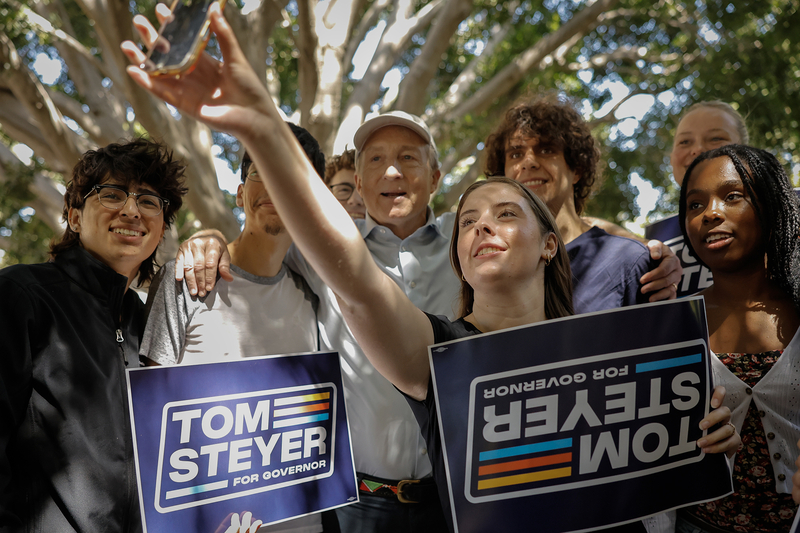
In California, special interests spent $26 million running competing ads on redistricting last year, making it the most expensive ballot measure race in state history. This year, California had the most expensive governor’s race in U.S. history, with billionaire Tom Steyer pouring $213 million of his own money into his unsuccessful gubernatorial bid.
Supporters of Prop. 4 say public campaign financing is necessary as a check against that kind of unfettered private campaign spending, because candidates often must accept campaign spending limits to qualify for public funding. They say public financing will lead to more diverse candidates by attracting those who otherwise couldn’t afford to run for office.
“We need to change the way we finance election campaigns so candidates can run and win without having to raise big money, and they can spend their time listening to voters rather than their donors,” said Trent Lange, president of California Clean Money Campaign and co-chair of the Yes on Prop. 4 campaign.
Gov. Gavin Newsom and the Democratic-led state Legislature, which voted last year to place Prop. 4 on the November ballot, also support the measure. Sen. Tom Umberg, a Santa Ana Democrat and a co-author of Prop. 4, said it would help alleviate a “growing cynicism in politics” and allow candidates to spend more time developing policies instead of fundraising.
“To the extent that we can engage particularly small donors, that will … empower and also engage the body politic, particularly young people,” he said.
But opponents say politicians should not use taxpayer dollars to run campaigns. They argue the measure would force voters to subsidize candidates they otherwise wouldn’t support, and that fraudulent candidates could exploit the system.
Voters have previously rejected ballot initiatives that would have allowed public money to be used for political campaigns. Nearly two-thirds of voters shot down a 2000 measure that would have allowed candidates to tap public funds for advertising. In 2010, 58% of voters opposed a 2010 measure to lift the 1988 ban.
“The voters have been quite clear they don’t want taxpayer money being used for politics,” Assemblymember Carl DeMaio, a San Diego Republican, said last year on the Assembly floor. “Unfortunately, politicians simply can’t take no for an answer.”
Critics also doubt the effectiveness of Prop. 4, arguing it is not specific enough to have teeth.
Prop. 4 offers only broad instructions to local governments and the state. It would ban candidates from using public funds meant for education, public safety and transportation. It would require candidates to prove they have enough public support and to agree to certain spending limits to receive funding, but doesn’t spell out how much. It would also ban candidates from using the money to pay for legal defenses, fines or personal loans to their campaigns.
The measure specifically exempts the Fair Political Practices Commission, the state’s campaign finance watchdog, from ensuring local programs are not exploited or abused, leaving it largely to local governments. But not every local government has its own watchdog agency, let alone an effective one.
The San Francisco Chronicle’s editorial board, in opposing Prop. 4, argued that its rules “are only meaningful if they’re enforced by independent, nonpartisan bodies. And Prop. 4 offers no guarantee they will be.”
Effectiveness debate
Fifteen states and Washington, D.C., offer some sort of statewide public financing for political campaigns, according to an analysis by the National Conference of State Legislatures.
Studies are mixed on the effectiveness of those programs.
Some, including one in 2003 by two University of Maryland scholars, suggest that candidates who accept public financing spend less time fundraising, freeing them up for other campaign activities.
Some researchers found that public financing expanded the pool of candidates running for office. A 2022 study of Seattle’s program, which gives each registered voter four $25 vouchers to contribute to the campaign of their choice, concluded that the program boosted the number of candidates by 86%. Another study of Arizona and Maine’s programs found that they “significantly increased competition.”
Others disagreed. The United States Government Accountability Office, the nonpartisan research agency advising Congress, studied Arizona and Maine’s programs in 2010 and concluded there was no evidence that public financing led to more candidates.
There’s little evidence that public financing has curbed the influence of private donors, according to the Seattle study and the GAO report.
In California, few studies have examined the effectiveness of local programs. A 2023 San Francisco Ethics Commission study found candidates have increasingly tapped into the public funds and that third-party spending was “at near all-time lows.” But the commission encouraged a more comprehensive analysis. A 2013 study in Oakland found no evidence its program diluted the influence of wealthy donors, although it did seem to boost competition.
Researchers point to the difficulty of studying public financing programs, because most apply in only a handful of states and it is hard to measure what would have happened if the programs had not been in place.
The lack of compelling evidence makes Prop. 4 proponents’ claims shaky, the San Diego Union-Tribune’s editorial board argued.
“So Proposition 4’s only certain effect would be to create a new category of government spending that taxpayers could be required to pay for — one with no track record of delivering promised benefits,” it said.
The ballot measure should not be overly prescriptive, said Dora Rose, deputy director for the League of Women Voters of California, a co-sponsor of Prop. 4.
“Prop. 4 sets basic safeguards and then lets communities learn from the evidence and decide what works for them,” she said.
For now, voters appear skeptical. A September poll from the Public Policy Institute of California found 53% of likely voters would oppose Prop. 4, while just 42% would vote yes. Another poll by the UC-Berkeley Institute of Governmental Studies shows a tighter matchup, with 35% of likely voters supporting the measure and another 35% against it.
Sacramento