State auditors find widespread compliance failures in opioid treatment oversight
Oct 15, 2026 | 5:00 am ET
Description
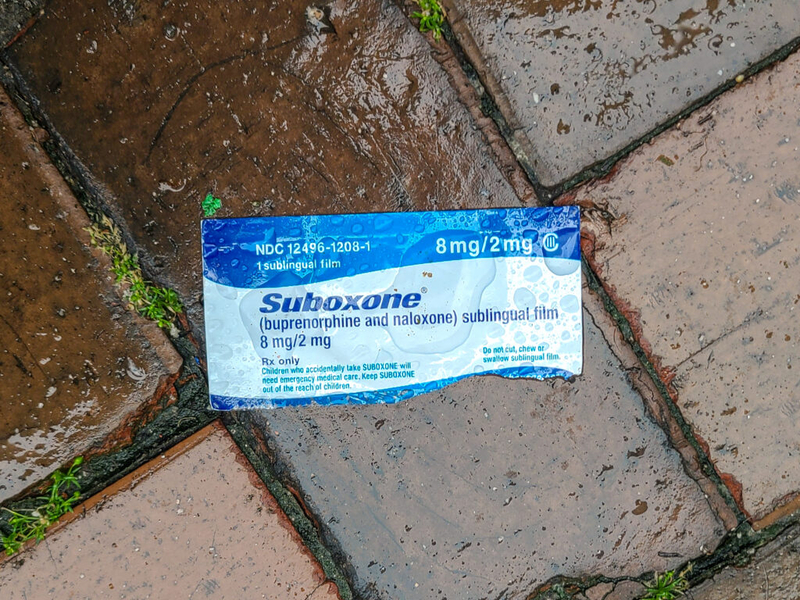
A discarded Suboxone wrapper on a rain-soaked sidewalk in June 2025. The medication, which contains buprenorphine and naloxone, is used to treat opioid use disorder. (Photo by Alexander Castro/Rhode Island Current)
A recent state audit of 100 Medicaid claims over a two-year period by all five opioid treatment providers that billed Rhode Island Medicaid during that period found at least one problem with every single claim.
But the state agency that oversees these providers failed to flag these problems consistently, despite visiting facilities every other year, according to the Oct. 7 report by Rhode Island’s Office of the Auditor General.
The Rhode Island Department of Behavioral Healthcare, Developmental Disabilities and Hospitals (BHDDH) regularly sends its inspectors to opioid treatment facilities. “These oversight activities were not sufficient to ensure full compliance with mandatory regulatory requirements,” the audit reads.
The problems documented noncompliance with the regulations for medication-assisted treatment, or MAT, the more formal name for therapies like methadone and buprenorphine. The drugs are given to people who feel they can’t control their opioid use and help to reduce cravings and prevent withdrawal.
The issues involved other medical services the federal government requires of opioid therapy covered by Medicaid, which is primarily federally funded and administered through states. To receive methadone or buprenorphine therapy, providers must ensure clients have routine counseling, annual physical exams, toxicology screenings and treatment plans.
Documentation is also required for these services, state auditor David Bergantino said in an email to Rhode Island Current Tuesday. But his office could not always determine whether required services went undelivered, or rather if providers simply neglected to document them sometimes.
The claims did not necessarily represent patients going without their medicine or providers billing Medicaid for services that weren’t provided, Bergantino said.
“The audit did not identify instances where providers billed but did not provide the MAT services billed to Medicaid,” Bergantino explained.
The providers remain anonymous in the report because the audit was technically not of the providers themselves, but rather BHDDH, which enlists them to render services.
“Since the auditee is BHDDH and the audit objective was evaluating how successful their monitoring was over provider compliance, we do not identify the providers as they are not the subject of the audit,” Bergantino wrote. “It would be unfair to identify a private entity in our audit report that was not the subject of the audit.”
The audit spanned January 2023 through December 2024 and looked at five providers who operate a total of 14 treatment facilities across Rhode Island. The facilities were referred to by letters in the audit report.
According to auditors, there were 1,729 deficiencies among the 100 sampled claims. The auditors found:
- 95 claims had missing or delayed assessments of patients’ medical, psychological or social circumstances.
- 75 claims had problems with the frequency of reviews for treatment plans, which are supposed to be reexamined every six months.
- 70 claims lacked required counseling sessions that are meant to accompany medication therapy.
- 42 claims failed to meet the annual benchmark for medical examinations — only one a year.
The 100 claims represented a sliver of the 274,412 opioid treatment claims submitted over those two years. Bergantino’s office estimated that if the rate of noncompliance held true across all of these claims, it would represent about $24.9 million in problematic claims.
The auditor’s office serves as a liaison between the state legislature and the federal government, and it regularly engages in “partnership audits” like these when the federal government has found significant noncompliance across states, Bergantino said. Historically, the feds have not sought repayment for these estimated amounts tied to noncompliant treatment.
“However, the federal government does expect that the State will take appropriate corrective actions to address the issues reported,” Bergantino added, “and the State could be subject to the issue being revisited by federal auditors in the future.”
The purpose of the audit report was to “identify gaps in compliance that may place clients at risk for poor treatment outcomes and to support recommendations that strengthen program integrity and quality of care,” it states.
Treatment versus compliance
While the report did not mention the providers by name, one of the five providers audited shared opinions on the process with Rhode Island Current. CODAC Behavioral Healthcare runs nine facilities in the state and offers medication-assisted therapy.
Linda Hurley, CODAC’s president and CEO, did not deny that regulatory noncompliance has occurred at her facilities. But she disputed the audit’s interpretations of its findings.
“I’m not saying that the audit was inaccurate,” Hurley offered in a phone call Wednesday. “I am saying that my interpretation of the results is different than that of the auditor general’s office.”
Hurley clarified that noncompliance with regulation does not mean subpar care.
“It does not mean that care was not competent,” she said. “The societal context wasn’t taken into consideration when they chose the time frame of the audit.”
Hurley said the audit did not adequately reflect the challenges providers have faced since the COVID-19 pandemic, such as disrupted in-person treatment options and a shortage of behavioral healthcare workers.
Hurley maintained that providers still were coping with staffing shortages and changes in treatment practices that arose during COVID.
Hurley also pointed to problems with the regulations. “They’re not awful, but there are certain things that certainly need to be modernized,” she said. “We need to recognize the autonomy of the people that come to us for care.”
She said annual physicals can be a high hurdle to clear for some patients, who may repeatedly postpone appointments because of work or family obligations — or for the simple reason that it can absorb two hours of their day.
“They have lives, you know,” Hurley said. “Like, ‘Why do I have to do this? I’m not sick. I have kids. I have a job.’”
That can leave providers like CODAC out of compliance while they still deliver care, Hurley said. She recalled being asked by medical staff whether patients who repeatedly postponed appointments might be discharged.
Her response: “No, we can’t. Are you kidding?…We’re their safety net.”
A week after the audit’s release, Hurley said CODAC hasn’t yet made changes, although she added her organization intends to review its practices. CODAC also undergoes additional oversight, including inspections by the Commission on Accreditation of Rehabilitation Facilities, she added.
State oversight under scrutiny
BHDDH spokesperson Randy Edgar said Tuesday in an email that the agency has met with providers, is reviewing the audit findings and is expanding its monitoring efforts.
Separately, the department’s corrective action plan, included in the audit, suggests additional unannounced inspections, internal provider audits and a centralized system to track compliance.
Also in Bergantino’s report is a separate finding of 6,347 potentially improper Medicaid claims totaling $875,696, of which $656,919 is paid with federal funds. The claims involved providers billing for daily methadone treatments, rather than bundling them together weekly as required, according to the audit report.
Bergantino said that these overpayments should be recovered from providers, and the federal government’s share returned.
In its own corrective action plan attached to Bergantino’s report, the Executive Office of Health and Human Services — the state agency which administers Medicaid — said it had already completed a review of the billing issues and was looking into the relevant claims, with “corrective action plans that include recoupments” being crafted at the time of the report.
“We are reviewing the Auditor General’s findings and will work closely together with affected providers to validate the identified billing issues and take corrective actions as outlined on page 30 of the report,” agency spokesperson Kerri White said in an email.
Providence, RI