Moore, lawmakers back proposal to tie prescription drug costs to federally negotiated prices
Oct 14, 2026 | 7:25 pm ET
Description
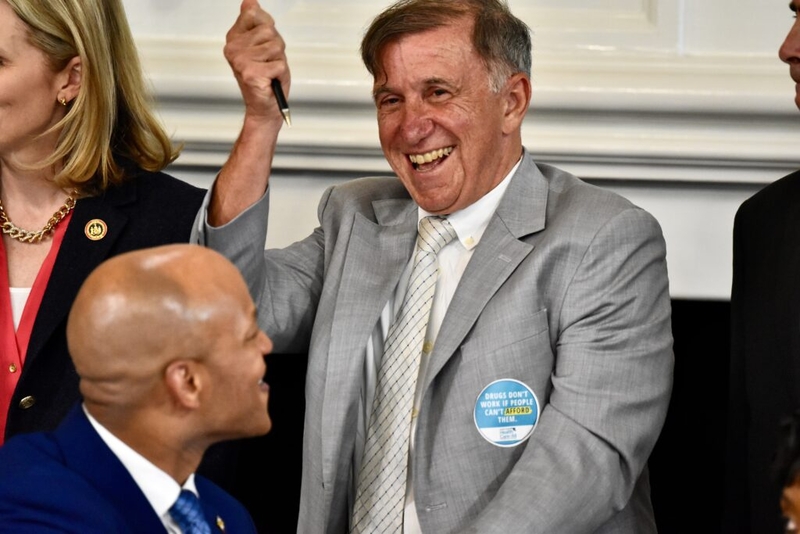
Vincent DeMarco, president of Maryland Health Care for All, celebrates the governor's approval of 2025 legislation that could help Marylanders save on prescription drug costs. (Photo by Bryan P. Sears/Maryland Matters)
Gov. Wes Moore offered his “public and loud” support for proposed legislation that would allow the state to more quickly reduce the price of some expensive drugs for non-Medicare recipients by piggybacking on the federally negotiated price limits under Medicare.
And at a press conference Wednesday announcing the legislation, he promised to sign the bill, assuming it survives the 2027 legislative session. The current odds look promising.
The Maryland Healthcare for All Coalition, the organization driving the measure, recently sent letters to House and Senate candidates in the upcoming midterm elections asking for their stance on the measure.
The coalition received support from 29 Senate candidates with 26 incumbents backing the measure, along with 98 House candidates, of whom 79 are incumbents.
To pass a typical bill, 24 senators and 71 House members need to approve the measure. With Moore’s public support, coalition president Vincent DeMarco said “we’re in pretty good shape.”
Board votes to cap how much state, local governments spend on Ozempic
“It takes a while for the board to set up these upper payment limits,” DeMarco said. “Naturally, the legislature wanted them to go through a process … and that takes a while. But what we’ve come to conclude is that there is a way to make it happen more quickly.”
The proposed legislation would allow the Maryland Prescription Drug Affordability Board to set “upper payment limits” for prescription drugs based on the Maximum Fair Price, which were negotiated between federal officials and pharmaceutical companies to offer lower prescription drug costs for those on Medicare.
“If the federal government sets a Maximum Fair Price for a drug under the Medicare negotiation, our board doesn’t have to go through this months of process, and could right away, if they deem it right, set that same upper payment limit for Marylanders,” DeMarco said.
The lengthy cost review process to determine if a prescription drug is unaffordable has been a sore spot for the board members as well as opponents of the board’s efforts.
The board’s current authority only applies to those on state healthcare plans, meaning state employees and incarcerated individuals.
The cost review process has taken months, as the Prescription Drug Affordability Board staff collect data and speak with drug manufacturers to learn more about how and why some drugs are more expensive.
Once board members determine that a drug likely “poses an affordability challenge,” the board then must investigate routes to lower those costs, which includes but is not limited to setting upper payment limits that create a ceiling for how much the state is willing to pay for a prescription drug.
The Affordability Board staff say that future evaluations should run more smoothly now that the process has been established, but the board is also looking for ways to streamline the cost review process even further.
The bill as currently proposed would at least trim the evaluation process for the 25 drugs that have already been negotiated by federal officials, as well as the 15 drugs currently in negotiations and any future negotiated prices.
“Under this bill, when Medicare negotiates what it pays for a drug, Maryland can pay the same once our board signs off. No more starting over, no more starting from scratch,” Moore said. “No more months of review to reach an answer for something that we already have, where we can save Marylanders 10s of millions of dollars a year and make life affordable for people in this state.”
Del. Jennifer White Holland (D-Baltimore County), is the anticipated bill sponsor in the House and Sen. Dawn Gile (D-Anne Arundel) is the expected Senate sponsor.
While Gile was not in attendance at the press conference, White Holland said the high cost of drugs are challenging for families facing tight budgets, who may go without or ration their pills when faced with unaffordable medications.
“Our friends, our neighbors — we are all hurt by this runaway greed,” White Holland said. “Whether it’s at the pharmacy counter … through our insurance premiums or with our taxpayer dollars, we all pay the high cost of prescription drugs.”
But drug manufacturers, some advocates of patients with rare diseases and other opponents of the proposal say that the efforts of the Prescription Drug Affordability Board to lower prescription drug costs could threaten access to life-saving drugs. They’re also skeptical over whether the board’s efforts will even result in lower out-of-pocket costs for Marylanders.
State officials approve 14.6% rate increase for individual premiums on ACA marketplace
“Government price-setting creates uncertainty for patients and risks limiting access to medicines,” said Will May, a spokesman for PhRMA, a powerful lobbying group representing pharmacy manufacturers. “Medicines may not be available if a pharmacy, hospital or physician cannot purchase them at the capped price. In countries that rely on government price-setting policies, patients often have access to fewer new medicines and wait longer for breakthrough treatments.”
Expanding to the private insurance market
Those potential consequences are yet to be seen, because in the years since the board’s formation from 2019 legislation, it has not lowered the price of any prescription drugs in the state.
Created by the General Assembly in 2019, the board had a hard time getting off the ground. It was slow to launch in part because if a veto from then-Gov. Larry Hogan (R) amid pandemic-induced economic uncertainty in 2020 that delayed the board’s formation.
After Moore allocated funding for the board’s operation in 2023, the entity went through lengthy rulemaking to create the “cost review” process for targeted drugs. The board finally picked its first six drugs for cost review in May 2024.
This year, board members determined Jardiance, the brand name for drug to treat Type 2 diabetes and other conditions, and Ozempic, another popular diabetes treatment and weight-loss drug, posed an affordability challenge and agreed to set upper payment limits based on their negotiated costs under the Maximum Fair Price.
The board’s authority is currently limited to just lowering costs for people with state health insurance, which includes state employees as well as incarcerated individuals.
Its authority is set to expand to the private insurance market in 2028. Because the board has not yet lowered costs on any drugs, a 2025 law granting the board’s extended authority will not activate until one year after it has set upper payment limits on two prescription drugs with its current authority.
The upper payment limits Jardiance and Ozempic limit go into effect in January 2027, meaning the expanded authority will not be in play until 2028 at the earliest.
That said, the upper payment limit for Jardiance is estimated to save the state around $320,000 a year, which could balloon to between $9 million and $16 million a year if expanded out to all Maryland health plans.
Savings for Ozempic would be greater. The projected Ozempic savings would go from $5.8 million a year for just the state health plan, to somewhere between $113 million and $165 million a year when expanded.
DeMarco said that there will be an analysis in the works to estimate savings if prescription drug costs in Maryland were tied to 25 prescription drugs currently on the Maximum Fair Price list. He expects those estimates to reveal hundreds of millions in savings for the state, if not over a billion.
Annapolis, MD