Va. lawmakers, Spanberger grapple with loss of federal healthcare funds for trans youth
Oct 15, 2026 | 5:28 am ET
Description
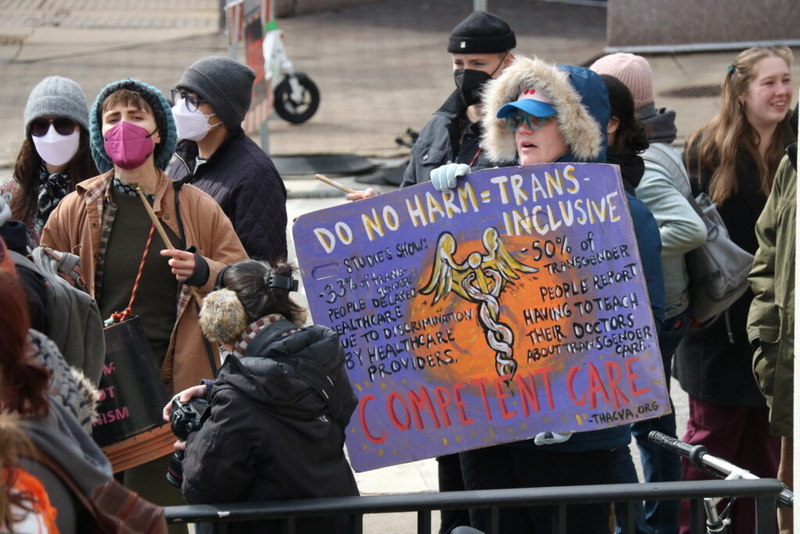
A crowd gathers outside of Virginia's Capitol on Feb. 10, 2025 to call on legislators to protect transgender people. (Photo by Charlotte Rene Woods/Virginia Mercury)
Federal Medicaid and Children’s Health Insurance Program money can no longer be used for certain gender-affirming care to young people in Virginia and other states, after a new U.S. Department of Health and Human Services rule took effect on Oct. 13.
This means that people under 18 on Medicaid and under 19 on CHIP would lose that financial assistance, but Virginia’s chapter of the American Civil Liberty Union argues Virginia’s state government could fund state-level coverage to replace it.
While patients with private insurance can still seek care where it is offered, the new HHS rule specifically prohibits young people using Medicaid or CHIP from having services like puberty blockers, hormone therapy or surgery covered.
Though about half of U.S. states restrict gender affirming care for minors, there are about 133,000 transgender youth in states without bans, including Virginia, that use Medicaid or CHIP coverage for their care, according to KFF Health News.
“Decisions about healthcare, including for transgender youth, should be made by families and their doctors — not the government,” ACLU attorney Wyatt Rolla said in a phone call Wednesday. “It’s important that every parent is able to get the healthcare that their child needs, no matter what kind of health insurance they have.”
Rolla noted how Virginia took a similar step by setting aside millions to help low-income citizens maintain healthcare after Congress let Affordable Care Act subsidies expire last year. Leaders could use the same strategy to support Virginia’s transgender youth, Rolla said.
Virginia’s most recent state budget earmarked $150 million to target assistance to households with incomes between 138% and 250% of the federal poverty level.
As of July, that range represents about 45% of people who had already dropped their ACA health insurance due to rising premiums and eligible households can tap into the state funding beginning next month.
Del. Rodney Willett, D-Henrico noted that the state “shouldn’t have had to” “plug the (ACA) subsidy gap,” but federal actions prompted lawmakers to do what they could. He supports the ACLU’s call for the state to take the same tack concerning trans youth care.
Willett chairs the House Health and Human Services Committee and co-chairs a subcommittee in the House Appropriations Committee. His insights can help shape which bills advance and which budget items get funded.
Whether or not the money will be able to be there, however, is the question.
Gov. Abigail Spanberger’s administration estimates the state could face a $2 billion to $6 billion revenue loss starting in 2028 due to the federal changes to Medicaid and other social services that levy more costs and administrative burdens onto states.
State agencies are already coordinating efforts to comply with H.R. 1, the reconciliation bill Congress passed last year that triggered the major shifts, and prevent eligible Virginians from losing their benefits.
“How do we keep filling all of these holes?” Willett asked.
Transgender minors have been a point of focus for President Donald Trump’s administration. Days after assuming office in January 2025, an executive order prompted three Virginia hospitals to pause offering gender-affirming care to patients under 19.
The order said the U.S. will “not fund, sponsor, promote, assist or support” what Trump labeled “destructive” procedures.
Now, with the modified rule, more youth stand to miss out on care, advocates say.
“These are low-income families that are in these programs, and the thought of them losing access to this healthcare is really devastating,” Rolla said.
ACLU and representatives from LGBTQ+ advocacy group Equality Virginia had met with DMAS director Steven Ford in August in advance of the changes to relay their concerns.
By late-September, a bulletin post from Virginia’s Department of Medical Assistance Services, noted that Virginia would no longer administer funds starting Oct. 13 when the HHS rule took effect.
In an Oct. 9 joint letter, the groups alleged Virginia violated its own procedural rules by complying with the HHS rule without proper process and emphasized that the rule doesn’t prohibit states from adopting their own substitutes for the lost federal funding.
“This is not a question of whether or not our administration is making a choice to pull back funds,” Spanberger told reporters at The Advocate last week when asked why Virginia was ending coverage. “This is a question of an example once more of a federal government and a Trump administration that is changing access to health care.”
On Wednesday, Spanberger’s office offered no new statement and said potential funding could stem from the legislature.
Meanwhile, Virginia is part of a 22-state lawsuit challenging the HHS rule and a court could potentially block or affirm it.
Willett said he hopes state lawmakers may be able to allocate some funding during its 2027 legislative session to aid affected families, but preliminary conversations have not yet started.
“It’s like everyday you wake up and before you read the news of the day, you think ‘what else could the Trump administration do?” he said. “Everyday there is something else that goes from bad to worse, and we’re constantly reacting to that.”
Richmond, VA