Prop. 144 could reshape Arizona mail voting while doing little to speed results
Oct 14, 2026 | 4:58 pm ET
Description
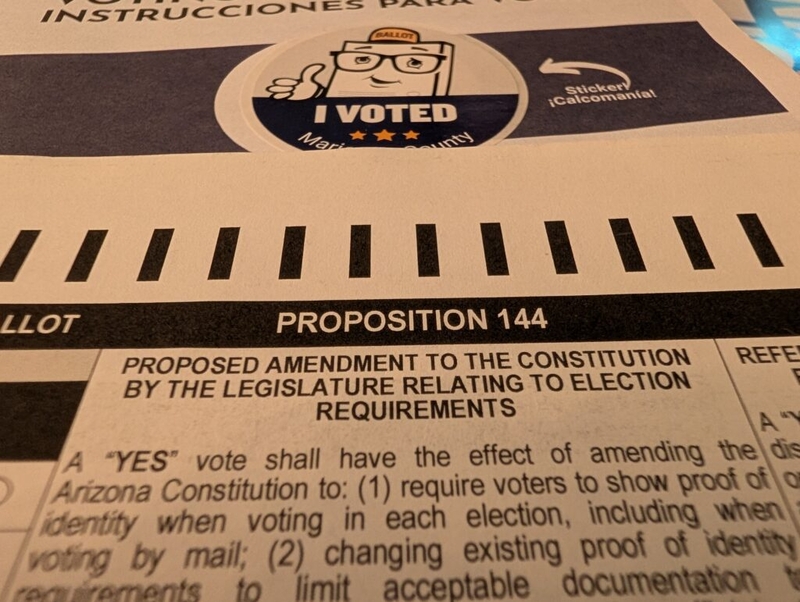
(Photo by Jim Small/Arizona Mirror)
Proponents of Proposition 144 say that it will make Arizona’s elections faster and more secure, but critics say it’s unlikely to significantly speed up results — and it could spell the end of no-excuse voting by mail, by far the most popular way to vote in the Grand Canyon State.
Prop. 144 would make numerous amendments to the state constitution, and the most impactful provision would require voters who cast a ballot by mail to provide state-issued identification every time they vote. But the ballot measure doesn’t include specifics about what kind of identification voters would have to provide or how they would do it, leaving that up to the Arizona Legislature.
That would mean the Republicans who have controlled the legislature almost exclusively for 60 years and voted for a bill that would have effectively banned no-excuse early voting, would be tasked with writing the rules on how mail voters provide ID.
Voters already weighed in on additional identification requirements for mail-in voters in 2022, when they narrowly rejected Proposition 309. But this time around, the mail-in voter ID requirement is nestled in Prop. 144 alongside much more popular provisions like limiting registering to vote and voting to citizens. Those already exist in state law and the Arizona Constitution, and have since Arizona became a state in 1912.
“It’s my experience in the sausage-making of how these things go that you take things that you know are popular and you attach them to a provision that you need to pass,” Gina Swoboda, the former head of the Arizona Republican Party, said during a Sept. 22 “Mechanics of Democracy Lab” at Arizona State University.
During an Oct. 1 Clean Elections debate, Greg Blackie, of the far-right Arizona Free Enterprise Club, which has long crusaded to tightly restrict voting by mail, encouraged voters to support Prop. 144. He noted that more than 90% of Arizonans support citizens-only voting.
“So, this measure is not some dangerous provision that’s going to result in the legislature adopting something they couldn’t already do,” he said. “What it does is it allows the voters to tell the legislature, ‘We want voter ID, regardless of how people vote.’ And that is popular.”
If voters approved the proposal, also known as the “Fast Accurate Secure Transparent Election Results Act,” it wouldn’t change who can register to vote or cast a ballot. But it would change how Arizonans who vote by mail verify their identities.
Currently, voters are required to provide ID when they register to vote and when they vote in person.
Those who vote by mail sign an affidavit on the green early ballot envelopes confirming that they’re registered to vote in that county and haven’t voted elsewhere. Violators can face perjury charges.
Blackie initially dodged a question about how mail-in voters would provide identification, but when pressed, he suggested three options: providing a driver’s license number or early voting identification number with the ballot; scanning a QR Code that links to an ID scanner that would verify voter identity; or calling an election center to provide a driver’s license number over the phone.
During the Clean Elections debate, Randy Keating, the chairman of “No on Prop. 144,” argued that the lack of specificity in the election reform measure was a “feature not a bug.”
“They want the chaos, right?” he said. “They want to make sure that there’s doubt, there’s confusion, there’s ambiguity in our election laws. Not only our election laws, but the Arizona Constitution, so they can point to a problem that they created and say, ‘We have to do something about that.’”
The state lawmaker who sponsored the legislation that became Prop. 144, Rep. Alexander Kolodin, is a member of the far-right Arizona Freedom Caucus whose record as an attorney and a state legislator are replete with unfounded claims about Arizona’s elections.
For more than two years, the Scottsdale Republican has been pushing legislation to make Arizona’s elections more like Florida’s in the name of “election integrity” and boosting trust in elections. The final version of Prop. 144 is a significantly pared down version of that legislation.
Keating said that the same politicians and organizations pushing Prop. 144 to address a lack of confidence in election results are the same politicians sowing doubt in the state’s elections in the first place
“This is a zombie idea that just won’t go away, no matter how much you show that the problem doesn’t really exist,” he said. “So, again, this is all just much ado about nothing. It’s an excuse to try to limit people who vote by mail, because they feel that their preferred candidates would probably have a better chance based on that, not their policy ideas.”
Kolodin, the Republican nominee for secretary of state, has backed changes to Arizona election laws that are inspired by conspiracy theories, including banning no-excuse vote-by-mail and returning to voting in tiny precincts, which election officials said was logistically impossible.
The proponents of Prop. 144 say it will speed up election results, something that many election-denier politicians say have made Arizona a “national laughingstock,” with final results typically posted about 13 days after the election.
It’s always been this way in Arizona elections, but no one cared until recently because Republicans easily won most contests up and down the ballot. But as the state has become a battleground, coupled with President Donald Trump’s evidence-free fixation on election fraud, it’s become a point of contention for Republicans.
“I think that many Arizonans don’t like that it takes a couple weeks to get election results when we see other, larger states able to have results posted the night of or the next day,” Blackie said. “And, so, when they can get results faster, and when they have confidence that everybody is proving who they are before they vote, I do think that that will raise confidence for Democrats, for independents, for Republicans — for all voters — when we’re all held to the same standard.”
A significant factor slowing the results are the roughly 250,000 “late early” mail-in ballots dropped off on Election Day and the preceding weekend. Signature verification of those ballots can be time-consuming, and proponents of Prop. 144 say that its requirement for all counties to allow voters to bring their ID to a polling place and watch their ballot be tabulated will speed things up, eliminating the need to signature-verify those ballots.
But how much that provision will speed up election results depends on how many people use it. Maricopa County provided that option to voters during the July primary election. Just 23,400 out of more than 677,000 voters who cast a ballot in that election in Maricopa County used that option, about 3.5% of voters.
The tabulation provision will also be costly for counties, many of which don’t currently have tabulators at all of their polling locations.
Prop. 144 would also prohibit foreign nationals from spending money to influence state elections. They are already barred from giving to candidates, but can give money to other political committees, including ballot measure campaigns.
Additionally, the FAST Act would create a new, tougher standard for challenging election laws enacted by the state legislature.
That provision reads “the people and the legislature may enact laws governing elections, including early voting and mail voting, provided such laws are rationally connected to a legitimate state interest including timely and accurate election results, efficient election administration, election security, and preserving public confidence in the integrity of elections.”
During the Sept. 22 event, Tom Collins, executive director of the Citizens Clean Election Commission said he sees this “as a fundamental effort to make the legislature have primacy over issues that currently it does not have … exclusive authority over and to force the courts and others to defer to them.”
Phoenix, AZ