Ukrainian TPS holders in Ohio left in limbo after federal non-decision decision
Nov 10, 2026 | 3:55 am ET
Description
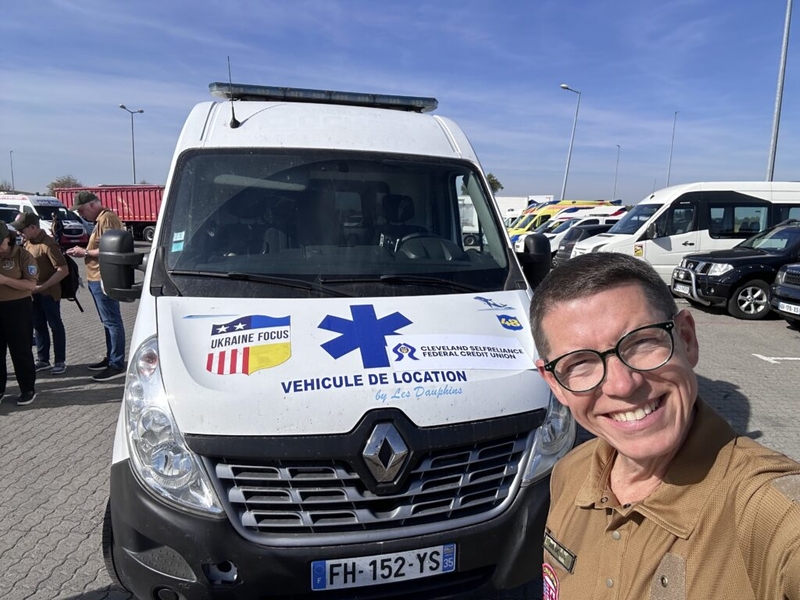
Ohio state Rep. Sean Brennan, D-Parma, with an ambulance to be delivered to Ukraine. (Photo courtesy of Sean Brennan)
While most Ohio lawmakers were out campaigning for reelection last month, Ohio state Rep. Sean Brennan, D-Parma, was driving across Poland’s border with Ukraine to deliver a couple dozen ambulances and medical supplies.
The trip was part of Ukraine Focus’s 19th mission to Ukraine. The Virginia-based nonprofit sources and delivers ambulances, among other programs to support to the war-torn country. The United Ukrainian Organizations of Ohio helped organize participants from Ohio.
“We delivered around 50 ambulances, as I recall,” Brennan explained. “Along with other vehicles, along with humanitarian and medical supplies for the Ukrainian military to use in the in their war efforts to maintain their sovereignty, which they’re entitled to and deserve.
Brennan’s Parma-area district has the largest Ukrainian-American population in the state, and many Ukrainians sheltering in the U.S. while the war continues have settled in the area. Those families face an uncertain future.
Roughly 100,000 Ukrainians are living in the U.S. under Temporary Protected Status — the same protections recently terminated for nearly 350,000 Haitians living in the U.S.
Ukrainians’ TPS status lapsed on Oct. 19. But rather than formally extending or ending protections, the U.S. Citizenship and Immigration Services did nothing. In a terse statement, the agency said an announcement “will be made at the appropriate time,” and until then, TPS holders can maintain their work authorization.
“They’ve put the people in limbo,” United Ukrainian Organizations of Ohio President George Jaskiw said.
“Is this just a reprieve before the election and then after election the hammer will come down? That’s what somebody asked me,” he said. “I have no answer. I don’t know what’s in the mind of (Department of Homeland Security) administration.”
The trip
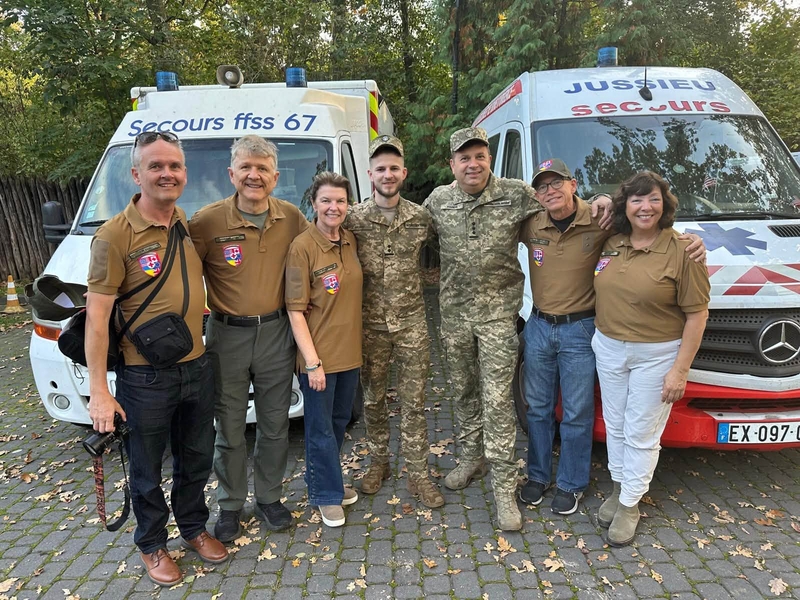
Brennan’s European sojourn started in Prague. He and several other volunteers (including Jaskiw) picked up ambulances and drove through Krakow in Poland, and then on to Lviv in Western Ukraine. Brennan was struck by the extent to which Ukrainians were carrying on with their lives despite four years of armed conflict.
“Now that being said, there were signs of war,” Brennan said, “There were a couple of mornings where the air raid sirens went off, and we had to go down into the bunker of our hotel for our safety.”
Security was tight at the border, he said, and they passed check points for several miles on their way to Lviv. After they arrived, the volunteers handed over the vehicles to members of the Ukrainian armed forces and toured a handful of the civilian efforts to support the war.
“We got to sit down with them and tie some of the ties onto the nets that are used on the front to camouflage vehicles and other equipment from the drones,” Brennan described. “We also visited a place where they dry food. They dry fruits, vegetables, and meat to create (meals ready to eat) for soldiers on the front. That was pretty amazing.”
But most surprising, he said, was a dilapidated Soviet-era building.
“They took us into the building onto one of the floors,” Brennan described. “They opened up the door, and there were about I would say 100 3-D printers making items for drones.”
“It was something out of a spy novel.”
While the volunteers were delivering ambulances, news broke that President Trump was going to rescind sanctions on Russian diesel and purchase millions of barrels from the country. The administration’s stated justification for the deal was to lower fuel costs.
“Lower prices for Americans, especially our Great Farmers, Ranchers, and Truckers, is my Greatest Priority,” President Trump said in a Truth Social post.
Experts doubt those purchases will materially affect the cost of fuel in the U.S., but they does offer a financial lifeline to the Russian government.
“People were dumbfounded,” Brennan said. “As was I, and I think I’m speaking on behalf of everybody that was on our trip.”
“Russia Supports Iran,” he added. “So, you know any American dollars that go to Russia for diesel, is going to be shot right back at us, and I don’t think anybody wants that.”
The TPS legal process
In Ohio, Ukrainian families are waiting anxiously to see what happens with their immigration status. USCIS’s non-decision grants them a reprieve, but not much of one.
Aleksandar Cuic is a law professor at Case Western Reserve University who works with the school’s immigration law clinic.
“I’ve never seen them not do anything,” he said. “Historically they’ve either terminated it, took away the designation, or they’ve extended it. That’s always historically what’s been done.”
Federal law requires the Secretary of Homeland Security to consult with “appropriate agencies” about the conditions in a country before terminating its TPS designation.
“TPS for Ukraine is due to a war,” Cuic said. “Unless they’re going to determine that the war is over or it’s safe to go back. That’s something that they have to do. They have to kind of show that hey, the conditions, why we created TPS, are now gone.”
At least on paper, it’s a thoughtful process, but in practice, it doesn’t always work out that way. In June, the U.S. Supreme Court allowed the Department of Homeland Security to end protections for more than 400,000 Haitians and Syrians living in the United States.
In Haiti, gangs control 90% of the country and five million people can’t get enough to eat. Attorneys challenging the revocation of TPS noted the U.S. State Department warns travelers that “no part of Syria is safe from violence.”
Then just days before the court issued its ruling, attorneys representing TPS holders uncovered documents indicating then-Secretary Kristi Noem never actually consulted the U.S. State Department about conditions in Haiti. The attorneys petitioned the court to set the case aside. Instead a 6-3 conservative majority sided with the Trump administration.
“I think it’s fair to say it’s kind of a political maneuver right now,” Cuic said. “You know, you’re looking at the countries that they’re pulling TPS from, (they) are countries that the Trump administration has, for lack of a better term, targeted.”
If federal officials decide to terminate Ukraine’s TPS designation, recipients will have 60 days to leave the country.

TPS holders’ uncertainty
Ivan Prodanyk left Ukraine with his wife and two daughters the day the war began. His family has Temporary Protected Status and they’ve settled in Cleveland. The government’s lack of a decision has rattled him.
“At first, it’s uncertainty,” he said. “You do not know what to do because you already started to do something here. You need to (be) working. You need to pay bills.”
In some ways, Prodanyk said, the situation in Ukraine today is even worse today than it was when he left, and he isn’t eager to uproot his family once again.
“You need to leave and start the life one more time?” he asked, “Where? In another country? Or come back to Ukraine and be under the missiles and bombs?”
Prodanyk said he and his wife both work and pay taxes. He was a lawyer in Ukraine and has been able to make his way through law school again here in the U.S. He’s frustrated at the “unfairness” of the government potentially forcing out people who are contributing to their communities.
“I don’t know why government not appreciate Ukrainians,” he said, “and they don’t want Ukrainians to stay here, even right now when the situation in Ukraine is terrible.”
If push comes to shove, and federal officials do terminate their status, Prodanyk and his family will leave. But he said he won’t put his children in danger, and won’t separate himself from his family, so they’ll be forced to find some other country that would welcome them.
While Prodanyk’s family braces for USCIS’s eventual decision, the agency’s delay is already having real world, negative impacts on other Ukrainian immigrants.
Alex is a mechanical engineer from Ukraine, living in Ohio under TPS. Ohio Capital Journal isn’t using his last name over fears of retribution.
“Due to all this issue, I lost my work,” Alex explained. “My company, who I worked for, they decided to terminate contract with me because there is no dates on my documents.”
“They didn’t want me to work illegal,” he added, “and just they decided I had to quit because I have no information about when my documents will be expired, if they will be extended, or no.”
Right before our interview, Alex visited the Bureau of Motor Vehicles to renew his driver’s license. He got turned away. Alex worries that for him, and other TPS holders, USCIS simply allowing work authorization to continue might not be enough for Ukrainian job seekers to land a gig.
“So, if their HR or whoever is gonna check the ability to work (they) will verify through the eVerify,” Alex said. “Most likely it will say that that person is liable for work, but that person cannot get to work without driving a car, which is the problem.”
Alex’s family comes from Bucha, the site of massacre in 2022 which still sees regular bombardment from drones or airstrikes. Alex has two children; a son who was born in the U.S. and a daughter in grade school. He explained she had a difficult time with classes at first because she couldn’t speak English, but now she’s doing much better.
“She’s comfortable. She likes to be here. She likes to live here. She has some American friends,” Alex said. “They are all happy together, and all that I want (is to) just stay here, build my future life.”
Follow Ohio Capital Journal Reporter Nick Evans on X or on Bluesky.
Columbus, OH