The most anti-labor law in Maryland you never knew existed
Oct 14, 2026 | 1:00 pm ET
Description
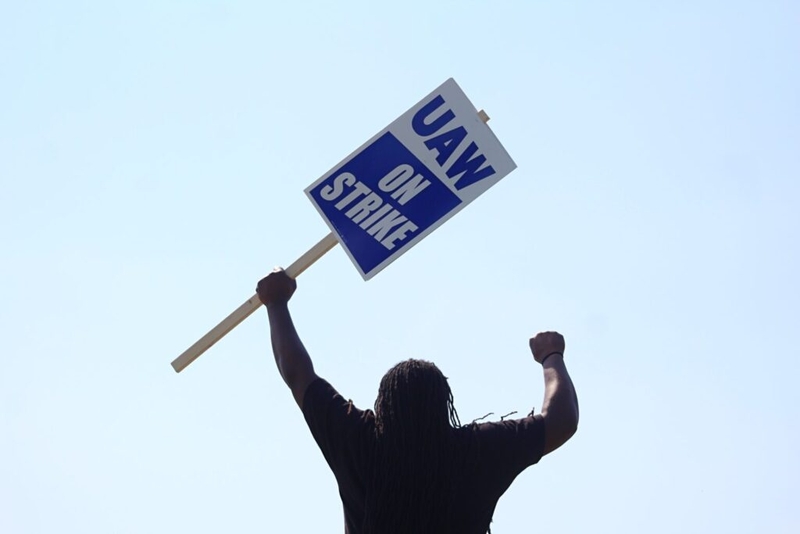
The right to strike -- as United Auto Workers did in 2023 in this photo from General Motor’s Lansing, Michigan, Redistribution Center -- , is prohibited for public sector workers in Maryland. That needs to change, writes Tim Wright, if we value the work those employees do (Photo by Anna Liz Nichols/Michigan Advance)
There’s a law in Maryland that’s standing in the way of teacher pay raises, smaller class sizes, and better and safer working conditions for all public sector workers, and unless you work in that public sector, you likely have no idea what that law is. It isn’t some obscure regulatory loophole buried in the tax code. Public employees in Maryland are legally forbidden from going on strike.
Under Section 22-205 of Maryland’s General Provisions code, the ban is stated in nine words: “Public employees are prohibited from engaging in a strike.” Teachers and other public school employees, library workers, transportation workers, sanitation workers, city, state and county employees — an enormous swath of the people who keep our state running are barred from the single most effective tool workers have ever had to win better pay and conditions. If they defy the ban, their unions run the risk of fines, decertification and, at worst, even firings.
“Essential services” is doing a lot of work
The traditional justification for strike bans is that public services are too important to interrupt — that a teacher walkout, unlike a factory strike, doesn’t just cost a company money, it disrupts children’s educations and families’ lives.
But if the work is so important that a strike is dangerous, don’t we want that work to be done in the best working conditions possible? These conditions will always end up being an afterthought without that basic fundamental right. The workers don’t truly have a seat at the table if they don’t have an exit from the room.
And in practice, the ban doesn’t eliminate labor unrest — it merely weakens workers’ leverage. When Baltimore County Public Schools have walked back negotiated raises, or when county budgets have squeezed school staffing, Maryland teachers relied on work-to-rule actions that helped with bargaining, but were unable to fully restore previously negotiated contracts.
In this environment, labor agreements can be made, but the underlying issues go unresolved year after year. No credible threat, no leverage, just public pleading to school boards and county councils who know the union’s hands are tied by law. That’s not labor peace. That’s labor powerlessness dressed up as public interest.
What the ban actually costs
The consequences aren’t abstract. When Philadelphia’s DC33 municipal workers went on strike for about a week, they won a 9% raise over three years — leverage Maryland public employees simply don’t have available to them, no matter how justified their case.
Maryland’s public sector workers have seen their real wages erode as cost of living increases outpaces negotiated gains even as Maryland institutes austerity cutbacks to social services every year.
There’s also a quieter cost: a workforce that knows its strongest tool is illegal negotiates differently — and loses differently. It’s harder to recruit and retain teachers and librarians in a state where, unlike nearly every private-sector counterpart, they have no meaningful strike leverage if a school board reneges on a deal.
Maryland is already grappling with education staffing shortages; a law that hands public employers the upper hand in every negotiation doesn’t help.
A ban that’s survived on obscurity
Part of why this law has endured is that it’s invisible until it isn’t. Nobody debates it at dinner parties. It doesn’t show up in campaign ads. It surfaces only when a specific group of workers — teachers in one county, librarians in another — run into a wall they didn’t know was there, and even then it’s treated as a one-off dispute rather than a symptom of a much broader structural imbalance written into state law.
That obscurity is precisely what has let it persist for decades without serious reconsideration. A right-to-work law would have unions in the streets. A strike ban that quietly took the streets away in the first place barely gets noticed.
If lawmakers are serious about supporting the state’s teachers and librarians, House Bill 1492, introduced in the 2025 state legislative session was a reasonable place to start. The Maryland Right to Strike coalition, consisting of dozens of public sector unions and community organizations from across the state has recently announced that it plans to continue this fight for a new public sector right to strike bill come this November.
But the larger conversation Maryland needs to have is simpler than any single bill: Why, in 2026, does the state still tell hundreds of thousands of its own workers that the most basic tool of labor power is one they’re not even allowed to consider?
Annapolis, MD