South Dakota’s federal-only voter list grows to nearly 6,000, surprising some who are on it
Oct 13, 2026 | 9:15 pm ET
Description
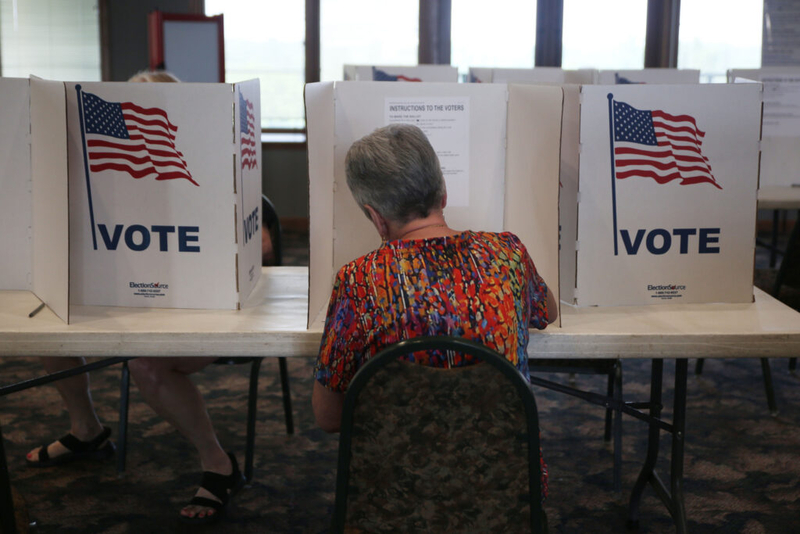
A voter fills out a ballot at a Brandon polling place during the runoff election for the South Dakota Republican nomination for governor on July 28, 2026. (Photo by Makenzie Huber/South Dakota Searchlight)
Julian Winchester didn’t know he was one of South Dakota’s nearly 6,000 federal-only voters, let alone what that means, until South Dakota Searchlight found his name on the list and called him this month.
The Lake Area Technical College student registered through a voter registration drive on the Watertown campus this fall. His driver’s license predates a change that added a citizenship indicator to new licenses, making it ineligible as proof of U.S. citizenship when registering to vote in South Dakota.
A new South Dakota law says people who fail to produce proof of their U.S. citizenship are registered as federal-only voters. That means they can only vote in the two federal races on the Nov. 3 ballot, for U.S. House and U.S. Senate. They can’t vote on the governor, four state constitutional amendments, state lawmakers or local races.
Winchester will need to provide a copy of his birth certificate or other accepted proof of citizenship to the Codington County auditor by Monday, the voter registration deadline, to be able to receive a full ballot.
What’s happening to him “seems like voter suppression,” said Winchester, who added he’d have been angry if he hadn’t learned of his federal-only designation until he went to vote.
“That’s the whole point of democracy: Every person gets a vote,” Winchester said.
The number of South Dakotans restricted to voting in federal races has nearly quadrupled to 5,735 since May, driven by two recent laws passed by the state Legislature and signed by Gov. Larry Rhoden.
A 2025 law designates newly registering voters and voters requesting absentee ballots as federal-only when they list only a mail-forwarding service or post office box as their address, unless they can provide a physical description of their South Dakota residence and attest to 30 days of state residency. Targets of that law include people who drive recreational vehicles across the country year-round while registering in South Dakota.
A new law this year requires newly registering voters to provide a birth certificate, passport, driver’s license, non-driver’s identification card or tribal identification card, or “any other type of acceptable documentary evidence of citizenship” permitted under federal law. Photocopies can be used in place of all of them except driver’s licenses and state or tribal identification cards.
Registrants who fail to document their U.S. citizenship are registered as federal-only. Courts have determined states can require citizenship documentation for state-level registration, but states must allow people to attest their citizenship without documentation when registering for federal elections.
South Dakota Searchlight purchased a list of the state’s federal-only voters from the Secretary of State’s Office as of Oct. 6 and emailed county auditors about voters whose registration information — including their original registration date or mailing address — raised questions about whether they belonged on the list. In three instances, auditors said the voters had been mistakenly designated as federal-only and corrected their status.
Samantha Chapman, advocacy manager with the American Civil Liberties Union of South Dakota, said the errors flagged by Searchlight underscore the “stakes” of the recent law changes.
“When a law is so badly written and, in my opinion, carelessly implemented, the results of people being unfairly disenfranchised are inevitable and extremely upsetting,” Chapman said. “This is someone’s fundamental right to vote. They didn’t do anything to lose it — there was an error that nearly cost them a voice in key races in November.”
Voters might not realize they’ve been registered as federal-only. Some may not notice the designation on the postcard they receive from their county auditor confirming their registration. The state’s online Voter Information Portal does not tell voters if they are registered as federal-only. Voters can surmise their status if their sample ballot in the portal includes only federal races, or they can check their status by calling their county auditor.
More than 4,800 of the 5,735 federal-only voters on the list are registered using a commercial mail-forwarding address or post office box, indicating they may have failed to provide a physical address or prove 30 days of residency, although they also could have failed to prove their U.S. citizenship. Another roughly 800 listed residential addresses and are restricted solely because they didn’t provide proof of U.S. citizenship.
About 40% of federal-only voters are either independent or non-politically affiliated (meaning they left the affiliation portion of the form blank), 38% are Republicans, and 21% are Democrats. Libertarian and “other” registered voters make up 1% of federal-only voters.
When contacted by Searchlight, Gov. Rhoden’s office said he won’t comment on pending litigation. The South Dakota League of Women Voters and Sioux Falls resident Jaysen Hill sued the state earlier this year over the citizenship law’s implementation. Hill says he was unable to vote in local races in the June 2 primary election because of a registration error and was never given an accurate explanation or a chance to fix it before casting a ballot.
In response to some of the lawsuit’s claims, the Secretary of State’s Office instructed county auditors in September to send federal-only voters more accurate letters explaining their status. The move addresses part of the lawsuit, which remains pending in federal court.
Some federal-only voters Searchlight called knew about their status and had plans to fix it; others were unaware. Chapman led a group of volunteers to call voters on the federal-only voter list and remind them of their voter status ahead of Monday’s registration deadline.
“It’s heartbreaking,” Chapman said, “to see these numbers climb month after month.”

Pierre, SD