Three takeaways from the latest Senate debate between Collins and Jackson
Oct 13, 2026 | 9:00 pm ET
Description
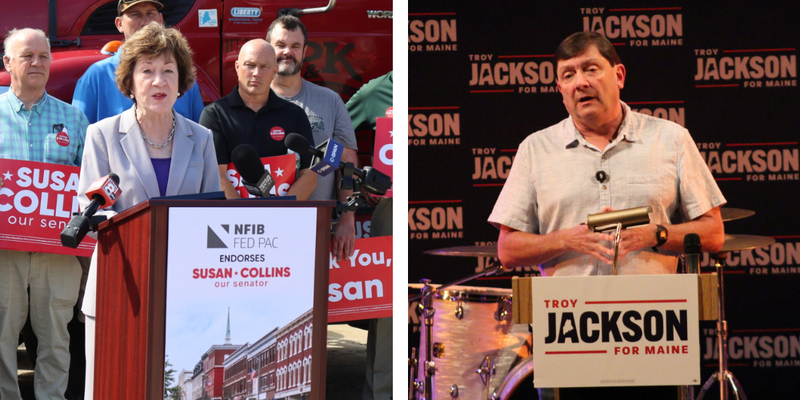
Republican U.S. Sen. Susan Collins (left) and Democratic nominee Troy Jackson appeared on the debate stage for the third time on Oct. 13, 2026. (Photos by Emma Davis/ Maine Morning Star)
During their second to last debate Tuesday night, incumbent Republican U.S. Sen. Susan Collins and Democratic nominee Troy Jackson continued to make the case that their approach to a Donald Trump presidency would be best for Maine.
The candidates had hammered this point in the first debate, when they blamed each other for Mainers’ struggles, and in the second, when they disagreed over how to address high energy costs. Discussion of tariffs, among several issues, again brought this fundamental disagreement into focus Tuesday night.
Tuesday’s debate, hosted by WABI and WAGM, was the third of four scheduled debates, the last of which will occur Thursday in Bangor in front of a live audience. Here are three takeaways:
Campaign finance
After Jackson took aim at Collins for her campaign being financially supported by nearly 100 billionaires and their spouses, Collins criticized him for not yet having shared who is funding his campaign.
“He promised to be completely transparent, yet he has not filed a single report,” Collins said, referring to Federal Election Commission filings. Due to his late entry into the race in July after former Democratic nominee Graham Platner dropped out, Jackson’s first FEC report is due on Thursday.
Jackson responded, “I’ll give you the report tomorrow, and then we’ll talk about it on Thursday,” the next debate.
“She didn’t deny that 90 billionaires are funding her,” Jackson added.
Meanwhile, the first look at Jackson’s personal finances came last week. Senate candidates are typically supposed to file personal financial disclosure reports within 30 days of becoming a candidate, but Jackson requested a 55-day extension. The disclosure confirmed that Collins has far more personal assets than Jackson.
Power
Tuesday’s debate put an even finer point on the candidates’ different approaches to legislating under Trump.
Jackson described Mainers’ choice as one between “a senator who helps Donald Trump hurt Maine, then tells us how concerned she is, or somebody will stand up against him before another family in Maine has to pay the price,” referring to the fatal U.S. Immigration and Customs Enforcement shooting of Johan Sebastián Durán Guerrero in Biddeford three months ago.
Meanwhile, Collins touted her ability to spare Maine from some of the Trump administration’s policy decisions.
“Our Constitution guarantees that, regardless of population, each state has two senators, but it does not guarantee that all 100 senators will have the same knowledge, experience, and clout,” Collins said. “So when you live in a small state like Maine, who you send to Washington really matters.”
How Collins has used her power also came up during debate about the president’s tariffs, when she mentioned that she got concrete, pulp and road salt removed from the tariff list.
Trump had openly promised to impose sweeping tariffs before he took office, and Jackson said, “When they did it, she acts like she’s surprised: ‘I’ll send a letter.’ That is not how you’re supposed to be using your power as the most powerful U.S. senator chair of appropriations.”
Collins countered that Troy would not have been able to negotiate for the exceptions.
“My point is that Troy would not have been able to convince the administration officials to remove these items from the tariff list,” Collins said. “I did.”
But Jackson called that work “a Band-Aid for a real big problem with a narcissist in the White House that is going to do whatever he wants.”
Immigration
Both candidates turned statements their opponents made about ICE against them.
After highlighting funding she helped secure for body cameras and de-escalation training, Collins said that ICE agents have not been properly trained.
“I think what happened is far too many ICE officers were hired and deployed without adequate vetting and training,” Collins said.
Jackson then said the ICE agent who killed Guerrero was part of the agency that by her own admission has not had proper training.
“He’s not coming back now because, in her words, no vetting,” Jackson said. “That is why I believe that this agency is just a rogue agency that’s doing Donald Trump’s bidding.”
Returning to his position that the agency should be abolished, he suggested Customs and Border Protection or the FBI could take on ICE’s work addressing things like sex trafficking, which Collins had pointed to in defending her stance that the agency should instead be reformed.
Collins later seized on that, pointing out that a CBP agent fatally shot Alex Pretti in Minneapolis in January.
“So clearly, that is not the answer,” Collins said.
In turn, Jackson said, “so customs border patrol isn’t the answer either” — although still defended CBP in Maine — before criticizing the senator for continuing to back funding for ICE, an agency he said has created a “pack mentality.”

Augusta, ME