David Jolly: Governor’s race likely comes down to undecided Black Floridians
Oct 12, 2026 | 4:47 pm ET
Description
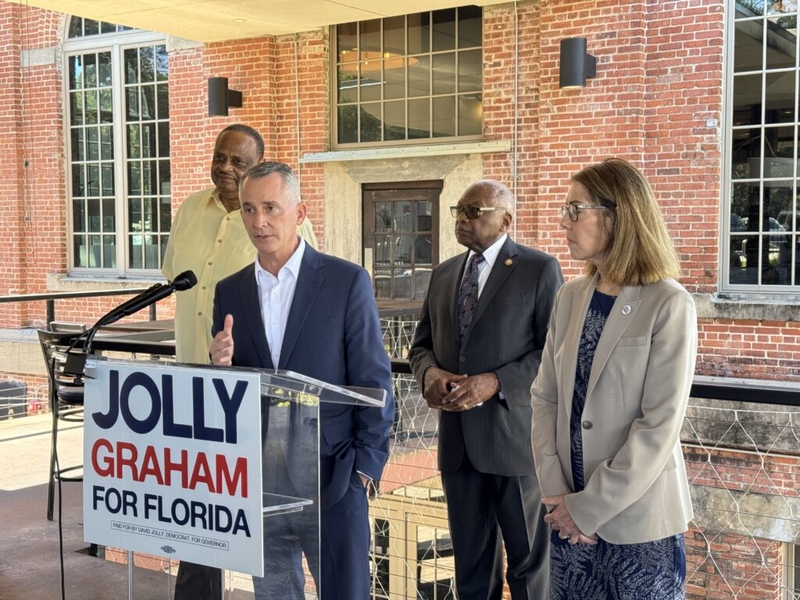
Speaking is former U.S. Rep. David Jolly. Behind him is former Rep. Al Lawson, left, sitting U.S. Rep. James Clyburn, center, and former U.S. Rep. Gwen Graham. (Photo by Jay Waagmeester/Florida Phoenix)
Undecided Black voters, David Jolly says, may decide who becomes Florida’s next governor.
Appearing in Tallahassee Monday, Jolly and running mate Gwen Graham were flanked by U.S. Rep. James Clyburn, a South Carolina Democrat, and former Democratic U.S. Rep. Al Lawson of Tallahassee, both prominent Black political figures.
About 10% of Black voters are undecided, Jolly said, with about 80% of siding with him. An NBC 6 poll shows Jolly with 76% of Black voters’ support and U.S. Rep. Byron Donalds, a Black Republican, with 10%.
“I think there are two final fronts in this race,” Jolly said, one being “the disaffected Republican.”
Donalds is “trying to scare a lot of Republicans to come back home,” Jolly continued.
“But I would say the most important front that this entire race could come down to is the 10% of undecided Black voters in Florida right now. We are around just north of 80 [percent], which historically three weeks out is about where we should be as a Democrat. Byron’s at about 9 or 10 [percent]. And the final front and the voters that might decide this race are the currently undecided Black voters in the state of Florida.”
If elected governor, Donalds would be the first Black governor in Florida’s history. Yet, per polls, Black voters seem to be siding with the Democratic candidate, who is white.
“Someone said to me, ‘Are you concerned, Jolly as a Democrat, you’re only getting about 80-81% of the Black voters,’ and I said, ‘Not as concerned as Byron should be that he’s only getting 9% of his own community. But that last 10% is where I think this race could get decided,” Jolly said.
Jolly on Monday met with the Florida State University Black Student Union and Divine Nine sorority and fraternity chapter leaders at FSU and Florida A&M University.
Angie Nixon, a Black Florida House member from Jacksonville, as the Democratic nominee for U.S. Senate “helps a lot,” Jolly said.
Monday evening, Jolly will appear at FAMU for a town hall. Donalds participated in a town hall on FAMU’s campus last month.
“One of the comments I have made and I’ve continued to make, look, there will be voters who decide to reach for history in this race. Some will reach for history because they want to elect the first Black governor. I don’t argue with that; if that is what is informing a voter, it’s not my place to argue with them,” Jolly said.
“I don’t squabble with the reach for history. That’s not my place to do. I do squabble with the agenda and the platform, and I think Byron has a hard time justifying his candidacy to a lot of communities, including the Black community.”
He pointed to those advising his campaign. Rev. Dr. R.B. Holmes, a Black minister in Tallahassee is chair of a coalition of pastors from historically Black congregations supporting Jolly, and various Black state legislators are part of his leadership team.
The former representative Lawson — who lost his seat when Florida’s Republican governor and Legislature dismantled his minority-opportunity district — insisted Jolly would make Florida history, too.
“A vote for Jolly is a vote to change the course of Florida,” Lawson said.
Tallahassee, FL