Former state senator and Clatsop County commissioner make their pitch to North Coast voters
Oct 09, 2026 | 1:00 pm ET
Description
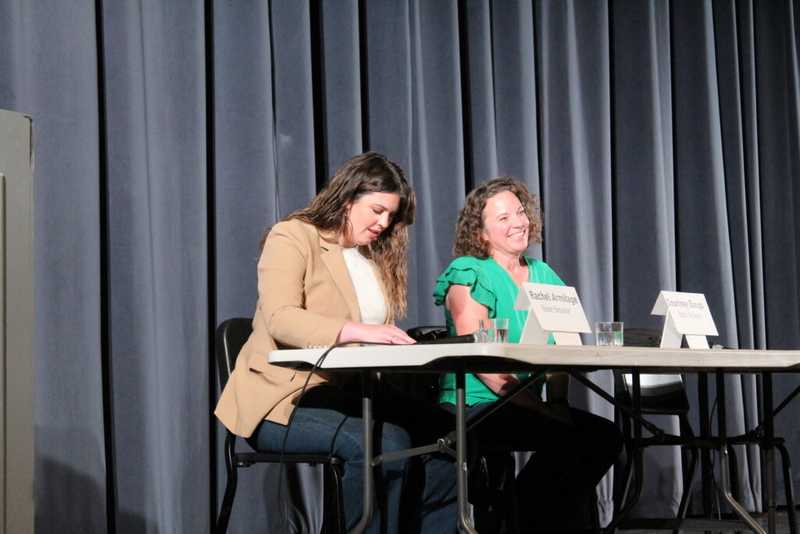
Democrat Rachel Armitage and Republican Courtney Bangs prepare to speak at a candidate forum for their race to represent Oregon's 16th Senate District at Astoria High School on Tuesday, Oct. 6, 2026. (Photo by Mia Maldonado/Oregon Capital Chronicle)
A former appointed state senator and a Clatsop County commissioner will compete against each other in November to represent Oregon’s politically split North Coast in the state Senate.
The seat stretches between the coastal towns of Neskowin and Astoria and east into parts of Washington and Columbia counties. Sen. Suzanne Weber, R-Tillamook, holds the seat, but she can’t seek reelection because she participated in a six-week quorum-denying walkout protesting Democratic bills in 2023. A constitutional amendment Oregonians voted for in 2022 bars lawmakers who miss more than 10 floor sessions without an excused absence from seeking reelection.
Democrat Rachel Armitage and Republican Courtney Bangs are stepping up to fill that seat, but first they’ll have to convince the mostly nonaffiliated registered voters in Oregon’s 16th State Senate District to vote for them. There are slightly more registered Republican voters in the district than there are Democrats, though prior to Weber’s 2022 election Democrats had represented the area for two decades.
At a Tuesday candidate forum at Astoria High School, Armitage framed herself as a candidate who’s been involved in the community from a young age and ready to split from her party if it means voting in the best interest of the district. Armitage previously served in the same senate seat when county commissioners in 2022 appointed her to finish former state Sen. Betsy Johnson’s seat after she resigned to run as an Independent candidate for governor. Armitage served in the Senate for a year.
Bangs, a county commissioner of five years, pitched herself as a working-class mom who has pushed to improve rural childcare, coastal highways and the overall cost of living.
“I’ve always said that if you want to get something accomplished, you ask a busy woman to do it because we don’t have time to waste in accomplishing what we need to get done,” Bangs said.
Forum moderator Craig Hoppes, superintendent of the Astoria School District, asked both candidates about their stances on transportation funding — one of the most pressing issues whoever is elected will have to face. The Oregon Department of Transportation is facing a $200 million budget gap for the 2027-29 cycle. If lawmakers don’t find a fix, the department says it would have to eliminate hundreds of positions and cut preventative and urgent maintenance services for the state’s roads, bridges and highways.
Democratic lawmakers in 2025 tried to raise money for the department by raising the gas tax by 6 cents along with increasing car registration and title fees and the payroll tax meant to fund public transit. A Republican-led referendum in May blocked those fees from taking effect.
Armitage said she opposed raising the gas tax last year, and she also opposed the move by Oregon Democrats to shift the controversial gas and transportation tax referendum to the May primary election ballot from November’s general election.
“I don’t think that working families got a fair deal,” Armitage said. “If we think the gas tax is bad, when you’re on minimum wage and you’re working 40 hours a week at a restaurant and you’re paying a fee to get your license or your vehicle renewed, that takes a healthy chunk of your paycheck and that can be destabilizing for working families in a way that is not acceptable.”
To bridge some of the transportation funding gap, Armitage said she supports charging road user fees for electric commercial fleets that the Legislature currently exempts.
Bangs also opposed the gas tax, even helping gather signatures for the referendum that killed it. Oregon’s roads need the state’s attention, but the transportation agency needs to have accountability with the money it spends, she said.
“When I saw that package come from the state and recognized that an abundant amount of the money was going to go to administrative fees or hiring new managers, I realized that that money wasn’t going to be hitting our roads,” Bangs said. “I also recognized that an abundant amount of that money was going to be going to the Portland metro area.”
She didn’t specify a funding source she’d support to fix Oregon’s roads.
Hoppes also asked the candidates about their stances on abortion.
Bangs said she doesn’t support abortion because of her faith, but she doesn’t see abortion access in Oregon changing anytime soon. Instead, Bangs said she’d like to do more to support women who are seeking or sought abortion.
As county commissioner, Bangs helped lead the creation of a grant program funded through public and private funds to increase childcare across the North Coast, and during the pandemic, she started a food delivery program to families in need.
Armitage commended Bangs for that work, saying the government should do more to make it easier to have children.
Gas tax, party switch are undercurrents in North Coast Oregon House race
“A lot of my friends are choosing not to have children because it’s just too expensive,” Armitage said. “I fundamentally believe in a woman’s right to choose. I don’t think that the government needs to be anywhere near our bodies in any respect, and I think that we need to make our society a whole lot better for parents and children in many ways.”
To boost job opportunities in the North Coast, Armitage said she’d push to cut red tape and fund grant programs that boost small businesses. She’d also push for investments in wastewater treatment so people can create more jobs.
Bangs said she’d adopt recommendations from Gov. Tina Kotek’s prosperity council, a nonpartisan group of business advisers charged with recommending ways to boost economic development. Bangs said she’d start with reducing payroll taxes and raising the ceiling for Oregon’s corporate activity tax, which applies to businesses with more than $1 million in sales or other commercial activity.
Counties will begin mailing ballots to registered voters on Oct. 14. The last recommended day to return ballots by mail is Oct. 27. To return ballots using a drop box, voters must turn in their ballots by 8 p.m. Nov. 3.
Salem, OR