John James introduces bill to use tariff revenue for manufacturer relief
Oct 09, 2026 | 2:16 pm ET

Description
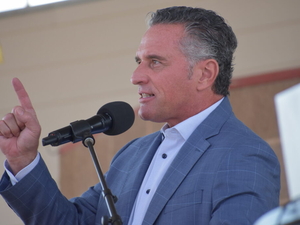
U.S. Rep. John James, R-Shelby Twp., speaks to reporters at the Michigan Capitol in Lansing, Mich., after Michigan Gov. Gretchen Whitmer's eighth and final State of the State address on Feb. 25, 2026. (Photo by Andrew Roth/Michigan Advance)
U.S. Rep. John James, the Republican gubernatorial nominee, introduced legislation in the U.S. House Tuesday to use tariff revenues to help American manufacturers harmed by the increased costs and supply chain disruptions stemming from tariffs levied by the Trump administration on other countries and retaliatory tariffs imposed on the United States.
“Michigan is disproportionally affected by the trade war, so it’s reasonable to use tariff revenue to reduce the effect on Michigan businesses and workers,” the Shelby Township Republican said in a press release from his office. “Our country needs to push back on unfair trade practices, but states like Michigan should not have to shoulder that burden alone.”
According to the text of the bill, H.R. 10759, to receive assistance, applicants must conduct “substantial production, manufacturing, agricultural, processing, or related productive activity in the United States,” and must meet a number of requirements around keeping production and manufacturing activity within the United States.
The legislation would establish several types of aid, including a refundable tariff impact credit, tariff working-capital loans for those “experiencing short-term liquidity constraints,” and rapid relief for “critical employers” in the case of imminent risk of closure of a domestic manufacturing facility or substantial layoffs.

It would also establish an “American investment credit” to fund actions to expand or establish domestic production, reshore supply chains, or substitute U.S.-made products for tariff-affected foreign inputs.
At least 35% of the assistance would be required to go to small or midsize businesses, meaning those up to twice the industry size standard set by the Small Business Act.
The relief would be financed through the “Tariff Relief for American Development and Employment Fund” or “TRADE Fund,” using “net additional customs duties attributable to covered tariff actions, after refunds, drawbacks, and administrative adjustments.”
Tariffs have been a top concern for voters in Michigan and across the country as affordability becomes a central issue ahead of the November general election. James’ Democratic gubernatorial competitor, Secretary of State Jocelyn Benson, has attacked James repeatedly for supporting GOP leadership in levying the tariffs.
The Michigan Smart Trade Alliance is tracking an estimate of the financial impact of tariffs under the Trump administration on Michigan households. The tracker, as of Oct. 9, shows a statewide tariff impact of more than $27.2 billion in Michigan since January 2025, or about $6,667 per household.
“The costs on Michigan families is taking a toll in the form of higher costs and frustration with trade policies and tariffs that are holding our economy back,” Michigan Smart Trade Alliance spokesperson John Sellek said when the tariff tracker was announced. “It’s time to end the trade war with Canada, get both sides to the negotiation table, and find a solution that will end this affordability crisis in Michigan.”
In Michigan, tariffs against Canada — and those levied in retaliation by the Canadian government — have been especially prominent due to the state’s proximity to Canada and a historically strong trade relationship between Michigan and its neighbor to the north.
For example, disputes over tariffs delayed the opening of the Gordie Howe International Bridge between Detroit and Windsor, Ont., and conversations escalated to the point that Canadian leaders hosted a grand opening celebration without any American officials present.

“I fought with Canadians in Iraq. We have a deep and abiding bond that will not extinguish. I’m committed to making sure we continue to improve and deepen our relationships, and making sure our differences are resolved in a civil manner, quickly,” James said. “Our countries need to work out a reciprocal, fair, and mutually beneficial arrangement so we can bring back jobs and protect our industry.”
The House is not expected to hold any votes until after the November general election, and the current legislative session ends in late 2026. However, Congress is expected to return to Washington after the election for a lame duck session that will include voting on appropriations bills for 2027, as funding expires in mid-December under the current funding package.
James referenced the bill in both a Tuesday debate with Benson and in a conversation at the Detroit Economic Club in September, though details of the bill were only just made available Friday.
The bill has been referred to the House committees on Financial Services and Ways and Means.
Michigan Democrats criticized the timing of the legislation — Michigan Democratic Party spokesperson Derrick Honeyman called the bill “nothing but a desperate political stunt from a flailing D.C. politician,” citing the fact that Congress is out of session until after the election.
And a spokesperson for Benson’s gubernatorial campaign similarly called the bill “a last minute political stunt designed to distract from his record of making life more expensive.”
“The timing tells you everything. After voting to continue Trump’s tariffs and getting called out for the $6,400 John James Tax he saddled on Michiganders’ backs, John James introduced this bill only after the House had ended its session and sent members home. If he was serious about passing this legislation he would’ve introduced it when the House was in session and secured even one cosponsor for it,” Benson’s press secretary Rajan Srinivasan said.
Lansing, MI