Election betting is booming as the midterms near. Do states have the power to curb it?
Oct 09, 2026 | 1:30 pm ET
Description
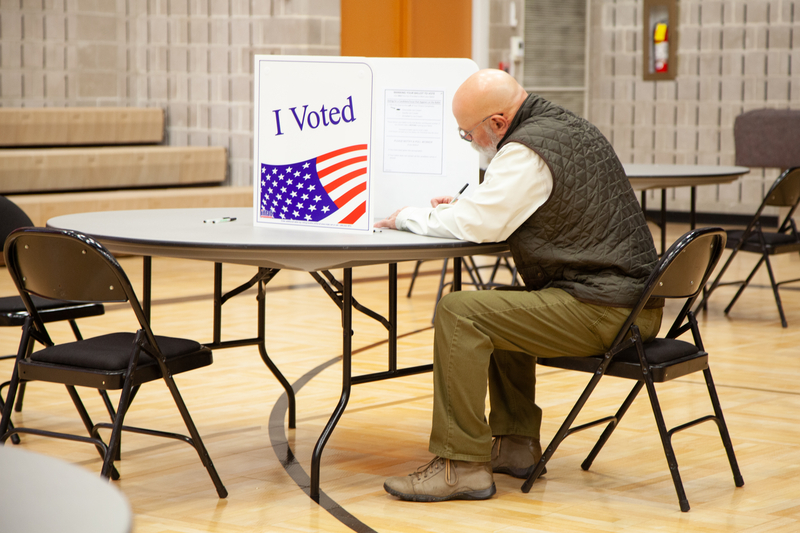
A growing number of state officials fear prediction markets are opening the door to a new era of gambling on elections — a practice many states have long prohibited. In this photo, a voter casts a ballot during the March 3, 2026 primary in Little Rock, Arkansas. (Photo by Katie Adkins/Arkansas Advocate)
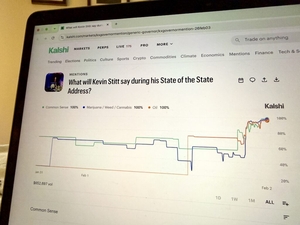
On Friday morning, the prediction market platform Kalshi gave the Democratic candidate in Minnesota’s U.S. Senate race an 87% chance of winning. The volume of trading on the outcome exceeded $1.8 million.
This is exactly the type of activity Minnesota and numerous other states want to shut down.
“They jeopardize people’s trust in government and government decision-making. They jeopardize people’s trust in elections,” said Minnesota state Rep. Emma Greenman, a member of the state’s Democratic-Farmer-Labor Party. She helped spearhead Minnesota’s first-in-the-nation near-total ban on prediction markets earlier this year.
Prediction markets have emerged as a flashpoint in state and federal relations, as a host of states struggle with the Trump administration over who has authority to regulate the platforms and whether state laws restricting gambling apply to them. While much of the fight centers on the future of sports betting, a growing number of state officials fear the sites are opening the door to a new era of gambling on elections — a practice many states have long prohibited.
Some state election officials have warned their residents in recent months that using prediction markets to place money on elections is illegal. Others are locked in litigation with the platforms. At least one state, Arizona, has filed criminal charges against Kalshi.
But the prediction markets remain widely available as Election Day approaches, with the industry maintaining that the federal government has authority over the platforms, not the states.
Betting on control of Congress
On the two leading prediction market sites, Kalshi and Polymarket, individuals can put money down on the outcome of a wide array of races and related questions, like whether Kansas or Nebraska’s U.S. Senate races will have a larger margin of victory.
That includes which party will control Congress following the midterm elections. On Friday morning, the Democratic Party had a 90% chance of winning the U.S. House on Polymarket.
Money changing hands over the outcome of elections is corrosive to democracy and amounts to an attempt to bypass existing bans on election betting, civic organizations and some public officials say. Twenty-three states completely ban election betting, according to data from the National Conference of State Legislatures analyzed by the Pew Research Center.
“It’s supposed to be a civic duty where people are deciding what candidate they actually think is best for a leadership position, not what candidate can make them the most money if they bet the right way,” said Benjamin Schiffrin, director of securities policy at Better Markets, a nonprofit watchdog group advocating for consumer and investor financial protections.
The prediction markets and their supporters say the sites offer contracts that pay out if a given event or outcome occurs. Under that view, the contracts are essentially swaps, a financial product often traded by sophisticated investors to hedge against economic risk.
Critics of the platforms say the contracts effectively function as wagers. Unlike swaps, which investors use to help offset the effects of events like rising interest rates, contracts on sporting events, elections and other non-financial questions serve no legitimate hedging purpose, they say.
CFTC and prediction markets
The Commodity Futures Trading Commission, the federal regulator that oversees markets for swaps, has asserted authority to regulate the platforms.
In a statement, Polymarket said it maintains that “prediction markets are regulated by the Commodity Futures Trading Commission under a federal framework, not a patchwork of state rules."
Kalshi didn’t respond to a request for comment. In a March court filing in a federal lawsuit, lawyers for Kalshi wrote that its events contracts are swaps and that election and sports contracts “fit comfortably” within that definition.
“The outcomes of political events such as elections are connected to obvious financial consequences,” the court filing says.
The Trump administration has firmly sided with the prediction markets. The CFTC is made up of five members, but currently only has a single commissioner, Michael Selig, who was appointed by President Donald Trump in 2025.
Selig has taken a favorable stance toward the industry, and in June the CFTC proposed a rule that would set up a new framework for how the commission regulates events contracts. The rule would continue to allow trading on elections.
In a July 27 letter to the CFTC, 16 civic watchdog groups, including Better Markets, Common Cause and Citizens for Responsibility and Ethics in Washington, warned that the rule ignores concerns about the harm the contracts could cause to elections.
“Event contracts that involve elections allow individuals to bet on elections, which is illegal under many state laws. This election betting would incentivize election interference and has the potential to undermine the integrity of our democracy,” the groups wrote, urging the commission to prohibit election-related events contracts because they go against the public interest.
The CFTC didn’t respond to questions from States Newsroom.
“Congress gave the @CFTC the exclusive authority to regulate prediction markets,” Selig wrote on social media in August. He added that the commission would defend its jurisdiction against states “seeking to nullify federal law and apply state anti-gaming laws” to the platforms.
Maryland issues public warning
In Maryland, Jared DeMarinis, the state administrator of elections, said that in his view, the election contracts on prediction markets violate the plain meaning of his state’s prohibition on election gambling.
The Maryland State Board of Elections, which oversees an office run by DeMarinis, issued a public warning about betting on elections in March and said that even though prediction market sites are accessible to residents, the activity on them may still conflict with state law.
DeMarinis argued that it’s important to take a strong position against election betting while the prediction market industry remains in its infancy. By 2028, a presidential election year, he fears betting on elections could become a more firmly entrenched practice.
“This is kind of like a watershed moment. You can kind of end it before it proliferates,” DeMarinis said.
DeMarinis in July asked the Maryland Office of the State Prosecutor, which investigates violations of state election law, to examine the legality of election-related wagering on the platforms. Maryland State Prosecutor Charlton Howard wrote in an email that the agency doesn’t comment on the existence or status of an investigation unless it results in criminal charges.
Wisconsin advisory, Arizona criminal charges
In Wisconsin, the state Elections Commission issued a public advisory in July warning voters against gambling on elections, including on Kalshi and Polymarket. The commission cautioned that residents who bet on an election and then vote in the contest could have their ability to vote challenged in the future.
The Wisconsin Elections Commission declined to make its administrator, Meagan Wolfe, available for an interview. But in a statement in July, Wolfe said that “it’s important for voters to understand the consequences if they bet on an election outcome.”
Arizona Attorney General Kris Mayes, a Democrat, filed state criminal charges against Kalshi in March. Mayes alleged the company had accepted bets from Arizona residents in violation of state law, including on sports and election wagering related to the 2028 presidential race, along with state-level contests in Arizona in 2026.
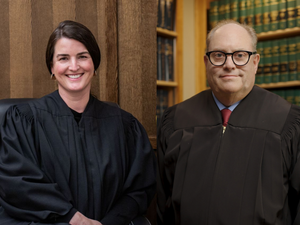
Kalshi preemptively sued over the prosecution in federal court and obtained an order halting the case from U.S. District Court Judge Michael T. Liburdi, a Trump appointee. He ruled that Kalshi was likely to show that a federal law granting the CFTC the authority to regulate swaps preempted Arizona’s gambling laws.
Liburdi wrote in his order that the CFTC had consistently treated weather-based financial products as swaps because weather events produce commercial consequences for a wide range of market participants. Contracts based on sports and elections function the same way, the judge wrote.
“That these event contracts can be used to offset financial exposure confirms the association between the event and commercial consequences to stakeholders,” Liburdi wrote.
Battles in the courts
The fight over who has power over prediction markets — and therefore, potentially, election contracts — is unlikely to be settled until the U.S. Supreme Court takes action.
The 9th Circuit Court of Appeals, which covers much of the western United States, and the 3rd Circuit Court of Appeals, which covers Delaware, New Jersey and Pennsylvania, have issued contradictory decisions.
The 9th Circuit has sided with the states, finding that federal law doesn’t preempt state-level gambling restrictions, while the 3rd Circuit upheld the CFTC’s exclusive power to regulate events contracts.
In September, New Jersey filed a petition asking the Supreme Court to decide whether federal law preempts states from regulating sports bets offered on markets registered with the CFTC — in other words, the prediction markets. The justices haven’t decided whether to take the case, but the high court is generally seen as more likely to intervene when lower courts are divided.
New Jersey’s petition is framed around the uncertainty over sports betting, but the outcome could provide clarity on election contracts as well. In 2024 the CFTC attempted to block Kalshi from offering contracts about which party would control Congress, but an appeals court in the final weeks before Election Day allowed the company to continue.
Schiffrin said the election contracts are essentially the same as the sports contracts.
“You’re betting on the outcome of a contest. It should be considered gambling, no different than if you’re betting on the outcome of a sporting event,” he said.
In Minnesota, a federal judge halted the state’s ban on prediction markets before it took effect this summer after the CFTC, Kalshi and Polymarket sued the state. U.S. District Court Judge Katherine Menendez, an appointee of President Joe Biden, ruled that federal law likely preempts the state’s ban on many contracts offered on prediction markets.
Minnesota bans gambling on elections and hasn’t legalized sports betting. Greenman, the Minnesota state lawmaker, said decisions about whether to allow betting should be made by people in the state.
“We should be rebuilding trust in government decision-making, that the public’s heart — the public’s interest — are what sit at the center,” Greenman said.
All States Newsroom content is free to republish. Read our republishing policy for more information.