Ball State president questions timing of college performance funding push
Oct 09, 2026 | 4:30 am ET
Description
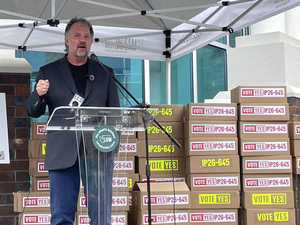
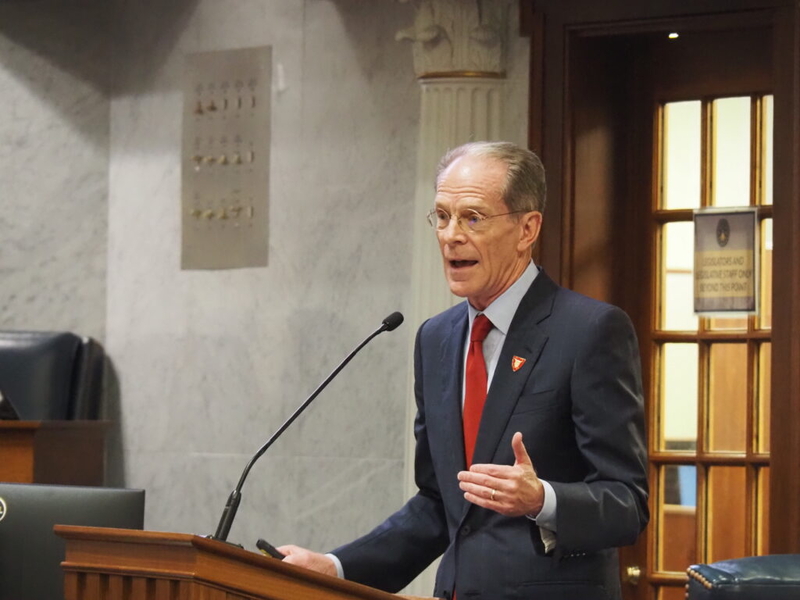
Ball State University President Geoffrey Mearns addresses the Higher Education Commission on Thursday, Oct. 8, 2026. (Photo by Mackenzi Klemann/Indiana Capital Chronicle)
The Indiana Commission for Higher Education’s plan to restore performance funding for the state’s seven public colleges and universities is premature, Ball State University President Geoffrey Mearns told the commission Thursday.
Outcomes-based performance funding accounts for a small portion of Indiana’s higher education budget, using a formula to reward colleges for positive outcomes like on-time degree completion.
Lawmakers zeroed out performance funding in the last budget amidst a dire financial forecast, which later proved false.
The two-year budget cut higher education funding by about 6% from fiscal year 2025.
Now, with state reserves projected to reach $5.2 billion next July, the commission plans to present a simpler version of the formula to the State Budget Committee next month in a bid to restore performance funding in the state’s next two-year budget.
The new version prioritizes affordability, accessibility, on-time degree completion and alignment with industry needs.
Mearns questioned whether there’s enough time to win over lawmakers, whom he said may not realize appropriations to Ball State are roughly the same today as 20 years ago, or that tuition has not outpaced inflation.
He said the state ranks 46th in the nation for higher education funding, which should be a higher priority.
“I think we improve our chances of increasing our investment in higher education if we keep our requests simple,” he said.
The commission met Thursday to hear capital project and line item requests universities intend to present to the State Budget Committee for the next budget.
The current fiscal year budget had no money for construction.
Thursday’s meeting acted as a practice round for college presidents as they prepare to meet with lawmakers, giving the commission an opportunity to share feedback.
Jenner said she anticipates a “very, very tough session.”
Talks between Jenner and university presidents about how to overcome the narrative that a college degree is not worth pursuing led back to outcomes, she said.
“I think it will be helpful for our General Assembly to see, because it’s not just — it’s an investment, but it’s also outcomes that we’re getting for Hoosier students,” Jenner said.
University presidents touted those outcomes in their presentations Thursday, boasting of tuition freezes, improvements in on-time degree completion, collaboration with industry and retention of graduates who still live in Indiana.
They previewed line item and capital project requests like the $54 million biomedical research laboratory and applied engineering center the University of Southern Indiana wants to build, and an $88 million Ball State project that would transform the library into a “21st Century learning commons.”
All of Indiana’s public colleges and universities agreed to freeze tuition for a second consecutive year in 2026.
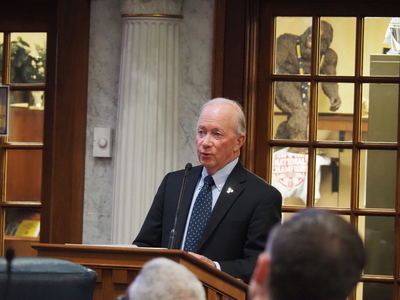
Tuition rates at Purdue University haven’t changed since 2012, a feat President Mitch Daniels said has saved families a collective $2.5 billion in 14 years.
Sixty-seven percent of Purdue students graduate debt-free, with in-state tuition still below $10,000, he said. Students who wish to graduate early can choose from 59 majors that can be completed in three years.
The cheapest tuition in the state is at Ivy Tech Community College, which charges $5,154 a year.
President Martin Pollio said the community college system introduced summer flex credits and transparent textbook pricing to keep costs low for students — 88% of whom leave with no college debt.
“We’re in an era of crippling debt all across this nation for college students, especially college students who leave with no credentials,” he said. “That is setting them up for a life of failure. Four out of five of our students leave with no debt whatsoever, and we get them the credentials.”
Pollio said he will ask lawmakers for a new $13 million line item to pay for deferred maintenance to roofs, HVAC, electrical and plumbing systems, with Ivy Tech investing $98 million of its own money.
Ivy Tech is seeking another $84.5 million to replace outdated facilities on the Terre Haute campus and $78 million toward its Evansville campus.
Daniels intends to ask for $100 million in capital projects funds for a proposed 13-floor health science and engineering hub at Purdue, with plans for offices, classrooms, wellness, retail, dining and student housing in the same facility.
Indiana University will ask for $663 million in capital projects, as well as a new $1.3 million line item to be matched by the school to support its entrepreneurial lab.
Other anticipated capital project requests include:
- $40 million for facilities renewal, consolidation and infrastructure projects at Vincennes University
- $47 million for renovation of Indiana State University’s Holmstedt Hall and decommission of Root Hall
- $88 million for artificial intelligence, new technology and infrastructure updates at Ball State University’s Bracken Learning Commons
- and $90 million for a new building for the growing Miller College of Business at Ball State, presented as an alternative if the first request is denied.
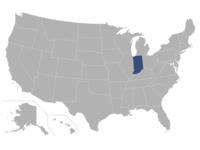
Indianapolis, IN