Debate underlines deep divisions on what WA voters should do about income tax
Oct 08, 2026 | 9:49 pm ET
Description
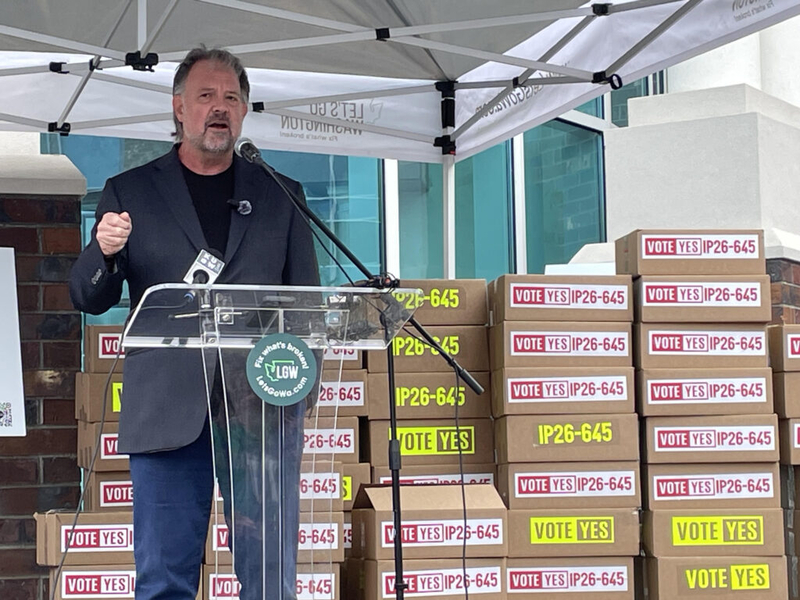
Brian Heywood, leader of Let's Go Washington, speaks at a press conference in Tumwater, Wash. on July 2, 2026 before the group turned in signatures for Initiative 645. (Photo by Jerry Cornfield/Washington State Standard)
An enclave of Washington’s wealthy provided a backdrop Thursday for a saucy debate on the merits and dangers of a ballot measure to erase the state’s controversial new income tax on millionaires.
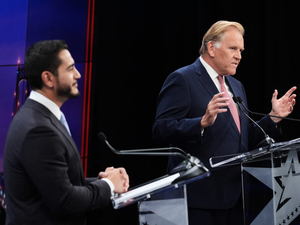
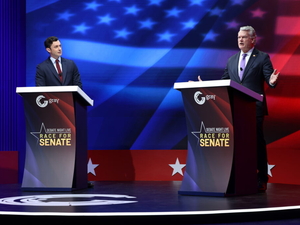
Brian Heywood, the hedge fund manager behind Initiative 645, and House Minority Leader Drew Stokesbary, R-Auburn, argued onstage at the Meydenbauer Center in Bellevue that the tax is unnecessary, will drive some wealthy innovators to other states and, eventually, will be levied on people earning far less than a million dollars a year.
“It’s easy to demonize the millionaires, but they provide an important role in our community. We want capital to come here and to invest in things. It’s that growth that is fueling all the great and wonderful things,” in the state, Stokesbary told hundreds of people attending the Eastside Leadership Conference hosted by the Bellevue Chamber of Commerce.
Joining them for a nearly hourlong forum were two supporters of the tax, Sen. Manka Dhingra, D-Redmond, the deputy Senate majority leader, and Soleil Boyd, executive director of the Children’s Alliance.
They defended the income tax as a necessary stride toward fixing a regressive system in which those who make the least expend a greater percentage of their earnings on taxes than the state’s wealthiest.
Washington, by joining 41 other states with this in their tax code, is better able to deliver services and programs to a growing population, Dhingra said.
“Nice things cost money, and you cannot continue to provide all the things we love, the quality of life that we love, with the most regressive tax structure in the country,” she said. “The math does not work. That’s what 41 other states have figured out.”
Heywood disagreed. “If the funding is not happening, it’s not because of something that happens with the repeal of an income tax,” he said. It’s because of spending decisions made by legislators, said the leader of the political committee, Let’s Go Washington.
Hours later, former Congresswoman Jaime Herrera Beutler, a supporter of the initiative, was set to debate April Sims, president of the Washington State Labor Council, an opponent, on KING 5
What is the fight about
The income tax is a 9.9% tax on individual and household wage income above $1 million a year. The amount of income subject to tax is based on adjusted gross income reported on federal income tax returns.
The tax was created by Senate Bill 6346, which the Legislature passed in March. It takes effect Jan. 1, 2028. The first dollars will start to arrive in 2029. The state’s chief economist estimates the income tax will generate $3.5 billion from 25,000 filers in its first year.
Only a few paragraphs in the 110-page piece of legislation actually concern the income tax. Most of the text deals with how the money will be spent.
For example, the new law eliminates sales tax on diapers, personal hygiene products like soap and toothpaste, and some over-the-counter drugs. It also will repeal sales and use taxes for retail services except advertising services and expand a tax credit program for lower-income families. All this happens in 2029 and the costs are to be covered from income tax collections.
A “yes” vote will repeal the income tax while preserving these other changes. A “no” vote will uphold the tax. Ballots go out by the end of next week for the Nov. 3 election.
Fears and loathing
The potential for the threshold to drop below $1 million is an ongoing flashpoint.
Pro-initiative forces have argued throughout the campaign that Democratic lawmakers will eventually levy the tax on households earning far less than $1 million because they will need the money. “Everybody knows it’s coming to that,” Heywood said.
In recent days, they’ve stepped up their assertions that it will decline to the point where retirees will see their pensions taxed.
Gov. Bob Ferguson, a Democrat, has vowed to veto any bill that would reduce the threshold. Democratic legislative leaders insist they have no plans to do so.
“I do not see a scenario when that threshold gets lower,” Dhingra said, adding that she would expect Heywood to run an initiative to stop it.
A few minutes later, Heywood asked those attending to raise their hand if they thought the threshold would stay at a million dollars, or higher. None did.
“Not one single person believes the income tax is going to stay at a million dollars,” he said.
His side got a little validation recently when Shoreline Rep. Cindy Ryu, a progressive Democrat running for a Senate seat, said she could see it reset at $250,000.
“We have candidates and we have electeds. Each one has their own opinion on how they want to improve the lives of people, but the law itself has an inflator built in” to rise with inflation, Dhingra said.
A fear of the unknown underpins arguments from the other side as well.
Opponents of the initiative forecast near ruination of the state’s social safety net and its ability to care for the most in need should those tax collections not materialize. The situation is already challenging with federal support for Medicaid and a host of social services getting cut and this would make it worse.
“More people will die. More children will not have access to high quality care or education. More families will pay more of their income while prices go up and without any relief from our state,” said Boyd, of the Children’s Alliance. The initiative “is absolutely going in the wrong direction, and the reasoning behind it benefits very few people and harms pretty much everybody else.”
Heywood delivered a sharp rebuttal.
“This is the sort of the trope that gets trotted out all the time: We’re going to spend this for the children, and if you don’t spend the money on the children, if you don’t go for this tax, people are actually going to die for a tax that doesn’t even exist yet,” he said.
Washington has been a successful state and has been the launch pad for successful companies like Boeing, Microsoft and Amazon, without an income tax, and can continue to do so, he said.
Washington voters have been asked 11 times over nearly a century to approve personal or corporate income taxes. The first vote, in 1932, was successful. But a 5-4 state Supreme Court decision in 1933 struck the measure down. Later measures failed, most recently in 2010 when the income thresholds were $200,000 for individuals and $400,000 for joint filers.
Olympia, WA