Debate over energy costs highlights how differently Jackson and Collins approach governing
Oct 08, 2026 | 10:41 pm ET
Description
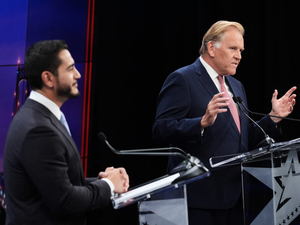
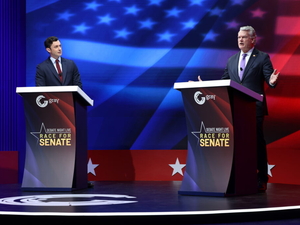
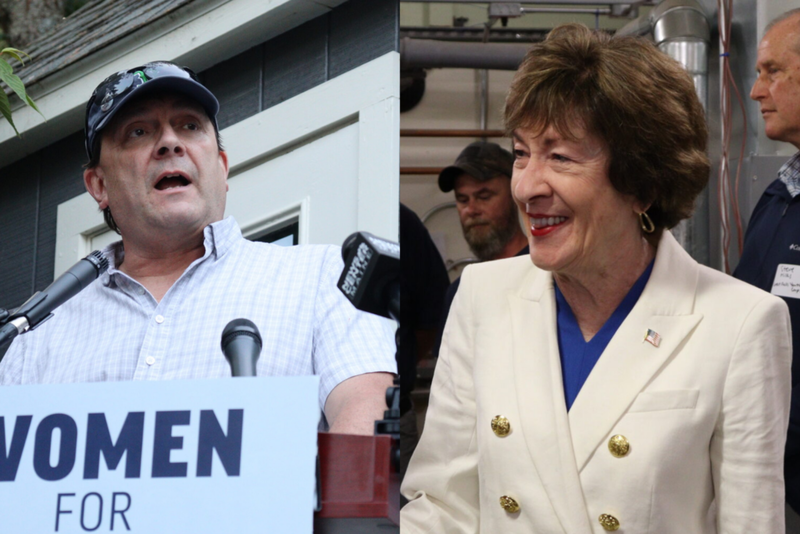
Democratic nominee Troy Jackson (left) and Republican incumbent U.S. Sen. Susan Collins (right) met for the second time on the debate stage on Oct. 8, 2026. (Photos by Emma Davis/ Maine Morning Star)
During the second U.S. Senate debate on Thursday, Democratic nominee Troy Jackson continued his criticism of Republican U.S. Sen. Susan Collins for not doing enough to oppose President Donald Trump’s power, while the incumbent touted her behind-the-scenes efforts to alleviate harm caused by the administration.
That was most acute during the WMTW debate amid discussion of energy costs, specifically soaring heating oil prices, an issue of grave concern to many Mainers as winter approaches.
Speaking over each other until the last breath, the candidates continued their sparring from the first debate on Tuesday over corruption and blaming one another for Mainers’ struggles.
The second debate also highlighted their disagreement over term limits — both for U.S. Congress and the Supreme Court — and agreement on changes to make Social Security solvent.
Energy costs
Heating oil prices have hit record highs in Maine. The Low-Income Home Energy Assistance Program helps certain homeowners and renters with energy costs, but many working families do not qualify and still struggle to pay their bills.
Both candidates said they would support an expansion of LIHEAP. Collins also suggested expanding the weatherization program, which provides free home energy improvements to eligible low-income homeowners.
The senator also said the country needs to become energy independent, which Jackson later echoed. However, he brought the issue back to the Iran War as the main culprit.
“What she doesn’t want to talk about is this is a crisis that was started by her and Donald Trump,” Jackson said.
Jackson said Collins voted five times against ending the war with Iran. Collins said she voted nine times to end the war. Both are correct.
Collins initially opposed early war powers resolutions, saying the War Powers Act gives deference for the president to wage wars for 60 days. She then began to support ending the war after the conflict hit 60 days.
At one point, Jackson alleged that Collins and her husband were profiting off of the Iran War.
“That is absolutely outrageous,” Collins said, “and you owe me an apology.”
In first debate, Collins and Jackson blame each other for Mainers’ struggles
According to Collins’ 2025 financial disclosure, her husband owns stock in two defense contractors for the U.S. military, Boeing and RTX. Her spokesperson previously told Maine Maine Morning Star that her husband’s investments are managed by a third-party adviser and that no individual stocks have been bought or sold from his account in more than three years.
Meanwhile, the senator touted her current behind-the-scenes efforts to address energy costs, saying she expects her conversations with Trump administration officials will result in getting LIHEAP funding released early, as soon as next week, and releasing all of the oil in the Northeast Home Heating Reserve, which is intended for a crisis.
“It’s great that she might be able to get some fuel released. That’s awesome,” Jackson said. “But look, the 100 million gallons that she’s talking about, the average in the United States is anywhere from 20.5 to 23.6 million barrels a day.”
(Actual consumer demand sits at the lower end of that spectrum.)
As the moderator turned to Jackson’s record as former president of the Maine Senate, he was asked about his 2019 vote to expand Maine’s Net Energy Billing program, which was designed to encourage renewable energy projects by offering customers credits to offset their power bills.
“It did cost more than it should have,” Jackson said, “but we reformed it twice.”
Jackson also pointed to the volatility of natural gas prices as a significant cost driver.
Term limits
Both candidates were asked if they support term limits in Congress. Jackson said yes. Collins said no. “That’s what you have elections for,” she added.
When Collins first ran for U.S. Senate in 1996, she said she would only serve two terms. She is now seeking a sixth. The moderator asked what changed her mind.
Collins pointed to the outsized federal earmarks she has secured for the state in recent years.
“What I’ve learned is how much more effective I could be as the seventh ranked person in the Senate versus 99th,” Collins said.
Both candidates were also asked if they support term limits for the U.S. Supreme Court. Again, Jackson said yes, and Collins said no.
Social Security
Discussion of Social Security offered a moment of agreement on Thursday.
Maine has the oldest median age in the country. Both candidates were asked what changes they would support to keep the Social Security Retirement Trust Fund solvent. The fund is projected to be depleted in 2032, after which the program could pay only 78% of scheduled benefits.
“We need to remove the cap so that wealthy people pay in at the same rate as working class people,” Jackson said.
Collins said she agreed that people who make more should pay higher rates for Social Security taxes.
She added, “I believe that we should create a commission of independent financial experts to give us advice on what should be done.”
Corruption
Accusations of corruption have become a focal point of the Senate race. They served as the first line of questioning during Thursday’s debate, though yielded repeat answers from both parties.
Collins continued to deny her alleged involvement in a pay-for-play scheme as first reported by ProPublica. When asked what she would say to voters who believe the report raises legitimate questions about whether campaign donors receive special access or influence, Collins responded, “Well, they don’t.”
Jackson was asked about Washington Post reporting that he helped lead a PAC, the Maine Senate Democratic Leadership, that accepted money from corporations while he was president of the Maine Senate.
Jackson said a group made the decisions about who to take money from and where it should go, not solely him.
“When we took money from a company, it (meant) nothing that we were actually going to support a bill or get a contract,” he added, referring back to the alleged pay-for-play scheme involving Collins.
Jackson and Collins also continued to disagree over how much Collins bucks the president.
Jackson continued to say Collins votes with Trump 96% of the time, which is derived from a CQ Roll Call analysis from the first seven months of Trump’s second term. Meanwhile, Collins said her general party unity score is lower.
Between the start of Trump’s second term and when senators left Washington for the campaign recess, CQ’s latest analysis has her voting in line with the president 92% of the time. Over Trump’s first and second term so far, CQ’s analysis has the senator supporting his position 90% of the time.

Augusta, ME