Maryland People’s Counsel will have to compete to keep his job
Oct 08, 2026 | 8:08 pm ET

Description
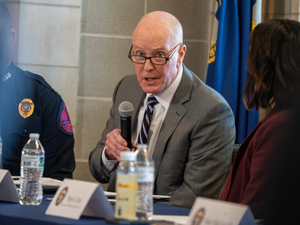
Maryland People's Counsel David Lapp speaks at a news conference in February 2025 alongside Attorney General Anthony Brown. (Photo courtesy the Office of Baltimore City Council President Zeke Cohen)
Maryland Attorney General Anthony Brown is considering new candidates for the role of people’s counsel — the state’s top advocate for ratepayers in regulatory proceedings concerning utility companies.
The current People’s Counsel, David Lapp, who has served in the role since early 2021, says he wants to stay in the role, after his initial five-year term concluded in June.
But the attorney general’s office, which appoints the people’s counsel, posted a job opening on its website nonetheless. In a statement, a spokesperson for Brown said it’s nothing personal — and Lapp will be considered for reappointment.
“This practice should not be viewed as a reflection on David Lapp’s performance. Rather, it is a fair and equitable process that allows for the broadest possible pool of qualified candidates,” said Jennifer Donelan, a spokesperson for Brown, in a statement.
During his tenure, Lapp has been an outspoken voice, often criticizing utility companies for what he considers overspending on gas and electric infrastructure, which has driven up ratepayer bills.
Lapp, who is an attorney, has long expressed concerns about excessive extensions and upgrades to the state’s natural gas pipelines, which he believes could become sunk costs and burden an increasingly small pool of customers as the state looks toward electrification. He has been staunchly opposed to Maryland consumers paying the cost of any electricity infrastructure build-out needed for hyperscale data centers.
Six years ago, Maryland changed how some electric rates are set. It went poorly, officials say.
In a statement, Lapp wrote that “it has been an honor and privilege to serve Maryland’s residential utility customers as People’s Counsel. I am applying for the position, and it would be an honor and privilege to continue serving in the role.”
Maryland law allows Lapp, who was appointed by former Attorney General Brian Frosh, to stay in his role after the expiration of his five-year term “until a successor is appointed and qualifies.” A competitive reappointment process isn’t required. And Lapp’s predecessor held the job for 14 years before her retirement.
But Brown “fill[s] the vast majority of positions through open, competitive recruitment,” Donelan wrote. The job posting closes Oct. 13.
“This is Attorney General Brown’s first opportunity to consider this important appointment and he owes it to the people of Maryland to recommend to the Senate the best qualified person for the Office of People’s Counsel,” Donelan wrote.
Before his time as People’s Counsel, Lapp was an assistant Maryland attorney general from 2004 to 2020. During that time, he was chief counsel of the office’s tobacco enforcement unit, which litigated against tobacco companies and managed the large multistate settlement that resulted. He also later served as deputy counsel to the Maryland Department of Health.
If he is reappointed by Brown, Lapp will have to be confirmed by the Senate — where he has faced some sharp words recently from Senate President Bill Ferguson (D-Baltimore City), who took issue with a transmission project in his district and the OPC’s handling of a legal loophole affecting the project.
But Lapp has the backing of House Speaker Joseline Peña-Melnyk (D-Prince George’s and Anne Arundel) and a large group of House Democrats. More than 70 delegates signed a letter to Brown in “strong support” of Lapp continuing in the role.
“Not only has Mr. Lapp increased the workload of the Office on behalf of utility customers, he has transformed the Office from a largely reactive agency to one that now routinely initiates matters before regulatory agencies,” reads the letter.
The letter states that Lapp’s office has had more success before regulatory bodies as well. In fiscal year 2025, the office participated in 226 cases and achieved 149 favorable decisions, compared to 200 cases and 94 favorable decisions in fiscal year 2020, before he arrived. That’s an increase in the success rate from 47% to 66%.
Utility companies have publicly sparred with Lapp’s office at times. After Lapp’s office filed a petition calling for an expanded investigation into Baltimore Gas & Electric’s safety inspections, after an inspector was found to be falsifying reports, for example, a BGE spokesperson criticized Lapp.
“OPC, in yet another in a long line of bombastic press releases meant to support its relentless effort to eliminate customers’ ability to use natural gas, is trying to improperly sway the determination of the public utility law judge overseeing this matter,” a BGE spokesperson told Baltimore television station Fox45 in March. In an April letter in response, Lapp’s office said those comments were “irresponsible and do not serve the interests of BGE customers or the public interest.”
In the past, Brown has supported Lapp on the issue of gas pipeline spending. In December 2024, the two co-wrote a Baltimore Sun editorial, in which they called for reforms to Maryland’s STRIDE law, which lets gas utilities recover the costs of pipeline improvements in advance of performing the work. The two appeared together during a February 2025 news conference on the issue.
Del. Marc Korman (D-Montgomery), who chairs the House Environment and Transportation Committee, was a leading signatory on the letter supporting Lapp.
“I appreciate that the AG has to run this process,” Korman said. “I hope that as part of that process, he sees what a great job David Lapp is doing, and chooses to reappoint him.”
Del. Lorig Charkoudian (D-Montgomery), who also signed the delegates’ letter, said she has spent “countless hours” with Lapp and his staff, including nights and weekends, poring over energy policy to try to make improvements that help ratepayers.
She praised Lapp’s work not only interrogating rate increase requests at Maryland’s Public Service Commission, but challenging the underlying policies at the regional grid level that are “rigged against everyday people.”
I appreciate that the AG (attorney general) has to run this process. I hope that as part of that process, he sees what a great job David Lapp is doing, and chooses to reappoint him.
“In my mind, there’s so many levels at which the work he’s doing is helping Maryland ratepayers at the short term, medium term, long term,” Charkoudian said. “When you start to comprehend the fullness of it, you’re like: ‘Wow, we are so lucky in Maryland.'”
She commended Lapp for his work on the extension for Maryland coal plant Brandon Shores. Lapp argued that the plant’s owner was over-inflating the costs it would take to keep the plant running, which consumers must bear. But he also fought the fact that the power the coal plant was not counted in a critical energy auction, driving up costs for consumers across the region by an estimated $5 billion. After Lapp’s advocacy, the regional grid operator changed the policy. He also made a filing urging regulators to return the $5 billion to consumers.
“PJM was like: ‘These are the rules. Too bad.’ And he was like: ‘Let me fight the rules,'” Charkoudian said.
Consumer advocacy group Maryland PIRG highlighted Lapp’s role in winning a significant $1.1 million civil penalty against Washington Gas for customer service issues. That came in 2022, following a 2021 complaint from the Office of People’s Counsel.
“In his time as People’s Counsel, David Lapp has been a powerful and effective voice for energy customers working to stop wasteful utility spending and anti-consumer decisions that drive up our bill,” wrote Maryland PIRG senior adviser Emily Scarr. “He is recognized as an effective consumer advocate not only in Maryland, but nationwide.”
But during the most recent legislative session, Ferguson blamed Lapp for not drawing enough attention to a legal loophole involving underground transmission lines.
Maryland officials say changes to electric grid governance aren’t enough
But Lapp’s office had repeatedly raised the issue starting as soon as 2023, including in news releases and filings to state and federal regulators — highlighted the fact that, because the projects receive fewer layers of review, costs could soar.
At the time, Ferguson was speaking out against an underground power line proposed for his district, in the historic Otterbein neighborhood. It was planned to route power to Baltimore Peninsula, even amid flagging development there.
Local projects like the one proposed for Otterbein are considered “supplemental transmission projects,” and officials at the regional transmission grid, PJM Interconnection, don’t conduct competitive bids — unlike with larger regional transmission projects.
Instead, the utilities select the projects and PJM conducts a “do no harm” review. Their cost-effectiveness can only really be challenged at the Federal Energy Regulatory Commission — after the projects are built.
In addition, Maryland regulators only conducted site reviews for overhead transmission lines, further reducing the scrutiny they receive. With key support from Ferguson, the state legislature passed a measure bringing underground lines before Maryland regulators for a siting review for the very first time.
“Frankly, I’m incredibly disappointed in the Office of People’s Counsel, who is charged with protecting ratepayers,” Ferguson said in February. “How this has not been flagged in the past is really unbelievable to me.”
In March, Lapp’s office released a detailed study it had commissioned in 2025, which determined that the costs of supplemental projects were rapidly increasing. The report indicated Maryland customers paid $2.8 billion for supplemental transmission from 2010 to 2030 — and could pay an estimated $2.2 billion more between 2031 and 2035.
“These local projects have been a high priority of our office, and we are encouraged that the legislature is giving it specific attention,” Lapp wrote in a March letter to committee leaders in the General Assembly, citing his years of advocacy work on the issue.
Annapolis, MD