Summit pushes for utilities commission action on outstanding pipeline dockets
Oct 08, 2026 | 6:27 pm ET
Description
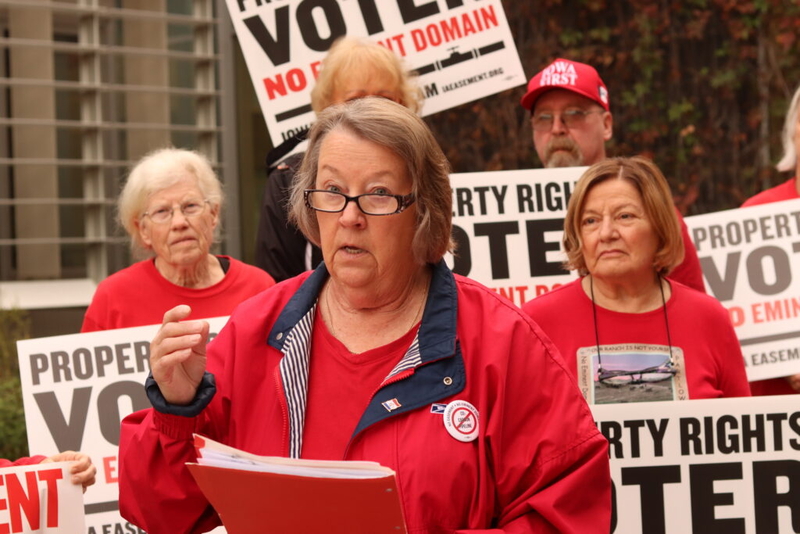
Kathy Carter, a Floyd County landowner, speaks outside of the Iowa Utilities Commission Oct. 8, 2026 in opposition to a carbon sequestration pipeline. (Photo by Cami Koons/Iowa Capital Dispatch)
The Iowa Utilities Commission has denied a request from Summit Carbon Solutions, the company seeking to build a carbon sequestration pipeline in Iowa, to consolidate outstanding dockets and schedule a hearing.
The IUC issued hearing schedules for two sections of pipeline in the company’s second phase of the project, but denied Summit’s request to combine the dockets.
The IUC did not rule on the remaining dockets for phase 2, which could still be consolidated in the future, as Summit has requested. Summit’s phase 2 pipeline routes would add laterals to the pipeline, allowing it to connect to more biorefineries than the original route included.
In the request, Summit said the IUC has scheduled and held hearings and issued orders for “several other energy infrastructure projects” but has been “ignoring Summit.” Summit’s initial filings for the project were made between October 2024 and September 2025, according to the request, but the company said it has not received the “basic procedural path” forward.
“Even if this Commission’s answer is ultimately no—though we see no reason why that would be the case, giving the Commission’s prior rulings—further delay on the bare minimum process (setting a hearing) will irreparably harm Iowa’s reputation,” the company wrote in the request for consolidation.
Summit argued that while other states and the federal government are “speeding up the permitting process, recognizing that energy infrastructure is paramount” the IUC is “making the process longer and more cumbersome.”
Summit said the drawn-out process is harming the ethanol industry and farmers who want access to the low-carbon biofuel markets the carbon sequestration pipeline would open up. The company said delaying a hearing on the docket is also harming landowners who want their objections heard and rural communities with a stake in the investment.
Colleen Tucker, a landowner from Mitchell County, addressed commissioners during public comments at a meeting Thursday and said it was “incredibly bold and frankly offensive” for Summit to speak on behalf of landowners in its filing.
Tucker said the IUC is not responsible for Summit’s investments and that the company’s investment in the project “doesn’t give the company a regulatory shortcut or a cut to the front of the line.”
IUC, in its order denying the consolidation of dockets, noted the lawsuit against Summit’s permit for phase one of the project as “part of the larger picture” impacting the docket.
Summit’s initial permit for more than 600 miles of pipe through Iowa, phase one of the project, was approved by the Iowa Utilities Commission in 2024, giving the company the right of eminent domain for the project. Landowners, the Sierra Club Iowa Chapter and several counties challenged the permit, arguing Summit should not be considered a common carrier.
In fall 2025, Summit filed a request to amend its permit with the IUC to no longer travel through South Dakota and to a sequestration site in North Dakota. The lawsuit over the initial permit was partially remanded to the IUC because of the amendment, and according to the IUC response, comments on how to proceed with the permit included a request to keep the Floyd and Ida County dockets in phase two as “stand-alone dockets.”
IUC held a hearing in September to determine a hearing schedule on dockets for two sections of pipe planned for Ida and Floyd counties, both of which are less than 5 miles. In its responses denying Summit’s consolidation request, IUC finalized hearing dates for the segments. The docket pertaining to Floyd County will be heard March 23, 2027 and the Ida County hearing will occur Feb. 23, 2027. Both will be held in Des Moines and are later than the middle of December hearing dates requested by Summit.
Summit announced in May that it planned to direct the pipeline west toward Wyoming and that it was considering using the CO2 for enhanced oil recovery, a process where the liquified carbon dioxide in the pipeline can be injected into the ground near existing oil fields to help push the oil to the surface.
Landowner opposition
Landowners opposed to the project said some of them were denied requests to intervene in the upcoming hearings because, though they live near the proposed route, they don’t own property in the counties.
Don Johannsen, a Cherokee County landowner, said the route is on adjoining land to his property and would directly impact him.
“They’re assuming that because I’m not on the line in Ida County, that it doesn’t affect me, but it clearly does,” Johannsen said while speaking to reporters Thursday morning.
The issue of who can intervene has been brought up throughout the Summit proceedings with the Iowa Utilities Commission. Lawmakers opposed to the project, or its use of eminent domain, have proposed legislation to widen the pool of people who could intervene in proceedings.
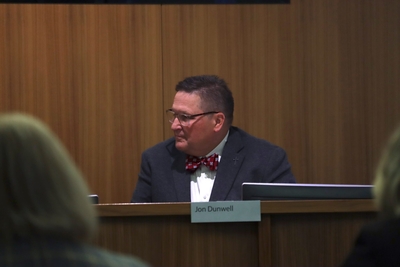
Landowners gathered Thursday ahead of the Iowa Utilities Commission’s first monthly public meeting with its newest commissioner, Jon Dunwell, who was appointed Monday by Gov. Kim Reynolds. Those gathered, in their signature red shirts, said they were opposed to the recent appointment and argued Dunwell’s past as a legislator made him partial in the pipeline issue.
Dunwell resigned his seat in the Iowa House of Representatives to accept the commissioner appointment, which will require Senate approval.
Kathy Carter, a Floyd County landowner, said she was “really concerned” with the newest commissioner.
“Because of his past on the Legislature and his ability to vote, I believe it’s a conflict of interest,” Carter said Thursday ahead of the IUC public meeting. “Anybody who’s been in that position to affect any legislation should not have the ability to vote on the IUC.”
Dunwell voted in favor of legislation in 2025 that would have imposed certain limitations on carbon sequestration pipelines in the state. This bill passed the Senate in 2025 after a group of senators held up votes on budget bills until the body debated the legislation. The bill was ultimately vetoed by Reynolds.
Dunwell voted against a House bill earlier this year that would have banned the use of eminent domain for carbon pipelines in Iowa, but the bill was not taken up in the Senate.
During the public meeting, Commissioner Joshua Byrnes, who also previously served as a state legislator, said commissioners are not always able to be “experts” on everything, noting the number of issues the commission handles, in addition to pipeline issues.
Property rights and the election
The landowner group said they have sent out surveys to all of the candidates running in state, federal and local races to ask them about property rights. Weston Grow, a Guthrie County landowner, said the group plans to release the responses to the questionnaire next week.
“Each and every legislator will tell you they are for property rights – they have been for almost six years,” Grow said. “We’re tired of waiting. It’s election time. Just like all the phony political ads we are reading, hearing, and seeing, don’t believe just because a politician says they are for property rights doesn’t mean that they actually are.”
Des Moines, IA