Arizona high court to consider whether Clean Elections can claw back disputed funds
Oct 08, 2026 | 6:21 pm ET
Description
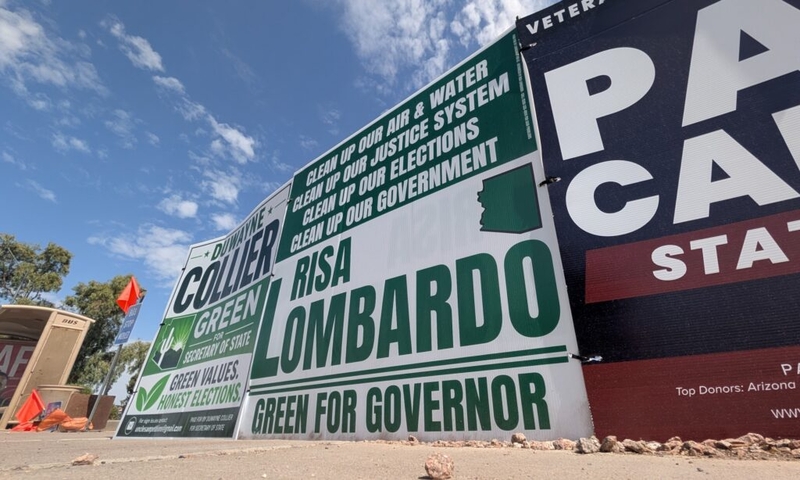
Risa Lombardo and Duwayne Collier are asking the Arizona Supreme Court to halt a Clean Elections investigation into whether they received millions of dollars in public campaign funding because of fraud. (Photo by Jim Small/Arizona Mirror)
Once candidates qualify to receive public campaign funds, there’s nothing the Clean Elections Commission can do to claw back that funding, even if fraud is later discovered, two Green Party candidates being investigated for fraudulently qualifying for millions in public campaign funds told the Arizona Supreme Court.
On Thursday, the state’s highest court agreed to hear the case. A trial court judge dismissed the pair’s lawsuit earlier and the Court of Appeals declined to take up their appeal of that dismissal.
Risa Lombardo and Duwayne Collier, the Green Party nominees for governor and secretary of state, asked the court to preemptively block the Citizens Clean Elections Commission from ordering them to repay a total $3.7 million. The two argued that, even if they did commit fraud, the commission lacks the authority to make them return the funds, and that the proper place to address potential fraud is the criminal court system.
Lombardo, Collier and and Republican Scott Neely, who lost his primary for governor to Andy Biggs, are all under civil investigation by the Clean Elections Commission and criminal investigation by the Arizona Attorney General’s Office for accusations that they falsified documentation for enough $5 contributions from voters to qualify for a collective $4.7 million in public campaign funds.
“Despite the fact that the Defendants have no such power, they have threatened the candidates with dire consequences if the candidates do not effectively end their campaigns,” Tim La Sota, an attorney for Lombardo and Collier, wrote in their petition to the high court.
La Sota accused Tom Collins, the executive director of the Clean Elections Commission, of attempting to bully his clients into ending their campaigns via letters he sent to them on Aug. 25 informing them of an investigation into their campaign finances. La Sota accused Collins of targeting his clients because of a political grudge, noting that Collins called them “sham” candidates in the letters.
But that wasn’t his opinion — rather, he was quoting the Arizona Green Party, which initially described Lombardo and Collier as “sham” candidates. That’s because they had no connection to their registered party and numerous ties to the Republican Party.
Collins invoked the Green Party’s label to demonstrate that the candidates didn’t have the backing of their political party to organize volunteer efforts to help the candidates qualify for public financing, something that regularly happens for Clean Elections candidates. State law bans candidates from paying people to gather those contributions,
In the letter to Lombardo, Collins warned her that, based on his preliminary investigation, he anticipated asking the commission to order her to repay potentially the entire $2.8 million she received once the full investigation was complete. He advised her to seek legal representation and to stop spending the money.
“This threat of having to repay millions of dollars is enough to stop the Candidates in their tracks,” La Sota wrote.
He said that the letters had forced the longshot candidates to suspend their campaigns.
The Green candidates say that only the Arizona secretary of state, along with the county recorders, have the legal authority to determine whether candidates collected enough $5 contributions from registered voters to qualify for public funding, and that the Clean Elections Commission has no say in the matter.
Like other Clean Elections candidates, Lombardo, Collier and Neely agreed to forgo large contributions and money from PACs in exchange for a fixed amount of public funding, based on the office they seek.
In August, the Arizona Mirror exclusively reported that six people who were listed in campaign finance records as having made $5 contributions to all three candidates were adamant they didn’t give any money to the candidates.
While La Sota said in numerous court filings that Collins’ investigation heavily relied on the Mirror’s reporting, Collins said in the letters that it merely confirmed what the Clean Elections Commission had already found.
“Collins’ insinuation seems to be that these donors did not actually donate the $5 themselves,” La Sota wrote. “But that conspiracy theory necessarily relies on thousands and thousands of people falsely signing the $5 Qualifying Forms attesting to the fact that they personally contributed $5. And again, the County Recorders verified the signatures and elector status of the $5 donors.”
This misstates what the Mirror found in its investigation. The six people who said they didn’t make the contributions said they believed their signatures had been obtained from unrelated petitions solicited in places like grocery store parking lots and fraudulently used on the qualifying contribution forms.
The Green candidates told the high court that the six people who said they didn’t make the contributions weren’t significant when the candidates purportedly collected 8,000 donations to qualify. The Mirror attempted to contact about 50 of the people listed as contributors, and none of them replied to confirm that they had made the contributions.
Because many of the people were listed as donating to two or all three of the accused candidates — another oddity that Collins noted in his letters as preliminary evidence that fraud had occurred — there were significantly fewer than 8,000 individual contributors.
The Mirror and the Clean Elections Commission found that Lombardo, Collier and Neely listed contributions from nearly 4,000 of the same voters, including more than 2,600 who were listed as giving to all three.
The duplicated contributions across multiple candidates account for nearly 75% of the voters listed as giving qualifying contributions to the trio.
At the same time that the Green candidates petitioned the Arizona Supreme Court to take their case, they refused to comply with the Clean Elections Commission’s subpoenas for campaign finance records and correspondence for its investigation. La Sota told the commission in a Sept. 24 email that the subpoenas were “overbroad and harassing” but would not point to any specific document request that went too far.
The five-person commission voted on Oct. 6 to deny their request to quash the subpoena. When they chose to participate in Clean Elections so they could receive public campaign funds, the candidates agreed to supply campaign finance documentation necessary for the commission to complete audits of their spending. The commission could take them to court to force them to comply.
Also on Oct. 6, the commission voted to extend the timeline for the civil investigation past its Oct. 29 deadline because of the candidates’ refusal to comply with the subpoenas.
Both the trial and appeals courts agreed within the past two weeks that it was too soon for the courts to rule on the Green candidates’ arguments since the Clean Elections Commission hasn’t finished its investigation or ordered them to repay the campaign funds.
La Sota told the Arizona Supreme Court that the lower courts were wrong, and that now was the only time for the courts to act since the Clean Election Commission was threatening to take action outside of its legal authority, and the issue would be moot after the Nov. 3 election. The Clean Elections Act gives the commission broad authority to enforce its rules and regulations.
“Without relief now, the Candidates will be threatened into silence and submission — relief later is useless because there is no way to give these Candidates back the chance to run the campaign they wanted to run with the funds that they are lawfully entitled to,” La Sota wrote. “Already, over a month has been lost thanks to the Respondents’ heavy handed, illegal threats.”
The Arizona Supreme Court is set to discuss the lawsuit on Oct. 14.
Phoenix, AZ