Democrats fight to hold a competitive Mesa seat in bid to flip the legislature
Oct 07, 2026 | 7:46 pm ET

Description
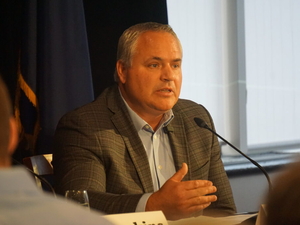
Rep. Lorena Austin and Jacob Martinez, both Democrats, and Republican Brad Bettencourt participate in the Clean Elections debate for Legislative District 9 on Oct. 6, 2026. The debate was moderated by journalist TJ L'Heureux of the Arizona Agenda. (Screenshot via Arizona Citizens Clean Elections Commission/YouTube)
Democrats are hoping to hold onto a Mesa legislative district in their bid to capture the state legislature, fending off a challenge from a Republican with ties to Kari Lake.
Legislative District 9, which stretches across Mesa’s downtown core and much of the west side of the city, leans Democratic but is among the most competitive districts in the state. Its two seats in the Arizona House of Representatives have been held by Democrats since 2022, though it’s been close.
In 2022, Seth Blattman narrowly defeated a Republican opponent to win his first term by just 760 votes. Two years later, Blattman eked out a second term with a vote difference of 928 between him and another Republican candidate. Blattman chose not to run for re-election this year.
During a Tuesday debate, political newcomer Jacob Martinez and Rep. Lorena Austin, who is seeking re-election, called on voters to reject Republican Brad Bettencourt, characterizing him as an outsider who will push many of the same policies the current GOP majority has.
“I think it’s very clear that the choice for our district should be people who are from this community, who love it and who will always advocate for it,” Austin said.
Austin and Martinez both grew up in Mesa. Bettencourt, who attended Arizona State University and has lived in Arizona for many years, touted his career in banking as proof that he is best suited to addressing affordability issues at the state legislature.
“Who up here actually has made the numbers work in the past? And who’s in the best position to make your life more affordable?” he said.
Bettencourt’s past criticism of the state’s elections were particularly spotlighted on Tuesday. Bettencourt previously worked as a technician at a vote center in Maricopa County in 2022, and testified that same year as a witness for failed gubernatorial candidate Kari Lake as she tried to overturn her loss to Democrat Katie Hobbs.
When asked on Tuesday whether he believes Hobbs was legitimately elected, Bettencourt refused to say she was.
“Katie Hobbs is currently governor,” he said in his first response. “If anyone doesn’t like that, they can vote in November.”
Shortly after Joe Biden won the 2020 election, Republicans who falsely claimed that Trump won frequently sidestepped the issue at the time by asserting that Biden was the sitting president. When pressed on whether he believes Hobbs was legitimately elected, Bettencourt conceded that she was elected, but omitted the key word “legitimately.”
“She’s elected governor,” he said.
While Bettencourt complained that he witnessed “some of the most incompetent and inefficient group of workers” during his time in Maricopa County elections, he was unable to say what legislation he would advance in the state legislature to improve conditions. Instead, he blamed the county’s election issues on “sloppiness.”
Meanwhile, Austin, who is Arizona’s first nonbinary legislator and uses they/them pronouns, said they would be interested in working to make elections more accessible for disabled voters and placing more ballot boxes in rural areas. And Martinez said he would push for the state to allow election workers to tabulate early ballots turned in on election day immediately, which he said would help speed up results and help raise public trust.
“People’s biggest complaint with our elections is that we don’t get results fast enough,” Martinez said. “Yet the Republican legislature refuses to allow early ballots to be counted before a given date, (which) then delays the entire count.”
All three candidates agreed that investment companies have strained the state’s housing market, but differed on whether lawmakers should take action against them. Austin pointed out that Democrats have proposed legislation to cap the number of properties investment companies can purchase in the past, but the Republican-controlled legislature has refused to consider it. They urged voters to support Democratic candidates in November to help that legislation become a reality.
“We have to do something different,” Austin said. “We’ve had bills on the table as Democrats but they’ve not received hearings, and so I hope that changes with a Democratic majority next session.”
Democrats have sought to flip party control of the state legislature several times in recent years, with no success. Republicans have held onto a majority in the state House since 1966 and have controlled both legislative chambers for all but four years in the past 60 years. But this year’s record-low disapproval of President Donald Trump and polls showing voters overwhelmingly prefer Democratic candidates over Republicans have reenergized hopes of toppling GOP control of the state legislature.
Martinez said he would prefer even tighter control of investment companies in the housing market, advocating for a full ban on companies buying single-family homes, which some economists have said is a key factor in the housing affordability crisis in Arizona and beyond.
But Bettencourt, a real estate investor, said that he would rather use other tools to increase homebuilding, like streamlining local permit processes. He added that he would consider a cap on how many properties investment companies could purchase, though he couldn’t say what that cap would be. And when Martinez criticized corporate landlords for failing to maintain residences, Bettencourt said tenants should be aware of their legal rights.
Martinez lambasted Bettencourt for his unwillingness to regulate investment companies, saying that the Republican wouldn’t advocate for the interests of everyday Arizonans but would instead focus on protecting the financial interests of investors like himself.
“Brad owns over 50 homes and has bragged about owning 50 homes,” Martinez said. “So, putting any sort of cap on what properties people can be buying and ensuring families can afford (them) — it benefits Brad to not do that. And that’s not the kind of representation that we need making decisions down at the Capitol.”
Bettencourt rebutted that he himself doesn’t own 50 homes, but that he co-owns multiple properties, along with others, which he said is “normal for someone who’s an investor.”
The trio also weighed in on education funding, particularly the state’s ballooning universal private school voucher program. Formally called the Empowerment Scholarship Accounts, the program has grown to an annual cost of more than $1 billion, and has been widely criticized for resulting in luxury purchases, like diamond rings and airline tickets.
Republican lawmakers have refused to contemplate regulating the program or instituting reforms aimed at creating accountability.
Austin and Martinez both said they would back legislation to implement changes in the program, including an income eligibility cap, reporting requirements or academic standards for schools that receive ESA dollars. But they also noted that doing so would be impossible without first flipping party control of the state legislature.
“We’ve heard so much talk about waste, fraud and abuse, yet when it’s money spent on lingerie or diamond rings under the guise of the ESA program, the Republican legislature stands by and does nothing,” Martinez said. “They’d rather see public education continue to be defunded and not have the resources they need than ensure that there’s accountability and that students in public schools have what they need to succeed.”
Bettencourt, meanwhile, said he wouldn’t change a thing about the voucher system.
“A lot of the families in my district like the ESA program and school choice, so I don’t want to make massive changes to it. But always look out for the fraud,” he said.
But when pressed on what changes could be made to address any fraud found, Bettencourt waffled, saying program administrators are working to do that already, and that he believes the rate of fraud in the program is far lower than in other government programs.
Martinez needled Bettencourt on his answer, criticizing him for replicating the GOP party practice of turning a blind eye to issues in the program. Bettencourt sharply replied that he opposes the fraudulent use of public dollars anywhere and added that some public schools also misuse taxpayer dollars.
Republicans frequently cast aspersions on public schools to deflect concerns about the ESA program, despite the fact that public schools — unlike the vendors that accept ESA money — must account for every dollar spent and undergo multiple audits and performance reviews. They also are required to accept every student in their district, unlike the private schools that take voucher payments.
The lawmakers that make up next year’s legislature must also consider whether to renew Proposition 123, a $300 million annual funding source for public schools. The initiative expired last year, and Republican lawmakers have been unable to come to an agreement to revive it, with some wanting to attach increased reporting requirements to it and others clamoring to earmark the money for teacher salaries, even though the education advocates and teachers themselves argue that letting public schools choose what needs the funds go towards is best.
Whatever the final deal looks like must be sent to voters for approval. Martinez and Austin said they would back a clean extension of the original funding plan, without adding extra requirements or caveats for schools to deal with, in line with what Democratic lawmakers have been pushing for two years. But Bettencourt was unable to say what he would support, admitting that he didn’t know enough about it to have an opinion.
“I know a little bit about this one, I’m not an expert on it yet,” he said. “I do want to get that through, but I know there has been some back-and-forth in the legislature so, this one I’d review a little more.”
Phoenix, AZ