Warmer soil and a warmer, wet winter expected in Iowa with super El Niño
Oct 07, 2026 | 7:41 pm ET
Description
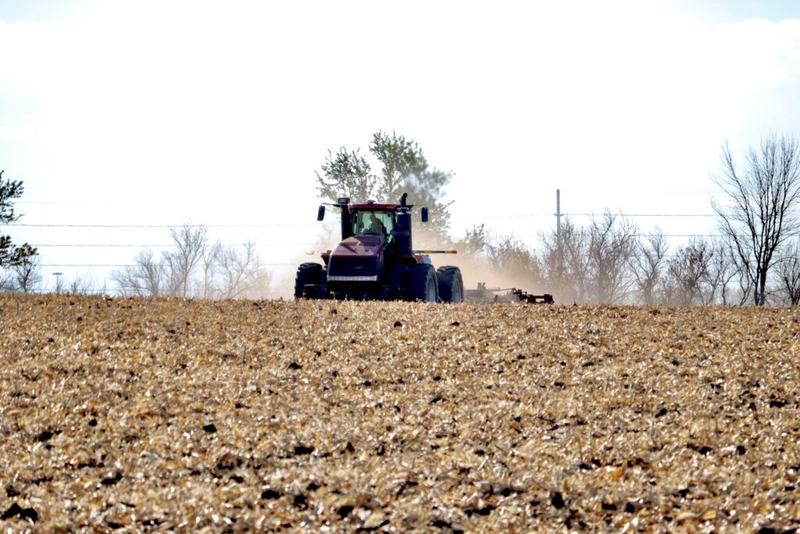
A farmer tills a harvested corn field in late October, 2024 near Boone. (Photo by Cami Koons/Iowa Capital Dispatch)
Weather patterns across Iowa, influenced by an abnormally strong El Nino pattern, will likely impact fall nutrient applications for farmers, according to weather and crop scientists in the state.
Climatologist for the state of Iowa Justin Glisan said Wednesday on a webinar hosted by the Iowa Farm Bureau Federation that the “cake is already baked” for a “very strong” El Niño event, beyond what has been “seen in the observational record.”
El Niño is a pattern observed when ocean temperatures in the equatorial Pacific are unusually warm, according to the National Oceanic and Atmospheric Administration. The warmer water, or cooler water in the event of a La Niña year, influences weather in the U.S. and around the globe. Glisan said there is a “huge plume of very warm surface-based waters” in the eastern equatorial Pacific that is leading to what has been described as a “super” El Niño.
Analogs from past strong El Niño years and climate outlooks from NOAA indicate that Iowa will have warmer, wetter conditions through fall and winter.
“Warmth is the theme here through fall and into winter with strong El Niño events,” Glisan said. “Generally, when we see warmer temperatures with these El Niño events, typically less snowfall, but more episodic snowfall events – we get more snow within a shorter period of time.”
While the forecasts show potential for more precipitation than normal in October and November, Glisan said these months are typically fairly dry, so Iowans should not expect “September behavior” to return. Glisan said last month was one of the wettest Septembers on record, with parts of the state reporting some rainfall 25 days out of the month.
Shawn Richmond, with Iowa Farm Bureau Federation, moderated the webinar and noted the wet conditions from September have delayed harvest activities for farmers.
“We’re also forecasting some challenges that’s going to create, beyond harvest, with nutrient applications,” Richmond said. “Especially as it relates to the guidance we have on the conditions we want to have when we’re putting nutrient applications in the ground.”
Wetter, warmer soils
Glisan said that following a September with precipitation patterns that mimicked wet spring months, soils are generally wetter. According to the latest crop progress and condition report from the U.S. Department of Agriculture, around 40% of sub and topsoil in the state had surplus moisture conditions at the end of September.
Soggy soil creates a thermodynamic lag, Glisan explained, meaning soil temperatures will “hang on longer” than they have in recent years.
Warmer soil temperature through the fall is significant because agronomists recommend waiting to apply fall fertilizers until soil temperatures are around 50 degrees Fahrenheit “and falling.”
Daniel Andersen, a professor at Iowa State University and a manure extension specialist, said that with anticipated warmer soil temperatures, manure application windows might be slightly later than normal.
Andersen said he also anticipates that farmers will have longer to apply manure before the ground freezes thanks to the forecast warmer temperatures brought on by the strong El Niño. Farmers prohbited by Iowa law from applying manure to frozen or snow covered ground, because there is high risk of the nutrients running off the soil .
“It’s hard to predict next year’s weather in the fall, but given where we’re at, if you can wait until 50 degrees and cooling, we should be in good shape,” Andersen said.
Andersen said Iowa does a “pretty darn good job of trying to manage our manure as a crop resource” but said there is “still room for improvement” when it comes to the balance of nutrients that will help feed crops and the amount that is lost to the environment.
Environmental groups and some researchers have pointed to fertilizer run off and manure application as cause for high nitrate concentrations in Iowa’s rivers. More strategic fertilizer application is a key component of the Iowa Nutrient Reduction Strategy, which aims to reduce the nitrogen and phosphorus entering Iowa’s watershed.
Cooler soil temperatures lead to a significant decline in soil microbial activity. Mike Castellano, an ISU professor and lead of the Iowa Nitrogen Initiative, explained that microbes in the soil take organic material in fertilizers and transform it into things like nitrate which is “easily lost to the environment.”
Delaying fertilizer applications until microbial activity declines in cooler soil temperatures can reduce soil nitrification and in turn, the amount of nitrate that could potentially run off the soil.
“We expect the relative rate of the transformation of ammonium to nitrate to be about a third of its maximum,” Castellano explained, pointing to research of soil temperatures. “So it’s still not zero at 50 degrees.”
Castellano said more and more he is seeing farmers apply fall fertilizers with nitrification inhibitors, which he said is valuable since there is still some nitrification happening even at lower soil temperatures.
Andersen said especially if farmers can’t wait for soil temperatures to drop, they should consider adding an inhibitor – additives that work to reduce the number of soil microbes that convert ammonium to nitrate.
“If there’s a year I was going to pick an inhibitor or really pay attention to waiting, this is the weather condition that I’m really focused on,” Andersen said. “A time period when we know the fall will be warmer than normal, and a time period where we’re starting that fall with a wetter profile and making the risk of more tile drainage next spring probable.”
Castellano said that wet soil, in addition to warm soil, encourage soil microbe activity.
“Unfortunately, in this year, we know that we have pretty good soil moisture this fall, maybe too much, and we also have those high temperatures, and so we really need to think about managing our fall nitrogen,” Castellano said.
Castellano said there is “little difference” in nitrate loss for fields applied under best management practices in the fall versus those applied in the spring. Castellano said fall application, however, “opens up” the spring season for farmers to spend time doing other things, including conservation work.
He said the Nitrogen Fertilizer Application Consultation Tool, or N-FACT, from the Iowa Nitrogen Initiative is one tool farmers can use to optimize their fall applications. The online tool helps farmers determine optimal nitrogen application rates for their farm based location, precipitation and residual nitrogen in the area.
Farmers in certain counties can also apply for free nitrogen soil testing with the Iowa Nutrient Research & Education Council and Iowa Department of Agriculture and Land Stewardship.
Des Moines, IA