Help crops and reduce flooding and pollution with new approach to drainage, speaker tells farmers
Oct 07, 2026 | 7:40 pm ET
Description
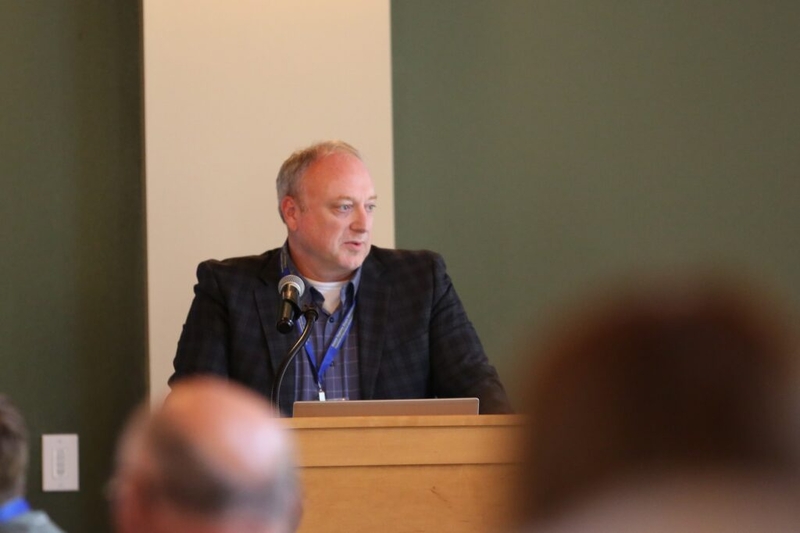
Chuck Brandel, a drainage expert with ISG, an engineering and architecture firm, delivers a presentation about “drainage water recycling” to the Eastern South Dakota Water Conference on Oct. 7, 2026, in Brookings, South Dakota. (Photo by Joshua Haiar/South Dakota Searchlight)
BROOKINGS — Farmers could reduce their reliance on groundwater, help mitigate downstream flooding and improve crop yields during droughts by storing their drainage water in a pond or wetland, according to a speaker at the Eastern South Dakota Water Conference.
Chuck Brandel is a drainage expert with ISG, an engineering and architecture firm with offices in South Dakota and other states. He delivered a presentation about “drainage water recycling” to conference attendees Wednesday at South Dakota State University’s McCrory Gardens Education and Visitor Center.
Brandel said the practice capitalizes on water moving through existing networks of perforated pipes buried beneath a crop field, called drain tile, which farmers install to remove excess water from the soil. Instead of allowing that water to drain away, drainage water recycling stores the water in ponds or wetlands and uses it for irrigation when the farmer wants it.
‘Wild places are worth fighting for’: Concern grows for receding South Dakota wetlands
“In some cases, you can gravity-feed your tile system into a low spot,” Brandel told South Dakota Searchlight after the presentation, “and then you’re pumping that back out and putting that back on the field.”
Brandel said the practice could do a lot for South Dakota, such as reducing downstream flooding and farm-chemical runoff, improving crop yields by making more water available for irrigation during droughts, and reducing the amount of groundwater used for irrigation. A prior speaker presented a chart showing irrigation accounts for 86% of South Dakota’s water use.
Multiple speakers at the conference said South Dakota needs more water to keep up with development and population growth projections. Some South Dakota water systems depend on pockets of groundwater known as aquifers.
Brandel said the reduction in groundwater use for irrigation could be substantial if drainage water recycling is widely adopted.
“If you build enough storage, you could potentially switch it all over,” he said, referring to individual farmers’ irrigation.
An Environmental Defense Fund estimate says building a pond, wetland or other storage area for a drainage water recycling system could cost $10,000 to $20,000 per acre-foot of storage. An acre-foot is the volume of water needed to cover 1 acre of land to a depth of 1 foot. The estimate lists additional costs to install drain tile, irrigation and other parts of the system.
Chuck Brandel’s presentation slides for the 2026 Eastern South Dakota Water Conference.

Pierre, SD