Noncitizens trying to vote? Vanishingly rare.
Oct 07, 2026 | 7:00 am ET
Description
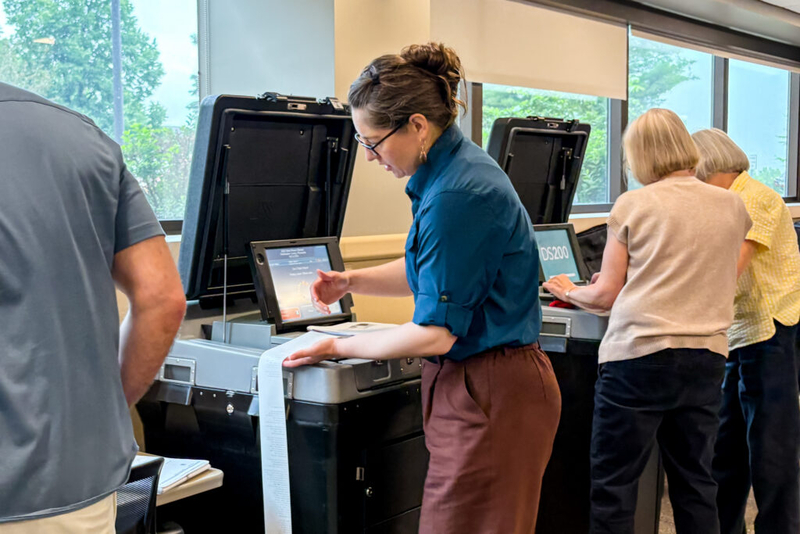
Election officials perform an accuracy test on voting machines ahead of the August primaries Wednesday, July 8, 2026. (Photo by Ria Gupta/Minnesota Reformer)
Last week the Trump administration announced to much fanfare that a grand jury had indicted 10 Minnesotans on charges of falsely claiming American citizenship to vote in recent elections. At a news conference in Washington, D.C., Attorney General Todd Blanche said the indictments show that voter fraud is rampant and prove the need for tough new elections legislation now pending in Congress.
But viewed in context — a period when Minnesotans cast millions of votes — the findings should actually bolster rather than undermine confidence in our elections. They show what countless careful studies have concluded: Actual voter fraud is vanishingly rare. They also put the lie to President Donald Trump’s claim that he won here three times, as well as the ceaseless barking from MAGA that noncitizens are swinging elections.
Consider what it took to round up these 10 cases. A recent report by ProPublica details how the Trump administration scrambled to find voter fraud in Minnesota and other states, assigning scores of agents from Homeland Security Investigations to fan out across the country and deploying a vast federal database of citizens’ personal information. The agents were so ill-informed and the database so error-prone that a federal prosecutor called the effort “dysfunctional.”
Despite this massive effort, all it produced was 10 cases of alleged fraud over two election cycles, a period when Minnesotans cast 5.8 million votes. An additional 1.3 million votes were cast during primary elections in that period.
Moreover, these are just allegations — and court records show that most people charged with voter fraud in Minnesota are never convicted. Considering the Trump administration’s record of failed indictments — from the sandwich thrower to the reflecting pool vigilante and all the Minnesotans wrongfully detained during Operation Metro Surge — we should be skeptical that even these 10 indictments will produce convictions.
It’s really no surprise that Trump’s team could find so little voter fraud in Minnesota. In the two general elections from 2018 to 2020, Minnesotans cast roughly 6 million votes.
Court records show there were just 40 convictions for registering or voting illegally in those years. That’s just 20 convictions in each cycle — or 0.00067% of votes cast.
The same pattern holds true nationally. After the 2016 election, the Brennan Center at New York University studied voting data from 42 jurisdictions in 12 states. They found 30 cases of suspected noncitizen voting out of more than 23 million votes cast.
Also in 2016, the New York Times surveyed elections and law enforcement officials in 49 states. They documented just a handful of cases of noncitizen voting out of 137 million votes cast.
Indeed, the way to reinforce Minnesotans’ confidence in our elections isn’t with intrusive new rules that threaten to disenfranchise thousands of voters, as with the Republicans’ proposed SAVE Act.
Instead, just tell people the facts.
In Minnesota, for example, the people who actually run polling places are not party insiders or faceless bureaucrats — they’re your friends and neighbors. They’re the same people you run into at church or the grocery store, and it’s not unusual to walk into a neighborhood polling place and recognize the folks handing you a ballot. Anyone can volunteer to serve on Election Day, and most step up precisely because they believe in our democracy. Moreover, state law requires that every polling place have election judges from both major political parties.
What about corrupted voting machines? Minnesota law requires every city to test its voting equipment at least three days before an election — and the public and the press are invited to watch, along with a representative of each major party. On Election Day, political parties can appoint observers to watch voting in every precinct and challenge suspect voters.
Why is noncitizen voting so rare in the real world? Think about it for a moment. If you’re living in the United States without proper documents, the last thing you want to do is attract the attention of law enforcement. Why would you risk getting your family deported to cast one vote?
Why is voter ID fraud so rare? Think another moment. Would you risk five years in prison and a $10,000 fine because someone asked you to vote with a fake ID?
Once voters understand how rare election fraud actually is, they’ll understand why there’s no need for drastic federal legislation that election experts say would throw thousands of Americans off the voter rolls.
Of course, if you want to defend our democracy and our elections, you don’t have to scour voting statistics or become an election judge. All you have to do is get out and vote on Election Day.

Saint Paul, MN