Handing out ballots and counting them up
Oct 30, 2026 | 12:45 pm ET
Description
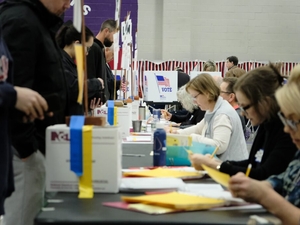
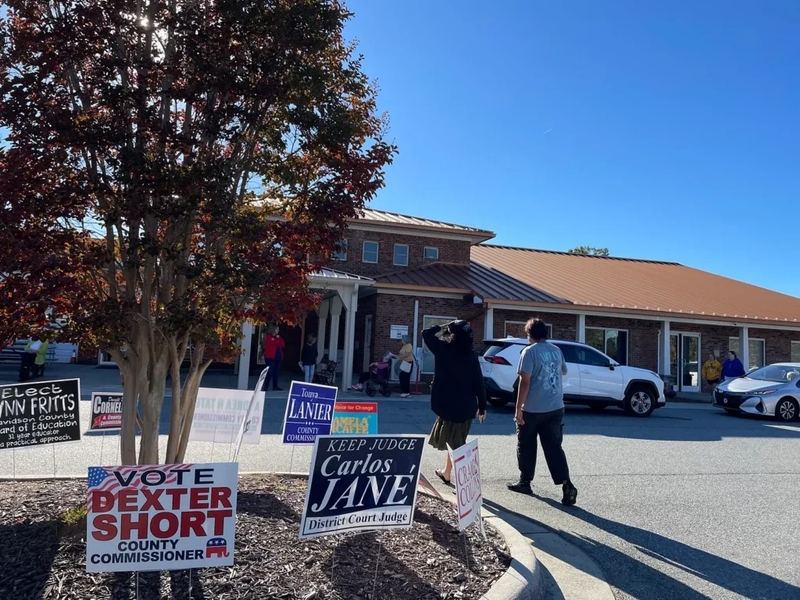
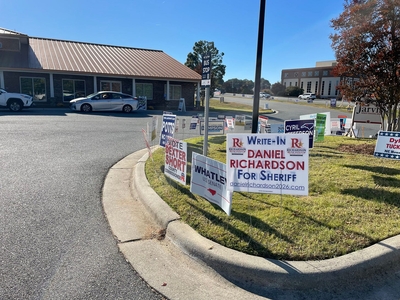
Voters enter a Davidson County early voting site. (Photo: Phoebe Zerwick/Down from DC)
“Low visibility ahead,” a Google Maps alert read one recent morning as I drove west on U.S. 421 toward Yadkin County for a meeting of the county board of elections.
And sure enough, when I hit the bridge to cross the muddy Yadkin, a soft fog hung over the river, the effect of cool morning air meeting water that still held the summer’s heat.
A coalition of voting rights groups is sending hundreds volunteers like me across the state to monitor local election officials when they open mail-in ballots and count up votes after Election Day. I’ve also been observing polling places and will continue through Election Day, all part of a nationwide effort to monitor this year’s midterm.
At 8:30 a.m. sharp, the three board members present of the five appointed bowed for a brief prayer and got down to the tedious business of opening absentee ballots. There were 28 total. One ballot was missing the required photo ID, but the voter had filed an exception form. Another ballot came in from the online portal used by military and other voters living overseas.
The board meets in the county warehouse behind its regular office space, which it uses as the only early voting place for Yadkin’s 25,784 registered voters. In 2024, voters here gave President Trump an 80 percent margin, one of highest in the state.
The elections supervisor told the board she had already rejected three ballots because the envelope was missing required signatures, then had spoken with the voters and issued clean ballots. Poll workers would soon be collecting ballots from a local nursing home, well before the Election Day deadline. Then it was time for the board to formally accept all 28 ballots, feed them into the voting machine to be tabulated, and get on with the day.
Not exactly headline-worthy, but it’s these details and the integrity of local officials like the ones in Yadkin County that make for a free and fair election.
Until the election of 2020, when President Donald Trump lost to Joe Biden, I never worried much about election integrity. But then Trump pressured local election officials across the country to falsify results in his favor, and when that failed, he rallied his supporters who stormed the Capitol to prevent Congress from certifying Biden’s win. He still calls it a rigged election.
Trump’s not on the ballot this year, but his party is, and he’s made it clear he is willing to interfere again if things don’t go his way.
The Department of Justice, at Trump’s urging, has filed a preemptive challenge against the election in Alaska and another suit to stop election officials in California from counting 20,000 mail-in ballots the suit alleges are fraudulent. Trump has not ruled out sending federal agents to polling places and promises a $1 million reward for information on electron fraud. And he has been relentless in spreading lies about widespread cheating, casting doubt about the integrity of our election system and the people who run it.
That’s just not the way elections are supposed to happen. So along with more than 800 other North Carolinians, I signed up for online training in “voter protection,” taught by lawyers from such nonpartisan voting rights groups as Common Cause, Democracy Now, the Southern Coalition for Social Justice, the NC Black Alliance and more.
My husband and I also went through training with the N.C. Democratic Party so that we can observe inside polling places, a role only available to volunteers appointed by the local Republican and Democratic parties. State law does not provide for nonpartisan observers inside the polls.
The state Republican Party is also training poll observers, with a focus on fraud, according to its website: “We must protect the ballot from any form of tampering, fraud or manipulation,” something that multiple studies have shown rarely happens.
To accept or reject
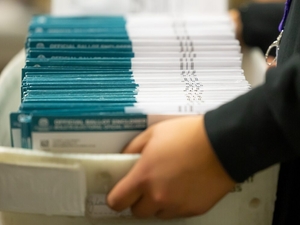
Local boards of election are meeting weekly until Election Day to open mail-in ballots one at a time, checking required signatures, that photo ID’s are present, and that the outer and inner envelopes are both sealed. It’s up to officials in all 100 counties to accept or reject each of these ballots.
The work requires patience and attention to detail. In Davidson County, the board reviewed 361 ballots on Tuesday afternoon, among them 22 cast online from voters living overseas. Two board members, a Democrat from Lexington and a Republican from Denton, transcribed these by hand onto paper ballots so that they could be fed into the vote-counting machines. In the end, the board accepted all but 14 ballots, which they rejected unanimously for several reasons, among them missing signatures or a required photo ID or ballots returned loose inside the outer envelope instead of sealed inside an inner envelope.
Davidson officials said they had sent letters to the 14 voters whose ballots were rejected, with the expectation that they would arrive in time for the voters to correct the error or fill out a clean ballot.
Statewide, the rate of rejected ballots is up from 2.6 percent in 2022 to 3.1 percent, according to figures released last week by the State Board of Elections. The data doesn’t list the reason for rejections. New rules require officials to reject ballots if the inner and outer envelopes are unsealed, and volunteer observers in 27 counties reported that many rejections were related to an unsealed inner envelope.
“Potentially thousands of votes could be spoiled by this new guidance,” Sailor Jones, the state director of Common Cause North Carolina, told The New York Times. “This is a huge deal for North Carolina.” That’s because we’ve had close races here decided by a few hundred votes.
An analysis by Common Cause of state data found that problems with mail-in ballots vary significantly by county. In counties where people of color make up a large share of registered voters, more than 7 percent of mail-in ballots were rejected, reissued or corrected by voters.
An inside view
I also observed election officials inside two polling places in Forsyth County, where I live, without a single instance of potential abuses to report back to the Democratic Party’s “voter protection” program.
Instead, I saw dedicated, knowledgeable election officials doing their best to make sure that eligible voters were able to cast their ballots.
Sometimes that meant trying various spellings of a voter’s name if it didn’t show up right away in the electronic voter rolls. Or if a voter forgot a picture ID, giving them a chance to file a form explaining the missing ID and to cast a “provisional” ballot, which are counted later by local election boards. They also did their best to make voters feel welcome. One worker in Kernersville told corny jokes all afternoon – most voters laughed – and he and his colleagues cheered every time a first-time voter cast a ballot.
And I saw lots and lots of voters: elderly voters with canes; disabled voters in wheelchairs; people dressed in church clothes, patriotic ball caps, sparkly shoes or Doc Martens; parents with their children in tow; first-time voters who barely looked 18; and a woman who had never voted relying on her adult daughter for help both to register and to vote.
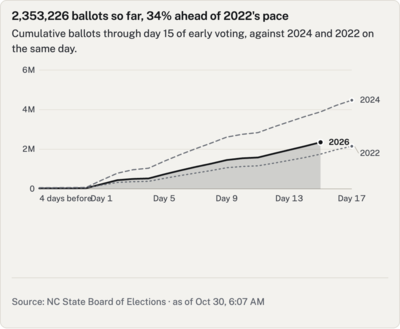
The enthusiasm I observed shows up in the data. By Friday morning, more than 2.3 million of 7.8 million registered voters in North Carolina had cast ballots, an increase of 34 percent from the last midterm in 2022. The largest share of these voters have been Democrats and unaffiliated voters.
The president wants us to think that all this is rigged.
The most detailed account of Trump’s effort to cast doubt on the integrity of election officials and of voters was published this week by The New York Times. The report tracked the president’s comments throughout the 456 days of his second term and found that he routinely refers to elections as rigged, crooked, stolen or corrupt – without any evidence to support these claims.
I don’t believe him, and according to recent polling that found widespread confidence across the state in our election officials, neither do most North Carolinians.
I’m headed back to the polls Saturday for the final day of early voting and again on Election Day. If voters get turned away, machines break down or worse, I’ll be there taking notes.
I hope it’s as uneventful as it has been, a bland but powerful record that will hold up against claims that the election was anything but free and fair.
Still, after Election Day, when it’s time for local officials to accept the rest of the absentee ballots and provisional ones and to certify the final vote count, volunteers like me will be back to watch – just in case.
This column was first published in Down From DC, a substack newsletter by Phoebe Zerwick and Natalie Jennings. It’s reprinted here with permission.
Raleigh, NC